
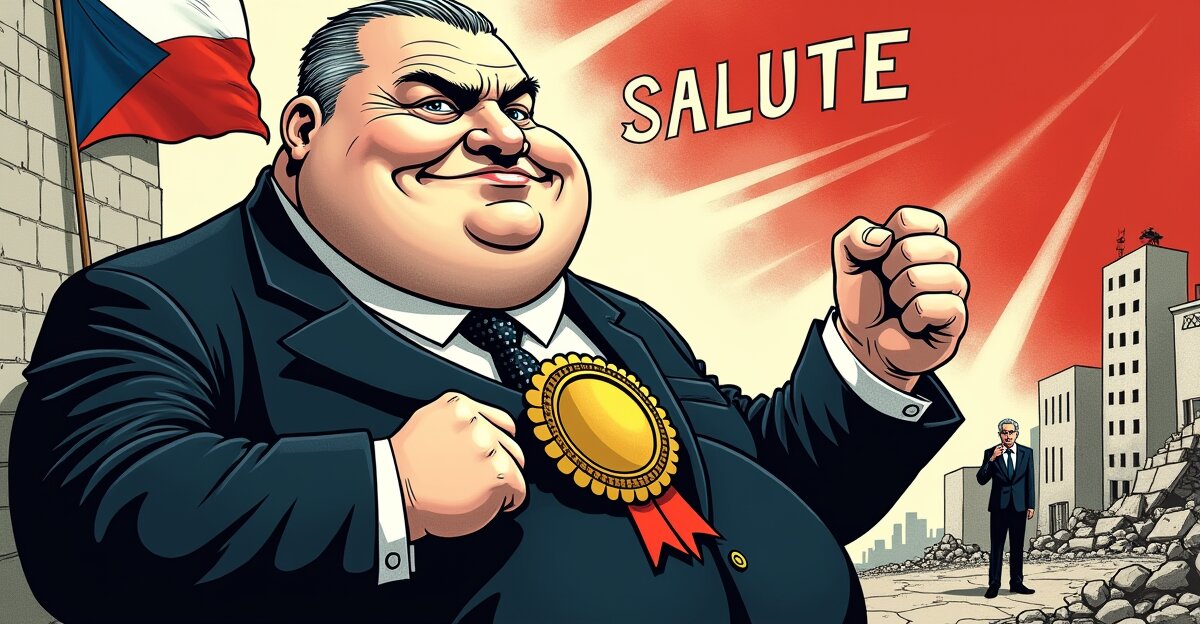
An American envoy thanks the Russian president for releasing a prisoner, then compliments the man who ordered the invasion of Ukraine.
"All I can say is, if I'm ever captured by Vladimir Putin, I'd rather die in a prison in Russia than have somebody on my behalf refer to Vladimir Putin as a humanitarian."
— Senator Kevin Cramer (R-ND)
On a Wednesday in October, in a gilded hall of the Constantine Palace in St. Petersburg, the United States of America said something it had never said before. Steve Witkoff, the White House special envoy and longtime confidant, stood beside Vladimir Putin, the man whose full-scale invasion of Ukraine is now almost five years old, and told him, on camera: "You talk so much about my president, President Trump, being a humanitarian, you are a humanitarian also, sir, and I salute that."
The occasion was the release of Stephen Hubbard, a 74-year-old retired schoolteacher from Michigan who has been locked in a Russian penal colony since 2022. Witkoff greeted him warmly. "I wanted to thank you very much. The president sends his thanks. Our whole nation sends it's thanks," he said. "Because of you, he's going home to his family." And then, in the same breath, while Putin's country still held as many as ten other American citizens in custody, came the compliment.
Translation: the U.S. government called a sitting autocrat a humanitarian, on video, for releasing a prisoner.
The man being praised has a track record that makes the compliment hard to classify as anything other than flattery. Putin ordered the full-scale invasion of Ukraine in February 2022. Russian strikes on civilian infrastructure have kept Ukrainian cities in a state of rolling blackouts and rubble. The State Department had formally declared Hubbard's detention wrongful, and last year the agency created a new "state sponsor of wrongful detention" designation, which it applied to Iran and Afghanistan, and which, pointedly, it has never applied to Russia, where up to ten Americans remain in custody.
Witkoff's compliment, in other words, was not a slip. It was a system. The system is this: flatter the autocrat, the autocrat hands over a gift, and the gift gets presented as proof that flattery works.
The backlash was immediate, and it came, of all places, from the right. Cramer, the senior senator from North Dakota, was the most forceful. "Humanitarian wouldn't be one of the first ten million words I'd think of to describe Vladimir Putin," he said. "He is anything but a humanitarian." He called Putin "as bad as it gets," and he acknowledged that Witkoff has a "different job" as a diplomat. But the line that made the news cycle was the one at the top of this article. Thom Tillis, the Republican from North Carolina, added his own version: "What an embarrassing and outrageous thing to say." Even Volodymyr Zelenskyy, whose government is being starved of U.S. support while its cities get bombed, took a swipe at the "humanitarian" remark.
The White House answer was a shrug in quotation marks. Pressed on the compliment, Trump said: "I guess you could say for that particular purpose." Vice President Vance defended Witkoff as "a diplomat" who was in Russia "to get a job done."
The most telling fact in the whole episode is who had to object. A sitting Republican from a state Trump won called his own party's president's words embarrassing and outrageous, and the president's response was essentially that's what the job requires.
The second hard-to-miss detail is what the release cost, because the White House changed its mind about that, out loud, in one day. On Truth Social, Trump declared that Putin released Hubbard "out of respect for President Trump," and that the U.S. "was not required to give anything in return. An unprecedented situation for Russia. There was no 'swap' necessary." Five days before the release, the administration had waived a fresh tranche of Russian sanctions just as they were set to take effect. The waiver was praised by Putin and panned in Congress, including by Republicans. Later that day, on the White House lawn, Trump changed the story. "A lot of stupid people said, and people that don't know how life works, they said, 'Why aren't you putting Russia sanctions and all this,'" he said. "If I would have done that, you would not have Mr. Hubbard coming back." In a follow-up post, he claimed that people who had pushed for the sanctions to go ahead had "called to apologize" once they learned the release was being negotiated, warning that if the sanctions had taken effect, "certainly those negotiations would have come to a complete and total halt."
Translation: the sanctions were the price, and the compliment was the tip. "No swap" means no prisoner-for-prisoner trade. It does not mean the transaction was free.
The pattern this episode fits is worth naming, because it is the operating manual for this administration's foreign policy. Witkoff built his career on the idea that every problem is a deal, and every deal is a relationship, and every relationship runs on flattery. In this role, that instinct has been elevated to statecraft: the envoy flatters the autocrat on camera, the autocrat hands over a gift, the gift gets photographed on a plane, and the flattery gets defended by the president and the vice president. The same week, the Nobel economist Paul Krugman published an essay asking whether Elon Musk "decide[d] by personal fiat to cut off Ukraine's access to vital communications" through Starlink, concluding that "no private individual should, or indeed even have the capability to, make national security policy," and calling for the United States to consider seizing Starlink outright. The same week, Trump blamed Zelenskyy for the war, and the Kremlin warned Ukraine to make "necessary decisions." A government that praises the bomber, starves the bombed, and blames the victim is not a government with a policy. It is a government with a mood, and the mood is in St. Petersburg.
None of that should obscure the human story at the center. Hubbard is a retired teacher and National Guard and Air Force veteran who was captured in the first weeks of the invasion, accused of manning a checkpoint for mercenaries, sentenced in 2024 to nearly seven years in a penal colony, and held with little contact from his family, who have maintained his innocence. He is in poor health and was being flown to a military hospital in Texas. He was the last American on the State Department's wrongful detention list. A 74-year-old man is going home. That part is good, and it deserves celebration. The administration just wrapped a homecoming in flattery, and the flattery is what is stuck to the story.
Cramer said he would rather die in a Russian prison than have that compliment spoken on his behalf. The envoy saluted anyway. The compliment is the only part of the episode that is permanent, because prisoners go home, sanctions get waived, and deals get made, but once the United States has called Vladimir Putin a humanitarian on camera, the sentence belongs to the record, and the record belongs to Putin. The question is not whether the compliment was a mistake. It was. The question is what the White House has decided a compliment is worth, and what else it expects to be able to buy with one.
Comments (0)
No comments yet. Be the first to speak up.
Join the Riot
Login with Google to leave a comment.
Login to Comment