A jury found that the world's most valuable social network lied to its users for a decade, and the market's response was a two percent gain.
"Facebook promised users that they (the users) controlled their data. This was false."
— Judge Francis Mathew, Santa Fe District Court
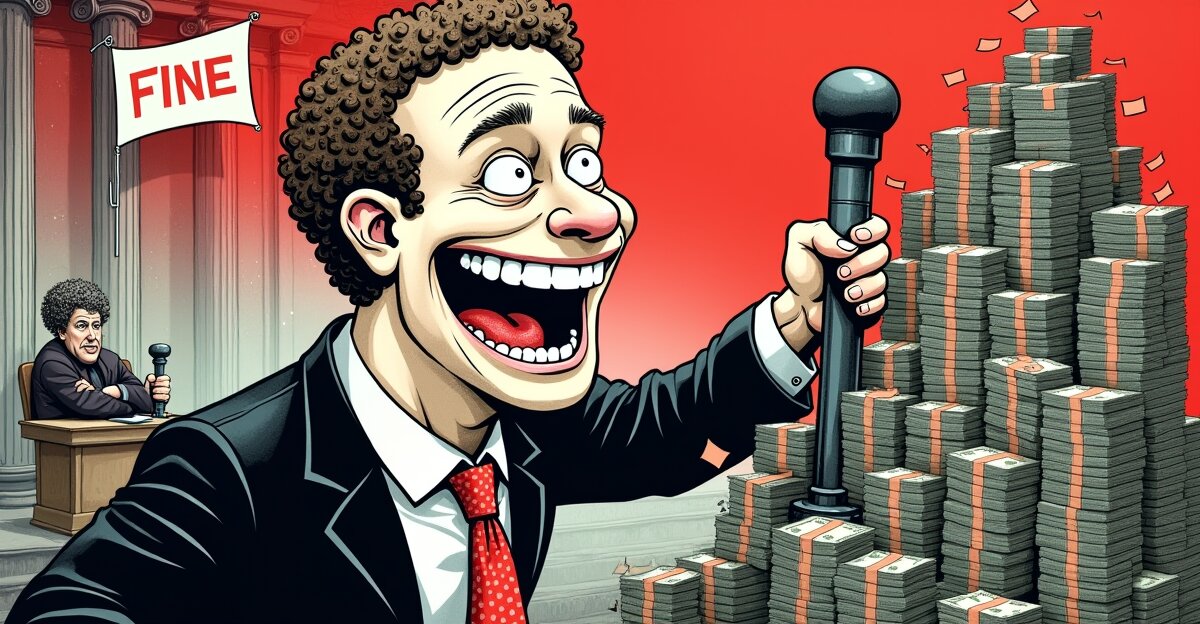
On Wednesday, a state judge in Santa Fe ordered Meta to pay New Mexico $25 billion, the largest fine ever imposed on the company. The judgment is the end point of a case that began in 2021, when New Mexico's attorney general sued Meta over the Cambridge Analytica scandal, the harvesting of Facebook data from roughly 87 million profiles that was funneled to a political firm whose clients included Donald Trump's 2016 presidential campaign.
The trial ran in September. A jury found that 26 of 29 public statements made by the company and its executives about how it handled user data were misleading, and that those statements amounted to more than 43 million violations of New Mexico's consumer protection laws. Judge Francis Mathew wrote that the deception was "intentional" and that executives "consistently misled users about how the platform worked."
The fine is, on paper, almost absurd. New Mexico law allows up to $5,000 per violation, which, applied to 43 million violations, would have produced a number in excess of $200 billion. Mathew wrote that a penalty of more than $219 billion was warranted under state law, then cut it to $25 billion. The state had argued for $35 billion to $40 billion. "This court should speak to Meta in the only language it understands, which is money, and the value of its stock price," state attorney Randi McGinn told the court. Meta had argued for a $3.45 billion cap. It lost by an order of magnitude.
Under the New Mexico constitution, the entire fine is directed to the state's school system. Peter Ormerod, a law professor at Villanova University, did the math and came up with roughly $12,000 per New Mexican. "It's quite unlike anything else we've seen," he said.
For a company with a market value of $1.8 trillion and more than $200 billion in annual revenue, the judgment is a line item.
The evidence against Meta was not circumstantial. It was the company's own words. The state's case rested in part on a 2010 Washington Post op-ed in which Mark Zuckerberg, then 26, assured readers that "you have control over how your information is shared" and that the company "does not and never will sell any of your information to anyone." The jury, after two weeks, effectively held him to it.
The mechanism was a personality quiz, free to take, that collected user data, friend data, and data that cascaded outward through social connections, and passed it to Cambridge Analytica, which built voter-targeting models that reached into the 2016 election. New Mexico argued that the state's entire population was deceived, that the company knew third parties had broad access to user data, and that it tolerated harmful content whenever doing so improved the bottom line.
Meta's defense ran to two points: it did not sell data, and the state failed to prove any consumer was actually harmed. The jury rejected both. In a partial win for the company, jurors did not buy the state's claims about false statements on content moderation, and Meta now touts a policy that catches an estimated 99 percent of content that violates its standards. But the core finding stands: the promises were lies, repeated publicly, for years.
Meta's reaction to the judgment was immediate and characteristically unbothered. C.J. Mahoney, the company's chief legal officer, said the lawsuit "seeks to impose a tax on speech" and that the company is "confident we will prevail on appeal." He also claimed that New Mexico's approach to enforcement "makes it all but impossible to do business in the state of New Mexico," which is a strong statement from a company that has never once declined to do business in New Mexico.
Analysts were quick to contextualize. Gil Luria of D.A. Davidson called the judgment costly but unlikely to affect the company's value. Nidhi Hegde of the American Economic Liberties Project called it "a drop in the bucket for Meta." Both were describing the same fact from different angles: the fine is real, and it is not enough to change anything.
The market agreed with Luria. Meta's shares rose two percent after the judgment, hours before the company was scheduled to report quarterly earnings that beat expectations.
Translation: the company's plan for the judgment is to treat it like an expense.
What makes New Mexico's judgment unusual is less the number than the fact that the state went alone. In August, Meta reached an $18 billion settlement with nearly all the states and territories over a separate trial about teen mental health, and New Mexico was one of only two states, with Florida, to decline it. Six other states' Cambridge Analytica-related suits were folded into the multistate settlement for $459.2 million. New Mexico's was not.
The result is that in six months, two separate Santa Fe juries have returned verdicts for the state against the same company. In March, one found that Meta misled users about the safety of young people and ordered $375 million in civil penalties, plus another $567 million into a state fund for teen mental health. This week's $25 billion judgment is the second.
Attorney General Raúl Torrez framed the ruling as a break with the past. "It has been a long time coming holding Big Tech accountable," he said. "I think today's judgment is a clear break with that past and a very clear warning to those in this space and beyond."
Now the money will do what fines do. It will sit on a judgment docket while Meta appeals, accrue interest, and arrive in New Mexico in installments, if it arrives at all, years from now. The state will spend the intervening years in court doing what Meta has spent two decades doing: delaying, narrowing, reframing.
But the record itself outlives the appeal. A jury of New Mexicans read the company's promises to its users out loud, one by one, and found twenty-six of them false. A judge wrote that the deception went "to the heart of Facebook's core business practices." A constitutionally mandated transfer of $25 billion is now on the books, earmarked for a state's schoolchildren, in a state that refused the settlement everyone else took.
The market shrugged. But shrugging is not an appeal. The lie now has a price, and the price is in the public record, and it will be cited in every future argument about what social media actually is: a free service, or a metered one.
Comments (0)
No comments yet. Be the first to speak up.
Join the Riot
Login with Google to leave a comment.
Login to Comment