
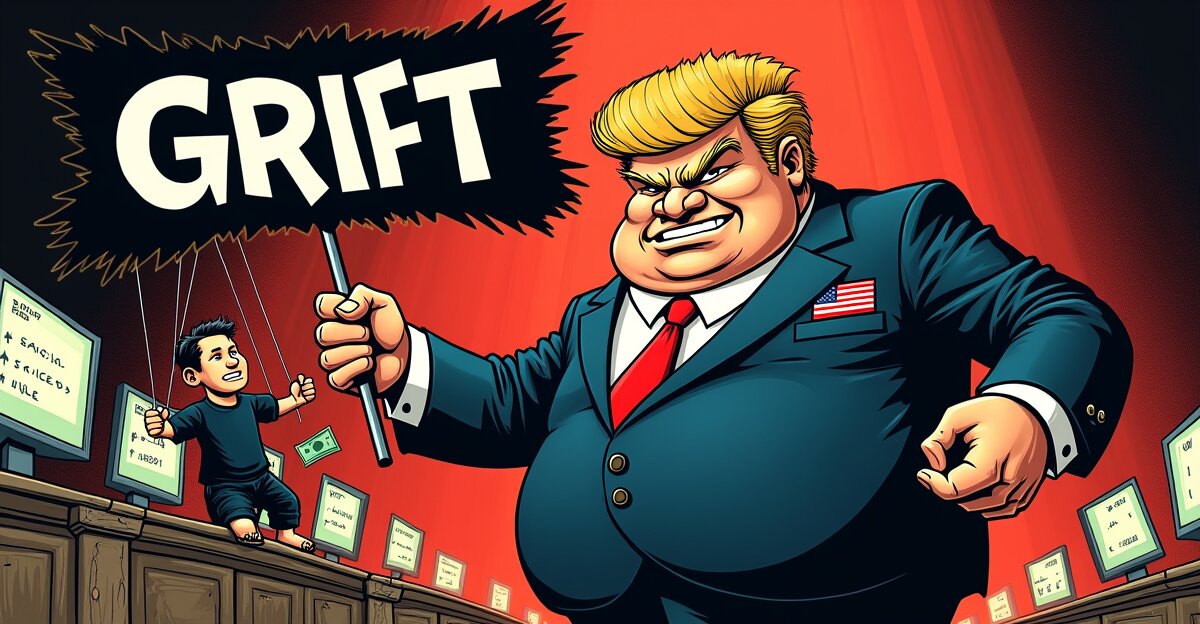
The president's own intelligence community told him his best friend was involved with a suspected Chinese operative. His response was to keep buying the friend's stock for ten more months.
"I haven't heard he's done anything wrong."
— President Donald Trump, November 8, 2026, the day Jensen Huang admitted an affair with a suspected Chinese spy
The story broke in two halves, the way everything breaks in this administration. The first half is the one most people read. On November 8, Jensen Huang, the chief executive of the most valuable company on earth, admitted an affair with a woman American officials believe is a Chinese spy. Four days later he resigned. Nvidia closed down more than four percent on the news.
The second half is in the president's financial disclosures. In October 2025, U.S. intelligence agencies told Donald Trump that Huang was involved with a woman they described as a Chinese asset. The Washington Post's review of the disclosures, aggregated by the nonprofit Keep Track, shows the president kept buying that month and every month after, until the records run out in August. By the end of August his personal stake was worth between $13 million and $62 million, up from between $615,000 and $1.3 million a year earlier. In total, the disclosures show him trading close to $100 million of the stock.
The friendship had a schedule. Trump met Huang for the first time on January 31, 2025, eleven days after taking office. The disclosures show he had bought as much as $5 million of Nvidia stock on January 29, two days before the meeting. Then came the $1 million a head dinner at Mar a Lago in April, a White House event the same month, the state visit to the United Kingdom, and, in September 2026, a White House state dinner with President Xi Jinping of China, at which Huang and his wife sat at the president's table. On October 8, 2026, Trump pinned the National Medal of Science on Huang in a building the State Department had renamed the Donald J. Trump Institute of Peace, honoring, in its words, "the greatest dealmaker in our nation's history." And one late December night, a pool photographer caught the president's cell phone showing a call with Huang at 1:40 a.m.
The closeness was not incidental. It was a channel.
The trades have the cadence of a portfolio manager who knows when the announcements are landing. In July 2025, Trump bought $10.25 million of Nvidia stock. In August, $31.4 million. That was the month the Commerce Department investigation into Megaspeed, the Singapore based Nvidia customer suspected of feeding American chips to China, was shut down. Nvidia's general counsel had reached out to the investigators invoking the name of a Trump nominated undersecretary, and the agents were "alarmed." The case was suspended and quietly handed to the Justice Department. In December 2025, a week after Trump announced that Nvidia's H200 chips could be sold to approved Chinese buyers with Washington taking a 25 percent cut of the revenue, the disclosures show another $2.1 million of buys. On January 6, 2026, barely a week before Commerce formalized the eased export rules, the president bought up to $1 million more.
That last purchase is the one Senator Elizabeth Warren put in writing. She asked Treasury Secretary Scott Bessent whether the Securities and Exchange Commission should investigate. Bessent's answer was that if Congress wanted to ban stock trading, it should start with members of Congress. The White House says the president does not pick individual stocks, that his portfolio sits in a trust run by his children and managed by outside firms that copy index funds. The index copyist in question, for the record, logged tens of thousands of trades in Trump's second term.
Translation: a portfolio that indexes Nvidia this selectively, at this moment, in this order, is doing something other than indexing.
Now, the spy. Her name is Alice Huang. In October 2023, Alice Huang (Huang Le in Chinese) sold her stake in Megaspeed to a Singapore shell company called Swiftdata. Days later, Megaspeed joined Nvidia's Cloud Partner program, which hands out priority access to advanced AI chips. In September 2024, Commerce inspectors visited the Malaysian data center and found Nvidia hardware that, in the words of people familiar with the inspection, was still in boxes. The boxes were the problem. Showing the technology to inspectors and then moving it elsewhere is a known way to beat export controls, and U.S. officials suspect some of the chips ended up in China. They have not been able to prove it. Trump has taken the lack of proof personally, in a way that has become its own genre of defense: "I don't know that she's a spy at all. Nobody's proven that." Then he added: "Usually what happens with that is that any woman coming to the country that's a beautiful woman that comes from China, they say she's a spy."
What Washington knew on paper, meanwhile, was more. In May 2026, Secretary of State Marco Rubio warned senior officials, including Commerce Secretary Howard Lutnick, that signals intelligence identified Alice Huang as a Chinese spy in a relationship with Jensen Huang. When Trump then invited Huang, at the last minute, to board Air Force One for a trip to Beijing, Rubio briefed the president directly on the affair. Trump, people familiar with the events said, was "not particularly moved" and collected Huang in Alaska as planned.
The administration's own export control machinery was failing in that period, and everyone inside it knew it. The entity list, the trade blacklist that is supposed to be the last line of defense, had gone more than a year without a single new name, the longest dry spell in 18 years. Treasury, Defense, State, and the Office of the U.S. Trade Representative all agreed Megaspeed belonged on it. Commerce, which holds final authority, did not act. On November 5, 2026, Treasury Secretary Bessent confronted Lutnick in the Situation Room, demanding to know why the country had not already banned the sale of advanced AI chips to Megaspeed. Bessent later told CNBC that the four agencies "were in favor of putting Megaspeed on the entity list for months."
Trump's defense of Lutnick: "We're having a very good relationship with China right now... I understand very well both sides."
Translation: the country's blacklist of banned buyers ran out of names in the same year the president's portfolio needed Nvidia's to keep winning.
The aftermath reads like a fever dream. Huang admitted the affair on a Sunday. That same day the president called him "an honorable guy" who "probably has an excuse for it" and said he would "certainly" take him along to China. On Monday, Trump said the FBI was investigating, that Huang "didn't know she was a spy," and "I really believe him." On Thursday, Huang resigned, and Nvidia fell. The president's sympathy arrived by telephone: "I spoke to him (Huang) yesterday. He's going through hell." Then: "What he feels most badly about is his wife and family. That's what he told me. He called me." If the woman were not a spy, he added, "Perhaps it would be different."
A quieter legal reality check is arriving by mail. Ethics lawyers point out there is no evidence Trump has broken conflict of interest law, because the president is not subject to the federal criminal conflict of interest statute. He is the only person in the country for whom the question "is this illegal" does not exist. Senator Chuck Schumer has flagged the $25 million Huang donated to the White House ballroom project. Members of both parties are jockeying to subpoena Huang for testimony. And the Democratic Congress taking over the House and Senate in January already has, by the admission of the administration's own Treasury Secretary, a very specific question on the docket: why did a sitting president buy his best friend's stock the week before his own administration made the friend's most lucrative deal legal?
Jensen Huang called Trump the day before he resigned. According to the president, the call was about heartbreak, about a family, about a man going through hell. Maybe it was. Markets do not do heartbreak. They do information. When Huang's name left the company, hundreds of billions walked out the door with it, and the president, as far as anyone can see, is still all in.
The question is not whether Trump broke the law. He can't. The question is whether a Congress that just won an election on accountability can figure out what to do with a president whose conflicts of interest are legal, uninvestigable, and overseen only by pool photographers and a 1:40 a.m. phone screen. The spy story has a beginning, a middle, and an end. The stock story is still being written, and the only person who knows how it ends is the one holding the stock.
Comments (0)
No comments yet. Be the first to speak up.
Join the Riot
Login with Google to leave a comment.
Login to Comment