
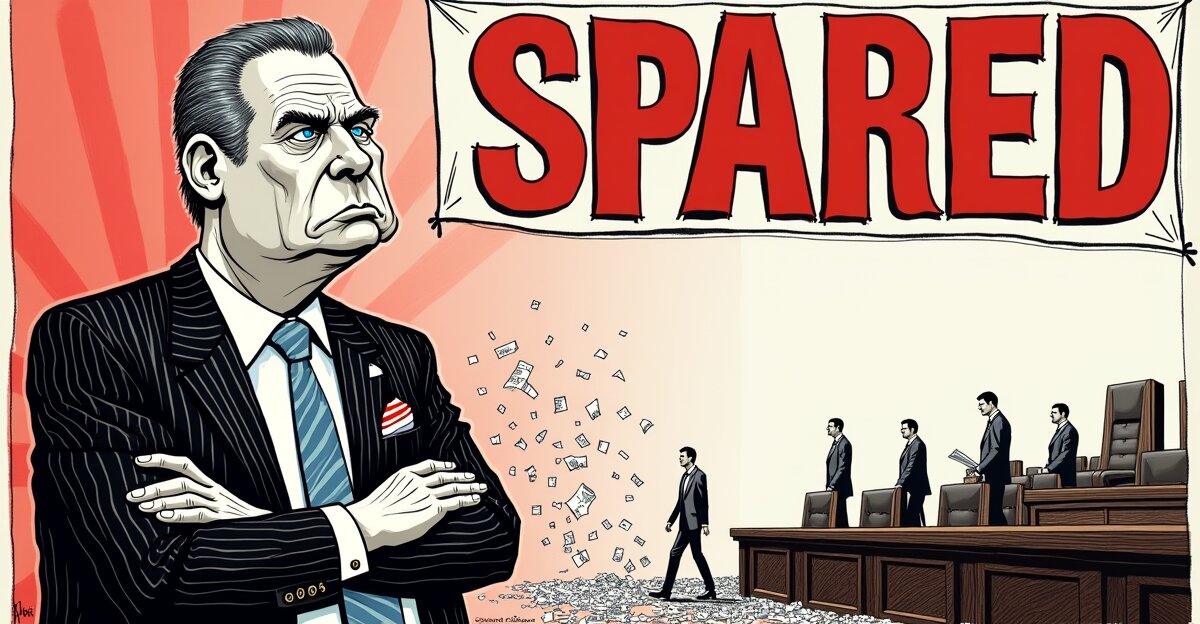
A war architect walked free on a Tuesday, and eleven members of the freshly elected majority were not in the chamber to stop him.
"They diagnosed why they lost the election. But tonight they were paralyzed to do anything about it. And that's the story of Congress."
— Rep. Thomas Massie, R-Ky., after the House voted down his impeachment resolution against the Secretary of War
The House killed the impeachment of Pete Hegseth on Tuesday night, November 10, by a vote of 211 to 204. That is the arithmetic of survival. The question on the floor was procedural, a motion to refer eight articles to the Republican-led Judiciary Committee, but the effect is a verdict. No trial, no public airing of the charges. The resolution will die in a committee that will not touch it before the lame duck ends. The man who launched a war in Iran without congressional authorization walks out exactly where he walked in: in charge of it.
The resolution was introduced the day before by Massie, the only Republican who voted to keep it alive. Massie, whose own primary was crushed this spring by candidates backed by the president and the secretary, filed the motion as "privileged," forcing a floor vote within two legislative days. That was the trap for the Republican leadership, and they set it.
The eight articles are specific. Three charge War Powers violations in Iran: starting the war with no declaration, no authorization, no imminent threat; continuing after both chambers ordered American forces out in H. Con. Res. 86; and continuing after the 60-day War Powers clock expired. Another charges him with disregarding civilian-casualty laws before a strike on an elementary school in Minab, Iran. Another, with directing "extrajudicial killings" of suspected drug traffickers in the Caribbean and eastern Pacific, secondary strikes on survivors, and orders not to rescue the shipwrecked: at least 243 dead. Another, with illegally seizing and deposing Venezuelan President Nicolás Maduro "to assert U.S. control over Venezuela's oil reserves." Another, with using the Pentagon to demote Sen. Mark Kelly for telling troops not to follow unlawful orders. Another, with an unlawful war in Yemen.
Hegseth spent Tuesday morning on a Pentagon podium telling a different story. He called the impeachment a "political spectacle," then "a farce, and it's a stunt and everybody knows it," the doing of "one disgruntled congressman." By the end of the day the roll call had disproved that too, with more than 200 members voting with Massie. The week before was a scramble to hold the line: a campaign-style video aimed at the White House, a social media push by underlings. Then he drew a line no one would have predicted from a former Fox News co-host, equating the vote against him to the two impeachments of Donald Trump in the first term: "If standing with President Trump puts me in that company, I'll take that company every day of the week."
Trump posted that Hegseth got an "A PLUS, PLUS, PLUS for his defense against a disgruntled, angry, defeated, former Congressman, Thomas Massie, a TOTAL LOSER!" When the gavel fell, he called the result an "EXONERATION of a Great American Patriot." In the administration's framing, a school, 243 bodies in open water, and a deposed head of state are all "the job." Hegseth had the words for it: "We destroyed terror regimes' capabilities. We sank the boats carrying poison into our communities. We put a narco dictator in handcuffs. These are not high crimes. This is the job, and it's the job well done."
Translation: the most explosive word in that sentence is "job."
But the vote was not lost in a clash of conscience. That is the detail that deserves the room. Eleven Democrats, fresh off a generational wave that flipped both chambers, were not there when the floor was called. The record names them: Julia Brownley, Lou Correa and Nancy Pelosi of California; Laura Gillen of New York; Steven Horsford of Nevada; Jonathan Jackson of Illinois; Brittany Pettersen of Colorado; Melanie Stansbury of New Mexico; Haley Stevens of Michigan; Marilyn Strickland of Washington; and Frederica Wilson of Florida. After a single procedural vote, there were eleven different explanations.
Jackson told TMZ his "traffic jam" absence was "inexcusable." Strickland and Gillen cited D.C. gridlock. Brownley said she was "rushing." Pelosi, Correa and Wilson were out of town. Pettersen admitted she had been at a super PAC event and there was "no excuse." The explanation Alexandria Ocasio-Cortez offered, on behalf of the caucus, was "someone may have had a health issue."
In the same building, other Democrats found the time: Jasmine Crockett of Texas rerouted around traffic because the vote "was just that important to me," and Pat Ryan of New York made it the day after back surgery. The math is ruthless and simple: the referral passed 211 to 204, and eight more Democrats on the floor would have flipped it. Seven Republicans were also absent, but the margin hinged on the side that had just been handed a mandate.
The part that should worry the party most: according to The Intercept, several of the representatives who blamed traffic had earlier that day attended an event hosted by Elect Democratic Women, an AIPAC-funded organization co-founded by whip Katherine Clark, who is running for majority leader. The event overlapped with the vote. When the gavel fell, Clark posted, "Republicans just blocked the House from impeaching Pete Hegseth." She did not mention the empty chairs on her own side of the aisle.
Incoming speaker Hakeem Jeffries told Politico it was "not the end of it. It's just the beginning." That is the right posture and the wrong lesson. The incoming majority's first test of discipline came before the gavel changed hands, and it was not taken. The party that just lost an election, given a chance to make amends, did what it has always done: buried the motion in committee, and counted the absent.
This party has done this before. In January 2009, the Obama administration, riding a change election that handed Democrats a filibuster-proof Senate, chose to "look forward as opposed to looking backwards." Accountability for the previous eight years never came. The Intercept's Eoin Higgins makes the point this week: the war on Iran is downstream of that choice. Democratic voters did not elect the party to rest on the wave. They elected it for accountability. In Higgins' words, they "want blood."
The Republican side of the ledger is equally instructive. The vote was not conviction, it was containment. Outgoing Rep. Darrell Issa of California said the resolution "is going to die in the Senate; it's just that simple," and that "the secretary has committed no high crimes or misdemeanors." Outgoing Air Force veteran Don Bacon of Nebraska said he would have "felt a little differently" if the resolution had mentioned firing 80 generals and not spending appropriated money. That is not a defense of the secretary's conduct. It is a specification of how much conduct the party is willing to put on the record before it will act.
The House has impeached only two Cabinet secretaries in its history: William Belknap in 1876 and Alejandro Mayorkas in 2024. In neither case did the Senate convict. The bar for what this chamber considers impeachable is not a constitutional bar. It is a political one, and on the night of November 10 it was set by the party that had just lost an election.
The future is more concrete than the past. In the next Congress, Adam Smith of Washington heads the House Armed Services Committee, and Hegseth and Deputy Secretary Steve Feinberg are first on his list to testify. A senior congressional staffer who watched the vote: "Oversight is going to come crashing down on his head. Will Hegseth continue to obstruct? Yes. But wait until the subpoenas start."
Rep.-elect Richard Ojeda of North Carolina did not use careful language. "I want Pete Hegseth not just impeached, I want him prosecuted. They murdered people in the Caribbean. And we killed 163 little girls in Iran," he said. "Everybody in my class is ready for him to go. We tried it. It didn't work. We'll do it again."
That last sentence is the whole story in miniature. The country voted in November for a government of consequences, and on the one night it could have been forced, eleven chairs were empty while the architect of the war walked out intact, upgraded by his own president to an "A PLUS, PLUS, PLUS." The question was never whether the new majority wanted accountability. It is why, on the first night it could be tested, eleven of its members chose traffic, a fundraiser, and a town somewhere else over the chance to use it. The chairs will be full in January. The test is not going anywhere. It is just waiting for a party that can be counted on.
Comments (0)
No comments yet. Be the first to speak up.
Join the Riot
Login with Google to leave a comment.
Login to Comment