
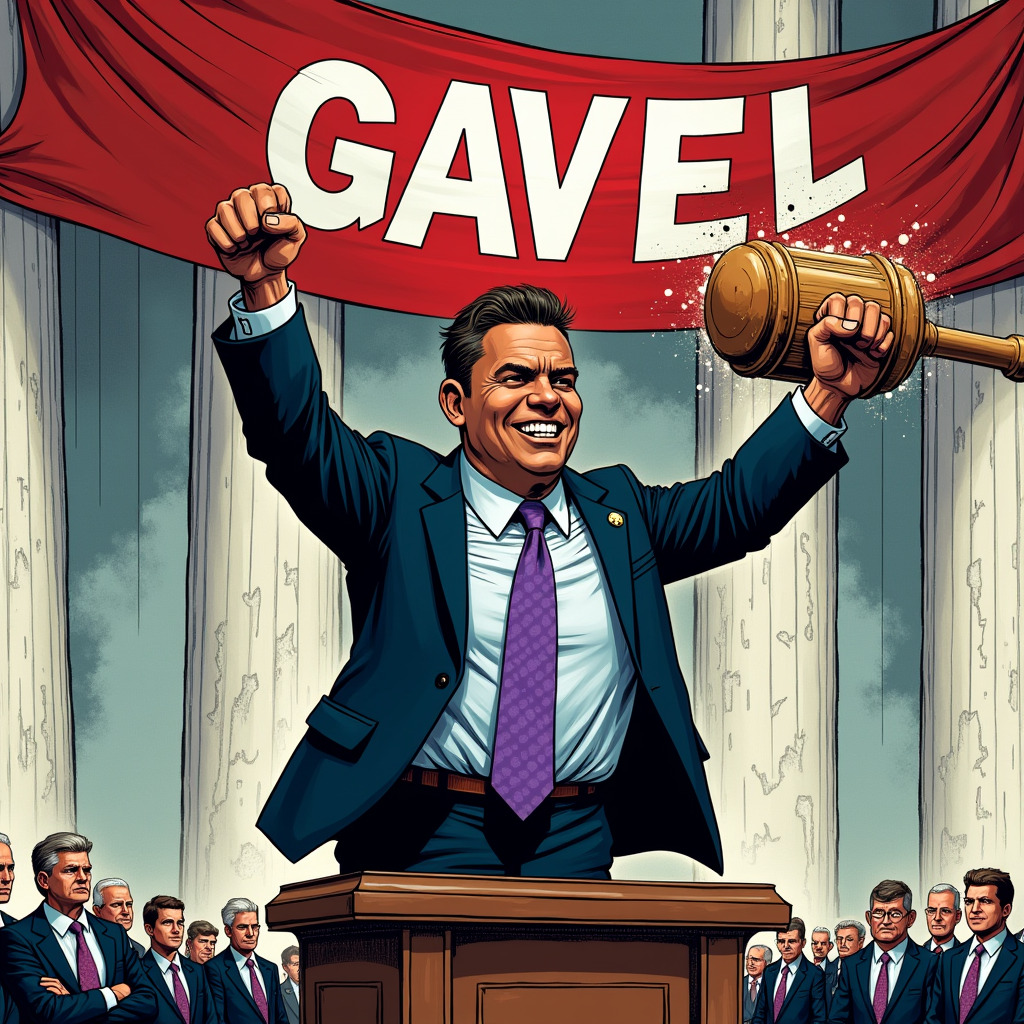
A party elected on a wave of change voted, behind closed doors, to hand the gavel to its most establishment man. The history is real. The receipt is 251 to 11.
"Our job is to fight MAGA extremism, not each other. Fight MAGA extremism, and to get big things done for the American people, and that is what we are going to accomplish together, beginning on January 3rd."
— Hakeem Jeffries, House Democratic caucus press conference, November 18, 2026
The history was made in a closed room. On Wednesday morning, the 262 members of the incoming House Democratic caucus gathered behind closed doors to pick their candidate for speaker, and they picked Hakeem Jeffries of New York, 251 to 11. No one had challenged him. There was no drama, no rounds of failed ballots, no whip count at the door. The first Black speaker of the United States House of Representatives now has his nomination, and he will collect the gavel on January 3, 2027, when the 120th Congress convenes and Democrats take their first majority in either chamber in four years.
That is the headline, and it is a real one. Jeffries, 56, a Brooklyn native and former prosecutor who has served New York's 8th district since 2013, has already made a record of his own: as minority leader, he became the first Black person to lead a major party in either house of Congress. In January, he becomes the first person to lead it from the chair.
But the margin is the story too. Eleven members of the party that just won the biggest House wave in two decades voted no.
The caucus that met Wednesday is not the caucus that met a year ago. Democrats added 43 seats, going from 214 to at least 257, the party's largest House majority in two decades, and they took the Senate with them, 56 seats. The country did not hand them a mandate for a status quo. It handed them a hammer, and the message, in Jeffries' own words from the press conference, was aimed at "the American people who are struggling in this failed economy."
Four years ago, when House Republicans regained the chamber with an extremely narrow margin, the party could not figure out who should hold the gavel. Multiple candidates failed to secure a majority before the conference coalesced around Mike Johnson of Louisiana. This time the machine had no trouble at all. It turned out the Democrats had already decided. The election was just the paperwork.
The difference is the margin, and the margin is the point. The Republicans in 2023 had to negotiate with a handful of far-right holdouts just to get a speaker at all. A party with 257 seats does not negotiate with its own outliers. It files the statement, and keeps walking.
Seven of the eleven noes were members-elect, and most of them won their races with the backing of the Democratic Socialists of America. In a joint statement after the vote, Darializa Avila Chevalier and Claire Valdez of New York, Adam Hamawy of New Jersey, Frederick Haynes of Texas, Melat Kiros of Colorado, Donavan McKinney of Michigan and Chris Rabb of Pennsylvania said they had engaged in "good-faith conversations" with Jeffries and seen "meaningful progress." There is "still work to be done," the statement said. "As such, our vote in caucus today was no."
The demands they listed read like a different Congress from the one the majority promised: Medicare for All, an end to the transfer of offensive weapons to Israel, a stop to what they called "ICE terror," and getting money out of politics. Don Leonard, the newly elected Democrat from an Ohio district Trump won two years ago, told CNN he would not vote for Jeffries unless the party committed to ending aid to Israel and undoing Citizens United.
The left's grievance has a paper trail. As minority leader, Jeffries refused to endorse a Medicare for All proposal, and in July he did not vote for an amendment that would have cut military aid to Israel. This month, a poll from Indivisible found that only 28% of registered voters view him favorably. The day before the vote, he announced support for lowering Medicare's eligibility age and expanding it to cover vision, dental and children.
Translation: eleven noes in a room of 262 is not a rebellion. It is a receipt.
The machine's answer was to insist on a receipt it could sign. Jeffries, who served as Democratic caucus chair under Nancy Pelosi from 2019 to 2023, requested a recorded vote of the full caucus even though he faced no declared opponent. A group of incoming progressives had been lobbying to force a recorded vote in the leadership race; asking for one yourself, before they can demand it, is a show of strength dressed as a formality.
After the vote, Jeffries posted a photograph of himself as a child on X and wrote, "Thank you House Democrats. Together, we will deliver bold change." Pelosi, who is retiring from Congress at the end of this year and who made her own history two decades ago as the first woman speaker, arrived at the caucus chanting "Hakeem Jeffries!" according to Roll Call. Steny Hoyer, the outgoing Maryland Democrat and former majority leader, told reporters that Jeffries "has the confidence of the caucus, and he has a good leadership team that is close knit and very organized."
The slate that followed was stacked with firsts of its own. Katherine Clark is bound to become the first woman to serve as majority leader. Ted Lieu of California was elected caucus chair, the first Asian American to hold the post. Pete Aguilar of California will be the first Latino majority whip. Hoyer framed the arithmetic the way the party intends it to be remembered: "We've been looking at people's talents, not a particular gender or race, and I think that's a good thing." That night, the newly elected Democrats are meeting with Barack Obama.
So many firsts that the party may forget which one the voters were actually elected for.
The formal election happens on January 3, and the math is not in question: Jeffries needs 218 votes in a chamber that will have at least 257 Democrats, with a handful of races still to be decided. What is in question is what the speaker's chair actually does, which is decide which bills reach the floor, which investigations get hearings, and which of the party's many agendas gets to be the agenda.
Jeffries has already sketched his. Cost of living first: groceries, gas, housing, health care. Then accountability, delivered with a line that was clearly aimed at the Trump administration's final two years: "House Democrats will hold the crooks accountable, not for partisan reasons, but for patriotic ones." The Congressional Progressive Caucus, through its chair Greg Casar, said it is "working daily with Leader Jeffries" and expects to press for "the first year of Medicare For All" and an end to for-profit immigration detention centers. The relationship is described by both sides, in their respective statements, as a negotiation.
The left's leverage is real but bounded. The wave that produced this majority was carried by moderate candidates in districts Trump won handily in 2024, and that is what makes the 11 noes noise rather than a threat. The more consequential party fight is already happening in the Senate, where Chris Van Hollen of Maryland is challenging Chuck Schumer for the majority leadership on December 1, with a handful of members publicly withholding their support.
On Wednesday morning, a Brooklyn prosecutor who spent a decade in the state legislature before Congress became, on schedule and without incident, the designated next president of the House of Representatives. The history books will record who sat in that chair on January 3. That much is settled, as the 251-to-11 margin makes plain.
The more interesting question is who actually got to write the book. The eleven who voted no already know the answer. They just have to wait until next January, when the new majority gets its first real vote on Medicare, on Israel, on money in politics, to find out whether anyone else will.
Comments (0)
No comments yet. Be the first to speak up.
Join the Riot
Login with Google to leave a comment.
Login to Comment