
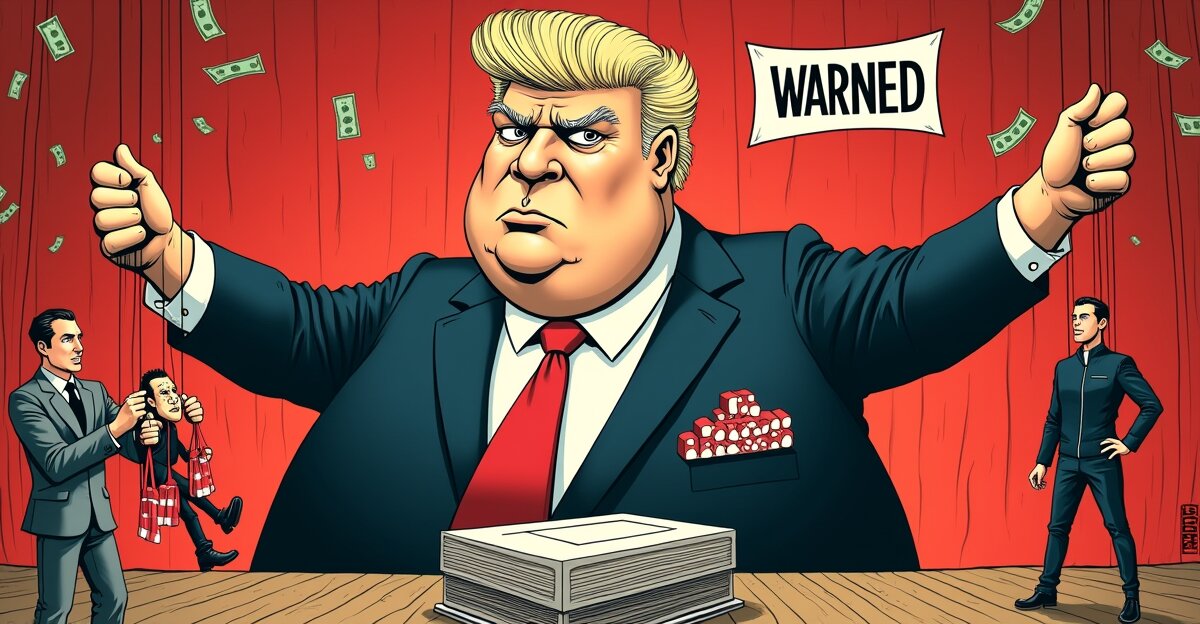
He was briefed in late 2025, warned in a classified memo the following spring, reminded aboard Air Force One, and then the president flew the compromised CEO to Beijing to negotiate AI chips.
"There is only one man to take his place - Tim Cook of Apple. A Legend replaces a Legend!"
— President Donald Trump, Truth Social, after Jensen Huang's ouster
The New York Times broke the story that destroyed Jensen Huang, but the more important reporting came a year earlier. In late 2025, intelligence officials told the president that the head of Nvidia, the company riding the AI boom to a valuation over $4 trillion, was in a relationship with a woman they believed was spying for China, the Times reported. American intelligence had been surveilling her for at least a year. U.S. and Singaporean intelligence suspected Alice Huang, an executive at a Singapore data center firm called Megaspeed, had been recruited by China's Ministry of State Security to feed information about Jensen Huang to Beijing.
The president was told. Nothing happened.
Then, in the spring of 2026, Secretary of State Marco Rubio oversaw the drafting of a highly classified memo, built on the surveillance, circulated to the most senior cleared officials before the president's May trip to China. CNN sources said Rubio briefed him again aboard Air Force One on the way over. The president brought him on the trip anyway. Huang attended part of the summit with President Xi Jinping, and the state dinner, on a visit where access to American AI chips was the central economic question.
Megaspeed deserves its own paragraph, because it is less a data center business than a study in how export controls get hollowed out. It began life as a spinoff from 7Road, one of China's largest video game companies. In November 2023, weeks after President Biden signed curbs on American investment in Chinese AI, ownership passed to a Singaporean shell company called Swiftdata. Soon after, Megaspeed became an Nvidia "cloud partner," a designation that meant preferential access to Nvidia's most advanced chips. The Times counted 200 shipments of AI chips moving through the firm, which rented the resulting compute power to major customers including Tencent and Alibaba.
Commerce's Bureau of Industry and Security opened an investigation into Megaspeed in September 2024. Singapore police were probing it by October 2025; her passport had been seized in June 2025. This month Singapore barred her from re-entering the country, and Malaysia is checking whether a Megaspeed subsidiary re-exported chips without permits. The investigation aged. The chips kept moving.
The affair itself is almost too absurd to summarize. The two were introduced in a Taipei bar in June 2024 by Alice Huang's own husband, Kang Wei, a Chinese businessman who had known Jensen for a decade and who, according to the Wall Street Journal, appeared to accept his wife's closeness to the billionaire and spoke openly about it. The Journal also reported that Alice Huang had visited Nvidia's Santa Clara headquarters in early 2025. When it became public, it turned out to be two relationships: the Times reported a second affair with an Nvidia vice president, which five employees came forward to expose.
The money ran in both directions. In April 2025, Huang attended a $1 million a person donor dinner at Mar-a-Lago, after which the administration briefly paused chip export restrictions before implementing them. In October 2025, Trump let Nvidia sell its second most powerful chip to China, with a portion of the sales flowing to the U.S. government. And Nvidia, the second largest corporation on earth, gave $25 million to the White House ballroom.
So what happened to the Megaspeed investigation? A coalition including Guardrails Action, Indivisible, and the American Federation of Teachers says in a letter to Democratic leaders that it was halted after direct intervention by Nvidia's general counsel. Daily Kos's account says the Justice Department instructed Commerce investigators to pause their work after Nvidia pressed officials. Bloomberg reported Lutnick blocked efforts to clamp down on firms suspected of moving high-end Nvidia chips into China; Axios reported he repeatedly stood in the way of enforcement. The details are disputed. The outcome is not.
In August 2025, Nvidia general counsel Tim Teter had asked the bureau for a meeting, claiming permission from Commerce Under Secretary Jeffrey Kessler to discuss the case. The bureau declined. Two months later, the president was authorizing chip sales to China.
Translation: the department whose job was to keep the chips in America stopped keeping them.
The collapse came fast. On November 8, after the Times' spy story, Huang wrote to Nvidia employees admitting an extramarital affair and reaffirming his commitment to the company. The board said it had "no reason to believe national security or Nvidia secrets had been compromised." The company's spokesperson said the relationship was nothing out of the ordinary. Two days later, the CIA director and the Director of National Intelligence briefed congressional leaders in a closed session. At a press conference, Trump said he was "amazed" by the allegations, that the FBI was investigating, and that his friend would be "in good shape." He added: "I asked him that question: 'Did you have any idea that she was a spy?' He said, 'I had no idea that she was a spy.'" Trump also called Huang to urge him to fight for his job.
On November 11, the Times reported the second affair, and the Wall Street Journal reported the board was preparing to oust its co-founder. Rep. Jim Himes, the incoming chair of the House Intelligence Committee, attended a classified briefing that day and later said he asked Jay Clayton and John Ratcliffe directly whether a counterintelligence investigation had even been opened at the FBI. "They didn't know," Himes said. By the time the ouster was public, Trump had already posted the Tim Cook succession line on Truth Social.
On November 12, Huang resigned as CEO, president, and board member, ending a 33 year run. Nvidia's CFO Colette Kress became interim chief executive. The company lost more than $600 billion in market value in days, and a retail investor filed a fraud suit over what he said was concealed. Attorney General Todd Blanche, asked about the spy, offered a remarkable non-answer: "There's no conclusions reached by the Department of Justice or by me or by [FBI] Director [Kash] Patel around who she is or is not." CNN reported that some officials in the Office of the Director of National Intelligence considered the spy characterization "not entirely accurate and over-torqued."
The spy may turn out to be a ghost. The warnings do not go away with her.
The Republican response has been a study in who gets blamed. Senator John Kennedy, R-Louisiana, said "the obvious question is why did [Lutnick] choose to sell advanced chips," and that if he were Lutnick, "I'd call a press conference this afternoon." Senator Kevin Cramer, R-North Dakota, demanded Huang's resignation on CNBC: "I can't believe we are even considering him not resigning... this is a guy that's right now so vulnerable to extortion, blackmail." The Republican chairs of the House Foreign Affairs, Intelligence, and China select committees requested that Huang appear for a joint closed-door briefing on November 18. By November 13, the summons had expanded to Lutnick. CNN reported that some of Trump's own advisers began discussing whether Lutnick should be fired. Treasury Secretary Scott Bessent, who has a long simmering feud with the Commerce chief, blamed Lutnick for what he called the leakage of Nvidia's advanced chips to China.
The Democrats, who took control of both chambers in November, are moving faster. Senators Ron Wyden and Richard Neal opened an investigation into a scheme to disguise an unconstitutional export tax as a national security tariff, one that benefited both Nvidia and the Chinese government. Sens. Elizabeth Warren and Chris Coons wrote that officials across the White House, State, and Commerce "were aware of concerns" about Nvidia and the suspected intelligence operation, "yet did not move to block the continued flow of advanced AI chips." A coalition of advocacy groups demanded that the incoming Congress "aggressively wield its investigative powers" against the president and his circle. The subpoenas, if they come, will be addressed to a building that has, so far, produced only denials.
Beijing called the Times' reporting "pure fabrication out of thin air." A Chinese Foreign Ministry spokesperson called it "smears against China". The denials are stacking up. Trump says he learned of the spy connection "recently," despite the reported 2025 briefing. The attorney general says his department never concluded she was a spy. Huang said he had no idea.
A president warned three separate times, and the men who controlled the investigation all had something to lose from it. The spy may be a ghost. The memo is not.
Comments (0)
No comments yet. Be the first to speak up.
Join the Riot
Login with Google to leave a comment.
Login to Comment