
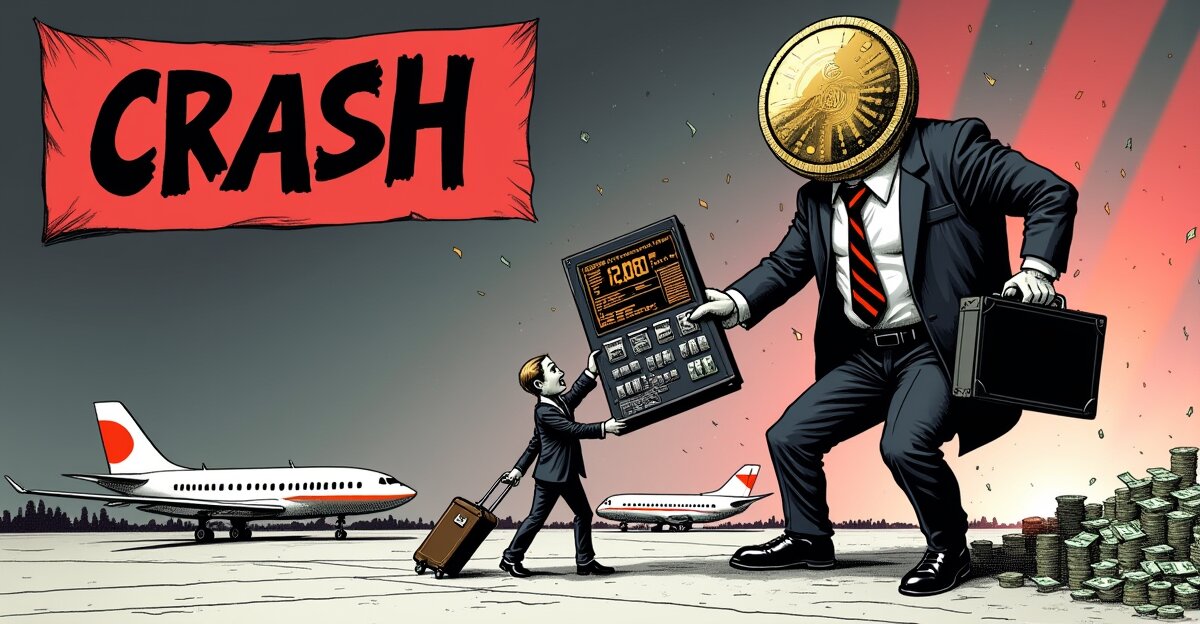
The Day the FAA Crashed, and Who Was Paid for It
When the nation's aviation system went down on Friday, the question was not what broke, but who had been paid to build what came next.
"This is L3Harris. It's our legacy telecom network. It's owned by L3Harris. ... But in the meantime, until I can build that, I'm stuck with L3Harris, which owns this network."
— Transportation Secretary Sean Duffy, at a press conference the day after the nationwide ground stop
The United States aviation system went down on Friday afternoon, and it was not a metaphor. A rare nationwide ground stop kept planes on the tarmac at every American airport for more than four hours. The Department of Transportation put the number of stranded travelers at more than 1 million. The stop was lifted that night, but thousands more flights were canceled Saturday, and the ripple, Duffy warned, could last for days.
The official explanation had the texture of a car that stalled because a horse wandered onto the road. Duffy said a contractor, L3Harris, had been upgrading a communications router at a "remote location" on the legacy telecom network the FAA still runs, and the work injected instability. The New York Times reported that outdated communications equipment became overloaded with data and began to fail. The FAA's own statement described "communication issues impacting multiple Air Route Traffic Control Centers." There were no signs of a cyberattack.
A 21st-century aviation system failed for a 20th-century reason. The wires were old, and the company that owned them was one the secretary did not want to be stuck with.
At a Saturday press conference that Politico described as "plagued by audio problems," Duffy did the arithmetic of the modern government. The old network belongs to a contractor. The new one will belong to three national telecom giants, once Congress sends the money. Until then, he is stuck. "Did we have incompetence?" he asked the room, which was about as close as a cabinet member gets to a confession before a correction.
The White House, which had held the crisis briefing Friday night with Duffy and the homeland security secretary, Markwayne Mullin, put the price of fixing the system at $50 billion. Former Rep. Marjorie Taylor Greene, who left Congress after breaking with the president, read the briefing for what it was. "It's literally like a shakedown for more money," she wrote, adding, without evidence, that of course it was a cyberattack. The post drew more than 1.6 million views, which is what happens when a government offers a cause so dull that conspiracy becomes competition.
The Machine That Wasn't (Officially) to Blame
The dull cause is not the interesting one. The interesting one went live that week.
The FAA had brought a new air traffic management system into nationwide use, built by a Boston startup called Air Space Intelligence. SMART ingests more than 200 data sources to flag problems before planes take off, and it had been running in limited form since September at Reagan National, Dulles, and BWI. As the planes sat on the tarmac, CNN national security analyst Juliette Kayyem did the math everyone was doing. "The FAA onboarded a new AI system 3 days ago," she wrote on X. "Hard to believe it's a coincidence."
Air Space Intelligence denied any role in the ground stop. "The current ground stop is not based on or a result of the SMART system, any product of ASI or our integration with FAA and ATC," the company's account said. It is a defensible sentence that will be quoted for years, because it arrived the day the system meant to prevent this kind of thing crashed right next to it.
The rollout had warnings attached. On October 13, 23 House Democrats asked the Government Accountability Office to review the deployment. "Concerningly, the nation's frontline aviation safety workforce apparently had little to no input into SMART's development and have received limited training and information during the current deployment process," the letter said. "The use of artificial intelligence within SMART has rightfully raised serious questions about its reliability and safety benefits." Twenty-five other Democrats asked the FAA to pause the tool until it shared its safety testing. The agency did not. Pressed on Fox News, Duffy called it "complete stupidity."
The company behind the code is not a random vendor. Air Space Intelligence, a Boston shop of roughly 165 employees, predicts congestion in busy systems for airline customers including Delta, Alaska, and United. Bloomberg valued the company at about $300 million in December 2023. On June 22, Duffy and FAA Administrator Bryan Bedford announced that it had beaten out Palantir and Thales for an FAA contract worth up to $875.9 million. September brought an Army contract worth up to $99 million and a sole-source $26 million Air Force order. In October it raised $325 million at a $3 billion valuation, with Andreessen Horowitz among the investors. The startup's valuation did a 10x in 22 months. The infrastructure it was asked to modernize did not.
The Money Trail
There is one more fact about that contract, and it is why this story is not about aviation.
In March, three months before his father-in-law announced the award, Air Space Intelligence's political action committee gave $2,500 to the campaign of Michael Alfonso, the 26-year-old Republican who now holds Wisconsin's 7th congressional district. He has never held office and has no background in the transportation industry. He has the president's endorsement and a fundraising operation that The Bulwark and the Daily Beast describe as a revolving door with the handle greased. His donors include Delta Air Lines and Southwest Airlines, both regulated by the FAA. UPS and DHL, both regulated by a trucking arm of the same department. The trade groups that lobby the Federal Highway Administration. At least 25 out-of-state business leaders and lobbyists with interests pending before the department gave a combined $41,750. Duffy's own dormant congressional campaign committee funneled another $1.5 million to the race through a super PAC.
The pattern repeats in the record. A New York executive named Peter Cipriano gave Alfonso's campaign $2,602.54 in March. His firm became a finalist for master developer of the multibillion-dollar Penn Station renovation. Less than two months later, Duffy announced that Cipriano's venture had been selected. Politico reported in October that the FAA is negotiating to buy shares in Air Space Intelligence at a set price, the first time the agency has sought an ownership stake in a contractor. The same institution would then be the company's customer, its safety regulator, and a part-owner.
None of this proves a deal. The $2,500 is small money next to a contract that size, and the award was competitive. All of it is the shape of a deal: the way the question looks when the system is built to keep the answer private.
The Show
The secretary has his own relationship with the companies his department regulates, and it comes with a title: The Great American Road Trip. The six-part YouTube series aired last month, following Duffy, a former Real World star, and his wife, weekend Fox & Friends co-host Rachel Campos Duffy, driving cross-country with several of their nine children. Alfonso appears. The show was financed by millions of dollars in corporate sponsorships from companies the department regulates: Boeing, Toyota, United, Shell, Royal Caribbean, Enterprise, and Lyft. John Oliver's segment on it was titled, in relevant part, Trump's most disturbingly cringe goon.
And then there is the president. During the ground stop, Trump posted about the "Motion Picture, Television, and Entertainment Revitalization Act." "I am working with Senator Tim Scott and, believe it or not, Senator Adam Schiff," the post read. CNN's Kaitlan Collins described it in one line: "Trump posts, not about the ground stop, but about reviving the entertainment industry in bipartisan fashion." Author Amy Siskind: "In the midst of a national crisis with the FAA shutting down airports and grounding flights, Trump is busy posting on Truth Social about the film industry. Such leadership." Kari Lake replied, on behalf of the industry: "Thank you, President Trump, for working hard for American workers and American industry!"
A president who brands himself the ultimate fixer did not fix anything on Friday. He posted about Hollywood, and a transportation secretary who stars in a reality show sponsored by the companies he regulates asked the press, "Did we have incompetence?" The answer, for now, is a $50 billion request and a root-cause analysis.
The country can afford a $3 billion AI startup, a $50 billion infrastructure ask, a YouTube series, and a president who posts about film tax incentives while the planes wait. What it has not yet figured out is how to ask, of the people who own the network and the people who get paid to modernize it, what exactly broke. The root-cause analysis is ongoing. The travelers are still at the airports.
Sources
- Raw Story: Startup eyed over flight chaos funnels cash to Transportation chief's son-in-law
- Raw Story: 'Utter incompetence': Trump sparks fury with unexpected post amid national emergency
- Raw Story: 'I'm stuck': Sean Duffy blames key services 'provider' for airport ground stop
- Raw Story: 'They are lying': Ex-Trump insider makes grim claim about real origin of flight grounding
- Daily Beast: Sean Duffy's Son-in-Law Receives Campaign Donations from Firms Doing Business With DOT
- NYT: What to Know About Friday's Nationwide Ground Stop
- FAA: Statement on Nationwide Ground Stop
- Politico: FAA stake in AI company
- No Hate Hot Takes: A Small AI Startup, $1 Billion in Federal Deals, and a Donation to Duffy's Son-in-Law
Comments (0)
No comments yet. Be the first to speak up.
Join the Riot
Login with Google to leave a comment.
Login to Comment