
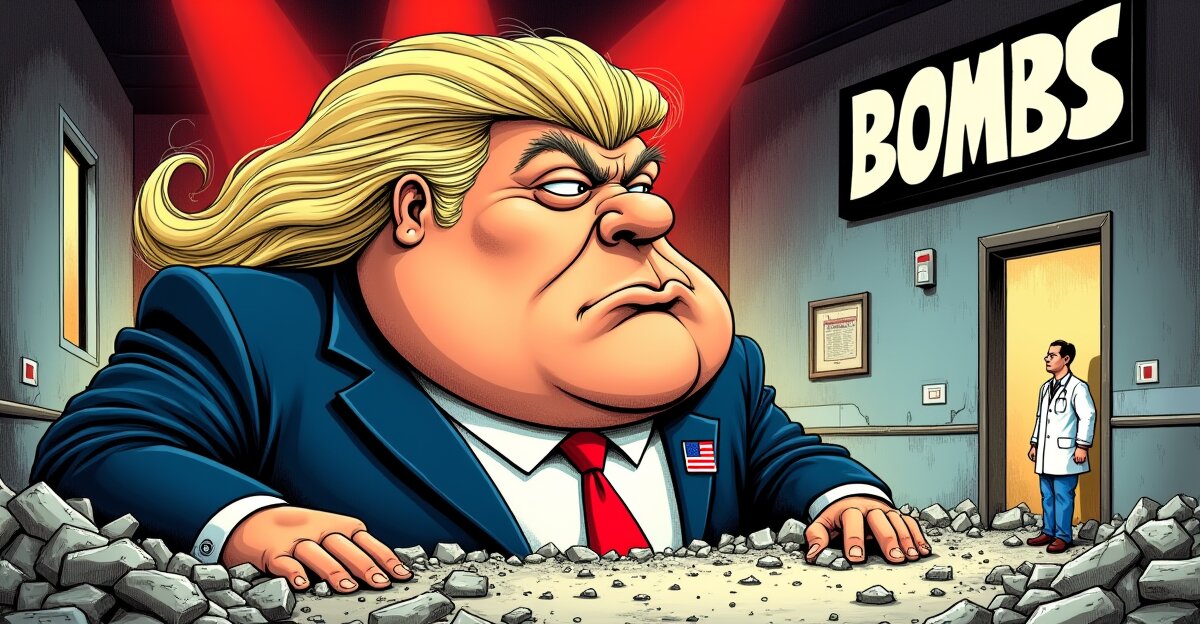
Six people died in a Gaza hospital on Thursday, and the ceasefire's "Board of Peace" had a verdict ready before the bodies were counted: blame the dead, who were killed by a bomb made in America.
"The Board of Peace deplores the death of any civilians and strongly condemns Hamas's continued exploitation of hospitals and other critical civilian infrastructure."
— The Board of Peace, the body President Trump created to run the Gaza ceasefire, on the Israeli strike that killed six at Nasser Hospital
Shortly after midnight local time on Thursday, November 12, a guided bomb hit the surgery building of Nasser Hospital in Khan Younis, in southern Gaza. The Health Ministry of the enclave reported six dead. Doctors Without Borders said 52 were wounded. Nasser is the largest hospital in Gaza, one of only a handful still functioning, and it serves roughly 1.3 million people. Its emergency, surgery, radiology, and laboratory departments were forced to shut down.
Among the dead was Dr. Rizk Abu Shaira, a 52-year-old general surgeon. The Health Ministry's director general told the crowd gathered around his shrouded body: "Dr. Rizk was at the hospital during the entire war. He didn't abandon his duties for even one day." A 13-year-old boy was also killed, and so was Khaled Abu Anza, 53, who, his sister said, was in the hospital for physical therapy after surgery. He "did not come to the hospital to engage in combat or resistance. He came for medical treatment."
Dr. Ayman Abu Obeid, who heads the hospital's surgery department, told NBC News there was "no notice, warning or anything" before the attack. "Suddenly, there was fire and shelling and walls were brought down instantly." Two British surgeons who had flown in earlier that month to help were inside the hospital when it struck. One was 15 to 20 meters from the point of impact. Both said they saw no fighters, no weapons, no military presence: only a medical team treating patients.
Outside the wreckage, munitions debris was displayed for news crews, and that is where the American part of this story lives. Two weapons experts, Justin Bronk of the Royal United Services Institute and Brian Castner of Amnesty International, identified the fragments as parts of a GBU-39 Small Diameter Bomb, a 250-pound guided bomb made by Boeing in the United States. It is a U.S.-supplied weapon that Israel has used in many strikes in Gaza. A third analyst, Sam Lair of the Foreign Policy Research Institute, called the imagery "inconclusive" but said the wings, tail, and warhead were consistent with the same family of bombs.
The Israeli military and the Pentagon did not respond to a request for comment on whether U.S.-manufactured munitions were used in the strike. The silence is the story.
Translation: America did not press the button. America built the product, and a bill that would have blocked this exact class of weapons has been sitting in Congress since 2025 without a vote.
The bill is the Block the Bombs Act, H.R. 3565, introduced in 2025 by Representatives Delia Ramirez, Sara Jacobs, Pramila Jayapal, and Mark Takano. It would prohibit the transfer of specified U.S. offensive weapons to Israel. The munitions that shattered Nasser's surgery wing are the kind it was written to stop, and the reason any of them were available is that nobody has made the transfer illegal.
The Israeli military and the Israel Security Agency have a different account. They say the strike targeted Muhammad Abu Ismail, the commander of Hamas's Khan Younis Brigade, and other militants who they say operated attacks from inside the hospital. The IDF alleges the hospital's second floor "serves as a Hamas military HQ, where civilians are not permitted to enter," that Hamas stored weapons there, and that "dozens of hostages were held captive" in the facility earlier in the war. It published undated photos of weapons. It said it used "precision munitions," and it later said "advance warnings were issued to the population."
Hamas called the military's claims "lies of the criminal enemy" and the attack a "war crime." The doctors on the scene said the dead were patients and the people treating them. The IDF said it was looking into the reports.
Translation: the military account needs the second floor of a working hospital to be a headquarters that civilians are not allowed to enter, with undated photographs as the evidence and, by its own account, no warning for the people who were, on every medical account, asleep.
The rest of the world reacted the way the rest of the world does to this. Eighteen foreign ministers, in a joint statement from a group including Egypt, Jordan, Turkey, and the Gulf states, condemned the strike "in the strongest terms," saying it violated international humanitarian law and the special protection owed to medical facilities. The United Nations said it was "deeply alarmed." The head of the World Health Organization said hospitals must never be militarized or attacked.
Then the Board of Peace issued its finding. The board was created in January under U.N. Security Council Resolution 2803, launched in Davos with Jared Kushner and Steve Witkoff at its side, and chaired by the president himself. It is the institution that now runs the Comprehensive Peace Plan, the U.S.-backed ceasefire architecture. Days earlier it had criticized Israel over delays in getting humanitarian aid into the enclave after storms destroyed thousands of tents and killed at least four people.
After the hospital strike, the board deplored the death of civilians. It strongly condemned Hamas's exploitation of hospitals. It called on both sides to uphold the peace plan, maintain the ceasefire, and advance Gaza's demilitarization. It did not condemn the strike. It did not question the use of a U.S.-made bomb on a hospital. It did not name the weapon. The one party it held responsible for the deaths at Nasser was the side that did not own the aircraft.
The arithmetic of this ceasefire is now a standing column. This was at least the seventh attack on Nasser since the war began in 2023 and the fourth hospital strike since the truce took hold in October of last year. In August 2025, a double-tap strike on the same hospital killed at least 20 people, including journalists. More than 1,400 Palestinians have died since the truce, the enclave's Health Ministry says, and the United Nations counts at least 340 of them as children. More than 1.4 million Gazans, roughly 65 percent of the population, are living in tents.
Medical Aid for Palestinians, which supports several departments at Nasser, called the attack "yet another indication that the so-called 'ceasefire' has brought neither safety nor an end to Israel's attacks on Gaza's healthcare system."
The surgeon who didn't abandon his post for a single day is the one in the shroud now. The bomb that ended that post was made in the United States, and the peace institution standing over the whole arrangement has already delivered its verdict: the hospital was being exploited. Congress will keep debating everything except the bill written to stop this, and the board will keep deplored civilian deaths in the abstract.
The peace plan can keep writing. The debris outside Nasser Hospital carries a manufacturer. The bomb was American. The verdict was Hamas. And six people who will never come back to work on Thursday morning get no share of either.
Comments (0)
No comments yet. Be the first to speak up.
Join the Riot
Login with Google to leave a comment.
Login to Comment