
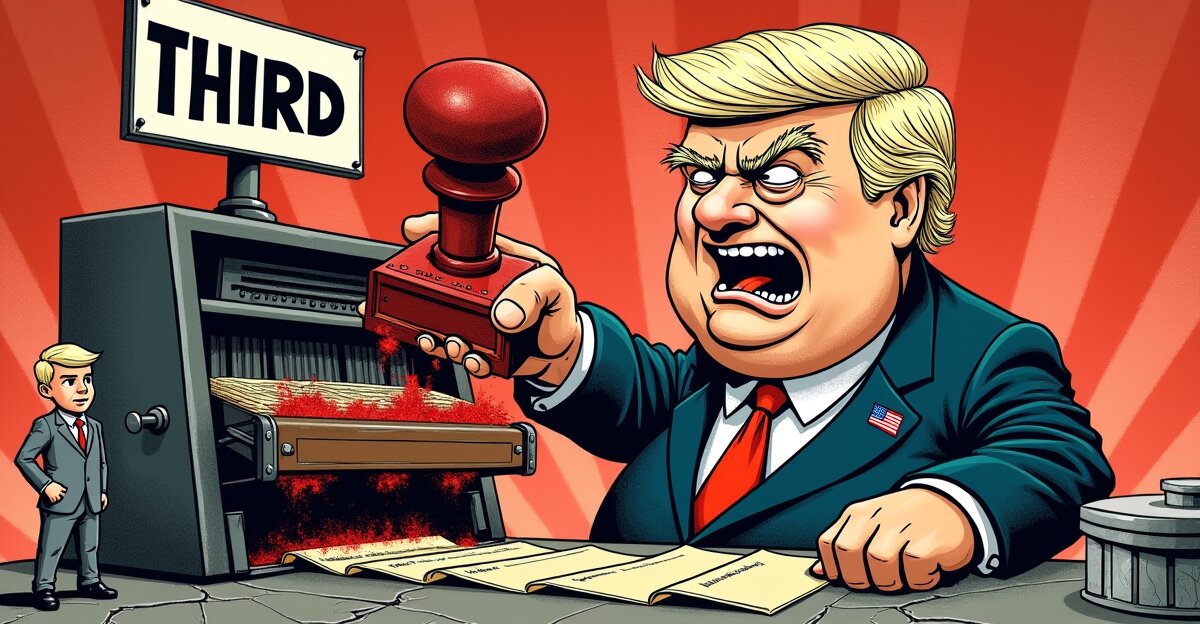
A statute of limitations is supposed to be a wall. This week, the Department of Justice treated it like a suggestion, and filed its charges on the last day the law allowed.
"Well, they're back again. It would almost be funny if it weren't such an appalling abuse of the Department of Justice, one that we cannot become numb to."
— James Comey, video statement, Monday
On Monday, court documents that had sat under seal for three weeks were unsealed at the request of the defense, and they revealed that the Trump administration has now charged former FBI Director James Comey a third time. The charge comes for an act committed a decade ago, in a story published a decade ago, after two separate investigations during Trump's first term both concluded that nobody should be prosecuted.
The document is not an indictment. It is what prosecutors call a "criminal information," a charging paper filed by prosecutors alone, with no grand jury, no judge, and no finding of probable cause. According to Reuters, it was filed under seal on October 5, 2026, the precise day the ten-year federal statute of limitations expired. The defense forced the paperwork into the light a month later.
That timing is the entire story.
The alleged crime, as laid out in the unsealed filing, is remarkably modest. In early October 2016, Reuters reported, citing a government source, on a secret order from the Foreign Intelligence Surveillance Court requiring Yahoo to scan emails for messages potentially tied to a foreign terrorist organization. The next day, The New York Times ran a fuller story, and the order was one Yahoo was legally barred from disclosing.
The government says Comey, then FBI director, "sought to correct misinformation which had appeared in the press by way of Reuters," directed his staff to speak with a Times journalist about accuracy concerns, and thereby "illegally transferred classified information." Ten years later, this is the offense.
The government knows what it is, because it already investigated this exact incident twice and declined to charge anyone. Federal authorities, including prosecutor John Durham, opened the first probe in early 2017. In December 2018, Durham wrote a classified memo recommending no criminal charges against anyone. A second investigation opened in January 2019 at the U.S. Attorney's office for the District of Columbia, under the code name Tropical Vortex. It closed in February 2020 without charges.
Two investigations, two no-charge conclusions, a decade of silence, and then, on the final day of the window, a document arrives.
The legal maneuver is this: the ten-year statute of limitations, the defense argues, "explicitly demands an indictment within 10 years of the offense," and "an information does not suffice." A criminal information is normally something a defendant agrees to accept, a shortcut that spares both sides a grand jury. Elie Honig, a former federal prosecutor and CNN's senior legal analyst, put it plainly: this is "a bizarre, and likely improper, use of a criminal 'information' to end-run the statute of limitations," and because Comey did not consent to it, it "likely cannot extend the statute of limitations."
The DOJ's response is a single line from its Rapid Response account: filing an information to toll the statute of limitations is "a widely recognized practice in federal court and has been approved by multiple circuit courts of appeals." The department, now headed by Attorney General Todd Blanche, the president's former personal lawyer, said only that this is "an ongoing criminal investigation" and that it would not comment further.
Comey's attorney, Patrick Fitzgerald, noted the procedural oddity in one sentence: the government "filed an 'information' against Mr. Comey that was not approved by a judge nor issued by a grand jury." NBC News adds the detail that settles the practical stakes: Comey cannot be tried on the information alone unless he waives his right to a grand jury, an unusual move, and prosecutors will still need an indictment to actually bring this case to trial.
Translation: the deadline was never a wall. It was a door, and the government filed its paperwork while the lock was turning.
The unsealing landed on the same morning as a second blow to the same department, from the same courthouse corridor. Judge Jesse M. Furman, the Obama appointee in Manhattan, issued a 55-page ruling that the DOJ's 2025 firing of Maurene Comey, James's daughter, was unlawful. She was a prosecutor in the Southern District of New York who had led the Ghislaine Maxwell case, prosecuted the Combs trial, and been involved in the office's Epstein case, until the administration removed her in July 2025 without telling her why.
Furman held that the firing violated the separation of powers, federal administrative law, and due process, and rejected what he called the administration's "sweeping and unprecedented theory of executive power," which would let the president fire line prosecutors for any reason or none. He ordered her reinstated with back pay.
The most quotable line in the opinion is about precedent: the administration's argument, Furman wrote, "is contrary to an unbroken line of Supreme Court decisions dating back almost two centuries, and the Supreme Court itself has not formally overruled any of those decisions. That is sufficient, in itself, to reject the argument."
A father charged on the deadline day. A daughter ruled unlawfully fired on the same morning. The family that fired back is the family the government is now prosecuting, and the calendar did the arithmetic.
This is the third case. The first, filed in Virginia last September, accused Comey of lying to Congress in 2020; it died when a judge found the prosecutor who brought it had been illegally appointed. The second, filed in North Carolina this spring, rests on an Instagram photograph of seashells arranged in the numerical order "86 47," which the government reads as a threat against Trump.
The backdrop is the long, documented feud. Trump fired Comey in May 2017, mid-Russia-probe, after the director refused to pledge personal loyalty at a private dinner. Comey's memoir likened him to a mafia don "untethered to truth." Trump has repeatedly claimed Comey is guilty of "treason," an accusation Comey called "dumb lies," and has called him an "untruthful slime ball." When the Maurene ruling dropped, Senator Sheldon Whitehouse offered the most useful analysis of the moment: "This will drive 'Ranting Man' Trump even crazier."
None of this is far from the ballot box. The midterm elections are next week, and as AP noted, this is part of "a series of politically charged investigative actions the department has undertaken in the run-up" to them. The department that raided a sitting congresswoman's home, that hunts for noncitizen votes that do not exist, and that fires prosecutors who work on Epstein, has now reached for a charging mechanism it would not have needed if it had simply investigated this story when it happened, in 2017, and twice decided to drop it.
Nothing's changed with me, Comey said in his Monday video. I'm still innocent, I'm still not afraid of these people, and I still believe in an independent federal judiciary.
The question was never whether the statute of limitations was real. The question was what happens when a department treats it like a target to be run down, on the last day of the clock, with the election nine days out. The law got its answer. It was a document.
Comments (0)
No comments yet. Be the first to speak up.
Join the Riot
Login with Google to leave a comment.
Login to Comment