In March, an unnamed FBI employee wrote down exactly what would happen. In January, it happened.
"I am concerned that the rush deadline on the project, for no discernable (sic) reason, will lead to mistakes that could destroy people's lives."
— FBI whistleblower, complaint dated March 2025, published this week by PunchUp after a FOIA request
The Federal Bureau of Investigation exists, in theory, to find the thing that is happening. So when the thing that is happening is the Bureau itself, it tends to get found only later, in a document, by someone who did not work there anymore. This week, a newly released tranche of internal FBI correspondence, published on the bureau's FOIA vault after a request by the Substack PunchUp, contained a written complaint from an unnamed employee of the Information Management Division, the unit that redacted the Jeffrey Epstein files for public release. The complaint is dated March 2025, weeks after Kash Patel became FBI director. The employee wrote that the director had threatened to fire workers unless they met his "made up" redaction deadline.
The employee then asked the question the rest of the bureau apparently decided not to ask: what happens when a made-up deadline produces mistakes? "What better way than to fire us for making mistakes during this ever changing process," the complaint reads, "or as scapegoats for the DOJ's lack of following proper procedures."
The warning was specific about who would get hurt. Reviewers, the employee wrote, were not removing personal information that could identify FBI agents and other employees, exposing them and their families to retaliation if the records went public. And the details staff had been told to leave unredacted could be pieced together to identify Epstein's victims, leaving them vulnerable to harassment or worse. The fear underneath all of it was that the Justice Department would publish the material without further checks and then blame the FBI for whatever it got wrong.
The complaint followed every official channel. It went to the FBI's Office of Integrity and Compliance. On March 24, 2025, assistant director Catherine Sheehan Bruno wrote that her office was obliged to report the allegations to the Justice Department's inspector general. The next day, an FBI lawyer confirmed that the employee was willing to be identified to the inspector general if necessary. That is the whole chain, working exactly as it was designed to work.
And then the records show the following: the FBI closed its own case.
There is no indication in the released material that the inspector general took the matter any further. There is no record that anyone working on the Epstein review was fired. The whistleblower, meanwhile, did what whistleblowers do. They kept redacting. Their stated reason, in their own words, is the coldest line in the file: they wanted their concerns on the record in case something went wrong. "Which it did."
Translation: the only written warning about the Epstein release sat inside the agency whose boss was being accused, flagged by that agency's own integrity office, and closed by that same agency. The person most likely to be blamed for the coming catastrophe was the person holding the pen.
Then January 2026 arrived, and the Justice Department released millions of additional Epstein records. The redaction job that had been rushed against a deadline with no discernable reason missed the one category of people it existed to protect. Survivors. Women who had never publicly disclosed their abuse.
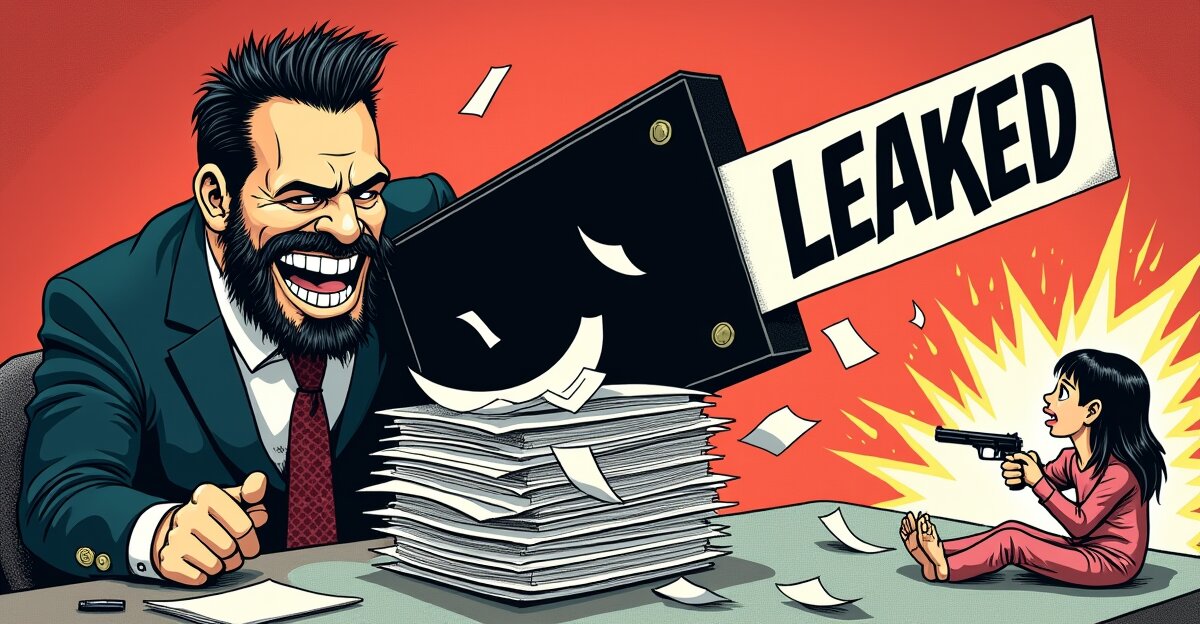
Take Marina Lacerda. She was sexually abused by Epstein at 14. In the January dump, her name appeared in at least 46 unredacted documents. What followed was a torrent of online abuse, the kind aimed at the person who now cannot even be anonymous. Her 12-year-old daughter was bullied at school by children asking whether Epstein was her father. In an interview with Reuters in June, Lacerda said she now sleeps with a handgun beside her bed, terrified that someone might break into her home.
The deadline was "for no discernable (sic) reason." That is not a description of a deadline. It is a description of a target.
The scale of the operation makes the haste easier to understand, or at least more legible. Roughly 1,000 FBI personnel were drafted into the redaction effort, and the bureau spent $851,344 on overtime between March 17 and March 22 alone, according to earlier Daily Beast reporting. A January investigation by The New York Times reported, through former FBI section chief John Sullivan, that an employee on the Epstein review team described Patel joining a conference call to berate workers and threaten their jobs unless the work was completed on schedule. The written complaint is the paper version of the same story.
There was also a payoff waiting at the end of the purge logic. Under this administration, the FBI's workforce has been cut by roughly 7 percent, per Reuters. Thousands of agents and civilian employees have left the bureau since Patel took over. A redaction deadline with no operational reason is a ledger: a way to ensure that when the publication goes wrong, the wrong belongs to an employee rather than to the office that set the clock. The workers get their overtime. The files get published. The names get out. The director keeps his job.
The complaint is surfacing for a reason, and it is not nostalgia. A day before the PunchUp report, House Democrats accused the Justice Department and the FBI of covering up evidence of the president's connections to Epstein. The White House called the allegations false. The DOJ's inspector general office declined to confirm or deny that an investigation into the whistleblower's complaint exists. The FBI and the Justice Department did not respond to requests for comment on the complaint itself. That is the full sum of the official response to a document that says, in the bureau's own words, that its director threatened to fire people over a deadline he made up, inside a process that was going to hurt victims.
The White House has had a year and a half to explain the January mess. It has used that time mostly to explain that the Democrats are the problem, the courts are the problem, and the question is the problem. The question the files raise is quieter and more annoying: someone said it would happen, in writing, to the people with the power to stop it, on a date they can now find in a FOIA release.
The architecture is the story. The warning was written down, not shouted. It traveled the proper chain, through the proper office, to the proper watchdog, and was closed by the institution the warning described. No one was disciplined. No one was fired, at least not in the record. The redaction continued at the pace the director set, and when the product failed, the product's victims paid for it: a woman sleeping with a gun beside her bed, a schoolgirl carrying the name of a dead sex offender like a backpack.
The whistleblower's closing line is the whole case in one sentence. They wanted their concerns on the record in case something went wrong, and it did. So now the record exists, and it is damning, and it is public, and the agency it was filed with has never once, in any document we can find, acknowledged that the warning came. The question was never whether anyone warned about the Epstein release. It was why the one written warning in the file came from the person whose job was on the line, and why the file's only recorded action was its own closure.
Comments (0)
No comments yet. Be the first to speak up.
Join the Riot
Login with Google to leave a comment.
Login to Comment