
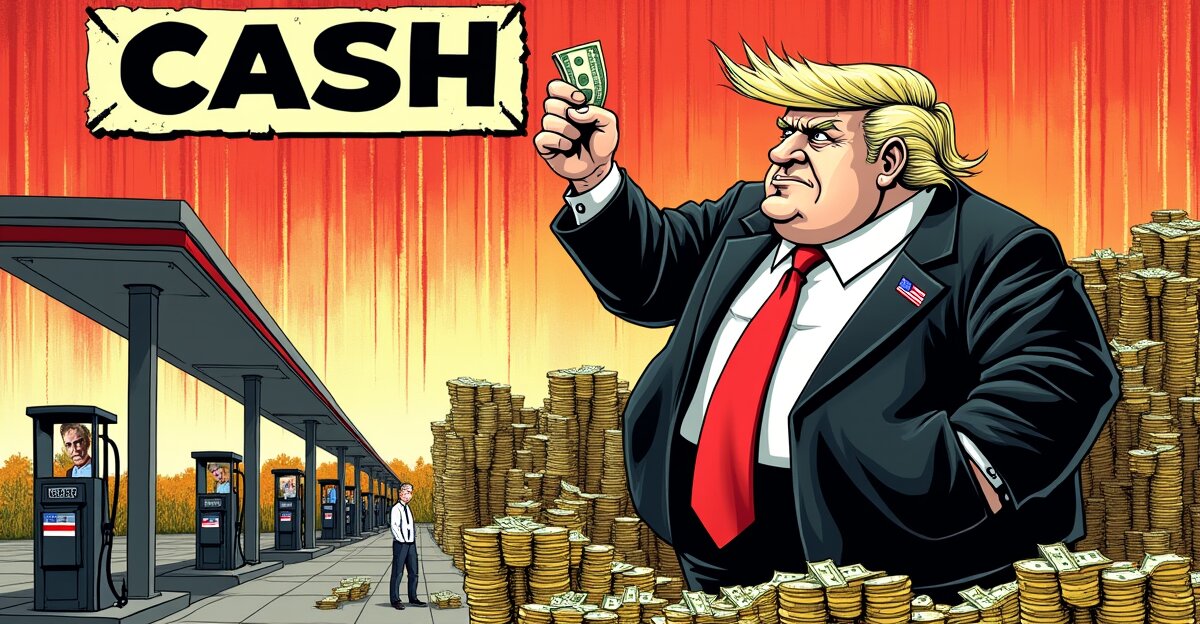
The war is in its eighth month, the pump is at record prices, and the president who started it just confessed, in a whisper, exactly who "we" is when "we're" making a fortune.
"I don't give a damn, I'm going to say it: We're making a freaking fortune."
— President Donald Trump, rally in Perry, Georgia, Saturday
The rally was in Perry, Georgia, deep in the president's base, the kind of town where the crowd is supposed to know what it bought and be grateful. Trump stood at the podium and told the room that the fossil fuel industry is "making hundreds of billions of dollars." Then, in a condescending little voice, he acknowledged that "people are paying a little higher" for the fuel his war made more expensive, and he waved it away the way a man waves away a scratch on a new car. "That number's going to come way down," he said. "But what we've done for this country, we're making money like this country has never made before."
He then pre-empted the news cycle that was about to report exactly what he was saying. "I can just see the fake headlines," he told the crowd. "President Trump is talking about all the money they're making while people are suffering at the pump. That will be the headline."
Translation: the pre-emption was the confession. The "fake headlines" were just the words he was afraid of hearing aimed back at him.
So he said them anyway. "But I said, I don't give a damn, I'm going to say it: We're making a freaking fortune." It was the second time in a week. A week earlier, at a rally in Arizona, he had made the same point in the same tone.
Here is the bill. As of Monday, the national average for gasoline was $4.29 a gallon and diesel was $6.35, according to the American Automobile Association. Diesel prices have hit all-time highs. The war, which the administration has tried to rebrand under the banner of "Operation Epic Fury," has been running for eight months, and it has choked off ship traffic through the Strait of Hormuz, the artery through which roughly a fifth of the world's oil flows.
Brown University's Costs of War Project, which keeps the tally of what the public pays, estimates that Americans have paid at least $144.6 billion more for fuel since the war began: $79.8 billion for gasoline and $64.79 billion for diesel. That is more than $609 per household, for gasoline alone.
A report released Monday by Democrats on the House Joint Economic Committee puts the gasoline tab at $101 billion, or an average of $856 per family. And the committee's state-by-state breakdown is the part that should worry any Democrat running for Congress. The states where families have paid the most: Wyoming at $1,454, Utah at $1,240, Alabama at $1,232, Montana at $1,180, Mississippi at $1,141, South Dakota at $1,122, Idaho at $1,108, North Dakota at $1,087, New Hampshire at $1,029, and Iowa at $1,010.
That is nearly the map Trump won in 2024. He campaigned on serving the fossil fuel industry, whose executives reportedly dumped $1 billion into his run, while promising working people he would lower the cost of living. Now the working people in his states are paying the war. The map didn't drift. It was aimed at.
The same Monday report did the math on the other side of the ledger: the president.
According to the Joint Economic Committee, Trump's oil and gas stock holdings could now top $81.6 million, up as much as $35.8 million this year. That is a near-doubling. And the timing is the part of the document that cannot be read as coincidence: 94 percent of his 2026 purchases in the industry came after he went to war with Iran.
The holdings, reported in ranges, cover eight companies: Chevron, ConocoPhillips, ExxonMobil, Marathon Petroleum, Occidental Petroleum, Phillips 66, Valero Energy, and Williams Companies. The committee also warned that the true number is likely higher, because Trump has not yet reported stock transactions for September or October and has a history of filing later than the law requires. The ledger is open. The receipts are coming.
Maggie Hassan, the New Hampshire Democrat who is the committee's ranking member, said the Iran war "has forced Americans to pay much more at the pump while Big Oil rakes in profits and the president's own stock wealth in the oil and gas industry continues to balloon." She added a line that belongs in every ethics textbook: "Unfortunately, this is nothing new from this administration and only reinforces that the president puts his own financial interests above the American people."
The White House response was one phrase, the kind you use when you know the sentence is true but want the reader to forget it: the president's portfolio is "independently managed by third-party financial institutions." Translation: the portfolio is independent the way a casino chip is independent from the house. It is traded by someone else, and the someone else is working for him.
The companies on the other side of the trade are getting rich too, which was the point all along. ExxonMobil and Chevron reported combined profits of $26.5 billion in the second quarter of 2026. One analysis of the war's first months put Big Oil's windfall profits at roughly $30 million an hour. And the president himself, according to a separate review of his filings, has grown $1.5 million to $4.4 million richer since the war started.
Jeff Colgan, who runs Brown's Climate Solutions Lab, told HuffPost that the profits "are coming straight out of the pockets of American consumers at a time when many people are feeling the pinch." Jamie Henn, of Fossil Free Media, offered the simplest translation of the president's "we." "When Trump says 'we' are making money he doesn't mean you, me, or the United States," he wrote. "He means Exxon, Chevron, and his other Big Oil donors."
It is the oldest trick in the language, wearing a red tie. The CEO stands up at the all-hands meeting, says "our company" is thriving, and watches the room notice that nobody in the audience got a raise.
The reaction from the left side of the aisle was immediate and, for once, unanimous. Bernie Sanders: "Trump just said the quiet part out loud: He doesn't 'give a damn' about higher gas prices, as long as his billionaire friends are making a fortune. Trump doesn't tell the truth very often, but he did last night!" Susan Glasser of The New Yorker called the remark "like the epigraph for the entire Trump 2.0 presidency." Melanie D'Arrigo, executive director of the Campaign for New York Health, put it most plainly: "Trump to people who want lower gas prices: 'Fuck you, I'm making money!' Just run this as an ad."
The polling suggests the country has already run the ad in its head. A survey this month found that 77 percent of Americans blame Trump for soaring gas prices.
And the midterms are weeks away. Democrats are campaigning on ending the war, and the reporting gives the argument traction: the military is struggling to protect its bases from Jordan to Kuwait to the United Kingdom, the official casualty count passed 850 in September, and Congress has already failed to stop the war by the books, leaving a group of advocates to try through the courts instead.
So here is the fake headline Trump predicted, exactly as he predicted it: President Trump says he is making a fortune while people suffer at the pump.
Except it wasn't fake. He said it. That is what makes this story different from the thousand other stories about a president who profits from his own decisions. This one comes with a recording, a congressional report, a university cost tracker, and a map of the ten states paying the most that looks, state by state, like his 2024 win column.
The question was never whether a man who buys stock in the companies his war enriches would get rich. The question was whether he would admit it. He did. On camera, in front of a crowd that paid $4.29 a gallon to get there, in a voice he deliberately made small, because he knew it was funny, because he knew it was on tape.
When Trump says "we," the American public is no longer under any obligation to be included. The war is his. The stocks are his. The fortune is his.
Comments (0)
No comments yet. Be the first to speak up.
Join the Riot
Login with Google to leave a comment.
Login to Comment