
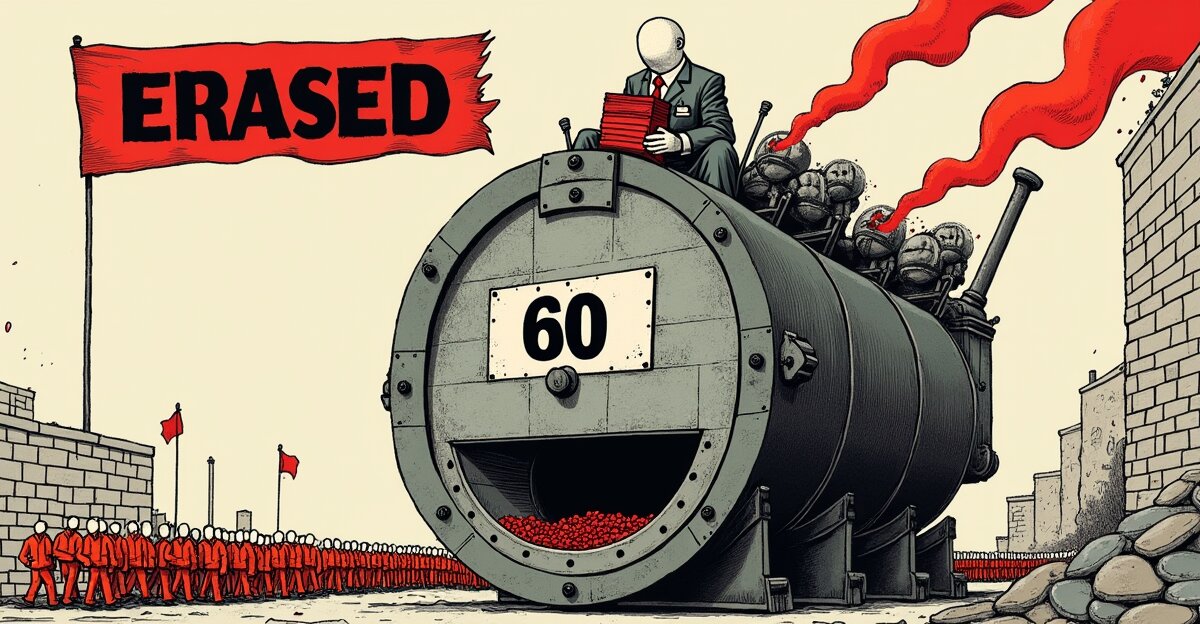
A 48-year-old man from El Salvador was found dead in a Georgia detention warehouse with a ligature around his neck, and the agency that held him counted his death as number sixty.
"When our country detains people, we have the responsibility of ensuring both their physical and mental health, not driving them, though incredible cruelty, to commit suicide."
— Rep. Pramila Jayapal (D-Wash.)
At 1:46 in the morning on Friday, staff at the Folkston D. Ray ICE Processing Center in Folkston, Georgia, found Luis Sandoval, 48, with a "ligature around his neck." By 2:28, he was dead. The El Salvadoran man had been arrested by ICE in Newark, New Jersey, on October 2 and transferred to Georgia on October 8, pending his first removal hearing. His official biography, in the agency's press release, led with a list of prior convictions: aggravated assault, terroristic threats, receiving stolen property, and a drug possession charge. His name was in the headline. "Criminal alien from El Salvador dies in ICE custody in Georgia."
ICE said staff and Charlton County emergency medical workers attempted to save him, and that the death is "under investigation," with an autopsy to determine cause and manner. But the count was already final. Sandoval is the sixtieth person to die in ICE custody since Donald Trump returned to office, and the twenty-seventh to die this year.
Rep. Pramila Jayapal, who has tracked the deaths one by one, posted the number to social media: "Today I received notification of the 60th death in ICE custody since Trump returned to office. Sadly, this appears to be a death by suicide." She ended with two words that have become a policy platform: "Dismantle ICE."
Folkston is not a courthouse, and its occupants are not a docket. It is a warehouse-style facility operated under contract by the private prison company GEO Group, one of more than 200 sites where ICE holds roughly 70,000 people on any given day. The building has a record. In April 2024, a detainee named Jaspal Singh died after being placed under medical observation for chest pains, and an ICE review concluded that the care he received at Folkston contributed to his death. The building stayed open. The contract continued.
This time, the warnings were public. In early October, some 500 detainees at Folkston began a hunger strike, citing a lack of due process in their asylum cases and conditions that Migrant Insider described as "moldy food, foul-smelling water, freezing cells, sleep deprivation, untreated dental pain and months-long waits for care." Lawyers with Asian Americans Advancing Justice reported detainees describing bugs in the water, rashes they had never had before, and hair falling out after showers.
In response, ICE approved force-feeding the strikers, a practice experts describe as torture. One hunger striker has lost 21 pounds. Georgia Senators Jon Ossoff and Raphael Warnock sent a letter to Homeland Security Secretary Markwayne Mullin and the department's inspector general demanding an "immediate investigation."
Sandoval died the day after the letter.
The wider numbers explain the pace. Human Rights Watch documented 39 deaths in the first year of the second Trump administration, in a June report. By September, the ACLU had counted at least 57, and noted that the mortality rate for people in ICE custody has more than doubled compared with the first Trump term and is the highest in more than a decade. Austin Kocher, president of Relevant Research and an American University fellow, gave the pace to The Guardian as a rhythm rather than a statistic: one person dies in ICE custody every ten days, on average, this year.
"Even in the past, there has not been such an overt dehumanization and overt view that migrants' lives are expendable," Kocher said. "I worry that that tone [from the Trump administration] has a tendency towards neglect and viewing migrants as disposable."
The official number is almost certainly low. In June, the administration rescinded a 2021 Homeland Security policy requiring ICE to report and investigate deaths within 30 days of release. The rule had been designed to close the "deathbed release" loophole, where a critically ill detainee is discharged just before dying, so that the death stops being an ICE death. The ACLU documented one case: Prisciliano Trejo Ricano, who spent weeks without effective care for severe symptoms, including coughing up blood, was transferred to a hospital in a coma, released from custody by ICE, and died of leukemia less than two weeks later. His name does not appear on ICE's list of people who died in custody. The agency says it will not investigate.
Translation: if a person stops working inside the fence, they count. If they stop just outside it, they don't.
Detention centers run on a specific vocabulary. Staff, according to researcher Nancy Hiemstra, refer to the people in their custody as "bodies." "We just booked in 17 bodies," one might say. "We don't have that body here, they transferred out three days ago." The word body is the only noun in the English language that refers to a person without revealing whether they are alive. It is logistics vocabulary. Package language. In Folkston, in Newark, in the tent encampments on a military base in the El Paso desert, that word is not a euphemism. It is an instruction manual.
And there is a paradox at the center of the machine. The same agency that documented a string of deaths caused by weeks of denied medical care is now aggressively keeping its hunger strikers alive, because a man dying of starvation in a building with cameras is a liability, while a man who dies of a disease after release is not a detainee at all. Kocher summed up the perversity: the best way to get medical attention in the system, it turns out, is to stage a hunger strike.
The response in Washington has been, so far, the count itself. Jayapal has said she will not "authorize another dime for ICE until we have real accountability," and she and Rep. Mark Smith have reintroduced the Dignity for Detained Immigrants Act, which would phase out private detention facilities, impose civil detention standards, and let members of Congress and the inspector general make unannounced visits. The bill will not move in a Congress where the same administration has "effectively gutted" the Office of the Immigration Detention Ombudsman and the civil rights office that once took condition complaints.
The counter, meanwhile, keeps moving. Sixty people, each with a place, a date, and a facility. Some of the names are known. Some are not, because the rules that would have made them known were quietly removed.
The question is not whether the sixty-first person will die in ICE custody. At one death every ten days, that is settled. The question is whether the agency will say so.
Comments (0)
No comments yet. Be the first to speak up.
Join the Riot
Login with Google to leave a comment.
Login to Comment