
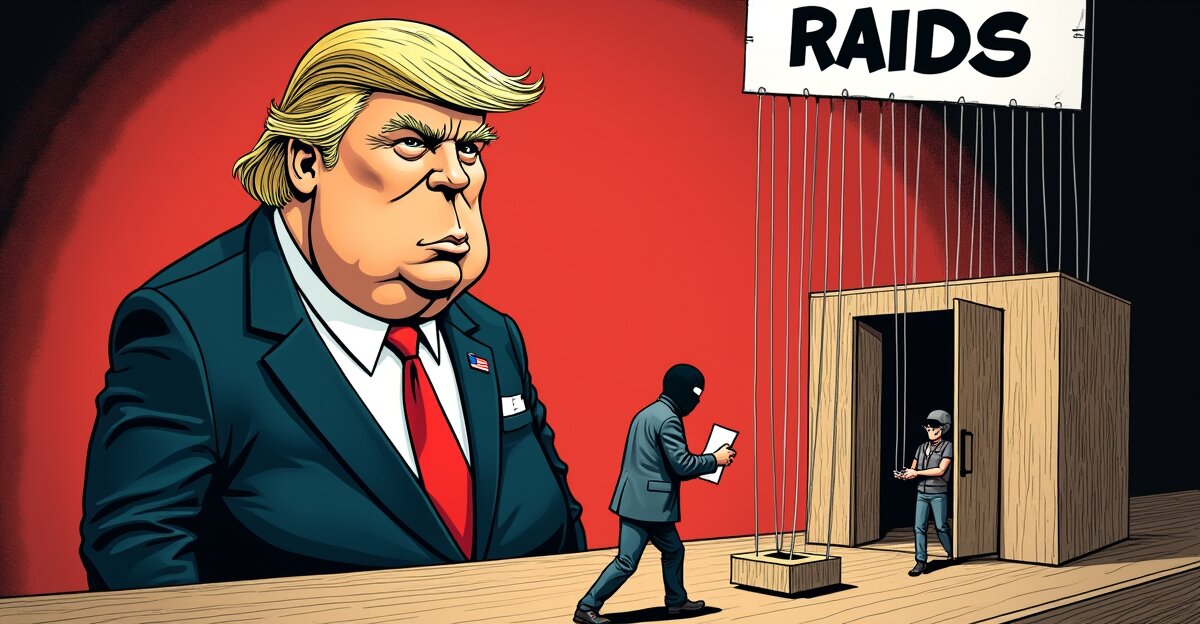
The voter fraud is a ghost. The armed agents at the doors are real.
"They will all go to jail for a long period of time!!!"
— President Donald Trump, after Los Angeles County refused to run a 20,000-name list in 48 hours
On Wednesday, a federal judge in Oakland did what the courts have been trying to do all year: she told the Department of Homeland Security that its war on phantom illegal voters stops at the ballot box. U.S. District Judge Araceli Martinez-Olguín, a Biden appointee, issued a preliminary injunction barring federal agents from conducting "elections-related field operations and field interviews" in nine states, California, Connecticut, Georgia, Missouri, Nevada, New York, Pennsylvania, Washington, and Wisconsin, that involve anyone the agents know, suspect, or should reasonably suspect is a U.S. citizen. The order took effect Friday and runs until the polls close on November 3.
That list of states is not random. David Janovsky, a policy analyst at the Project On Government Oversight, looked at it and saw what everyone sees: close elections. "I look at this list of states, and I can think of some high-profile races that may be anticipated to be close in a lot of those jurisdictions," he said. In Georgia, Jon Ossoff and Mike Collins are fighting over a Senate seat that may decide control of the chamber. In California and New York, a handful of House districts could pad a Democratic majority or lose it. The agency is not sweeping the country. It is sweeping the map.
The operation, launched in August under the name "Unlawful Voter Initiative," works like this: USCIS staff build target lists, the lists go to ICE, and agents show up at American doors to ask whether you are who you claim to be. DHS compiled more than 48 million voter records from "independent and commercial sources of questionable provenance," according to the court's description of the program. The data pipeline traces back to an executive order signed in May 2025 that directed the Justice Department to demand voter rolls from the states. Most red states handed theirs over voluntarily. In 26 others, the Justice Department's lawsuits to compel the rolls were dismissed, because the federal government has no business micromanaging state voter files.
What the data has produced so far is a comedy of corrections. In Nevada, DHS claimed to have found nearly 16,000 non-citizens registered to vote. After further inquiry: 185. After state officials checked: zero, all of them U.S. citizens. In California, the feds claimed 190,000 people had "engaged in unlawful voting activity," then cut the number to 20,000, and the investigations have produced a single indictment. Nationwide, the agencies advertised that they had investigated 300,000 individuals for voting misconduct and prosecuted 130.
The 16,000 "illegal voters" of Nevada did a disappearing act: 16,000, then 185, then zero.
The people behind this have a track record of building it before. FOIA records obtained by Democracy Forward link the initiative to Heather Honey, a prominent 2020 election denier who has supplied the president with conspiracy theories and now serves as a senior advisor to both DHS and ICE. The same records show the administration considered sending undercover agents to investigate the pro-democracy organizations that register people to vote, particularly in Pennsylvania and New Jersey. The Voting Rights Act was not designed to police a data-matching exercise. It was designed to stop people from knocking on your door with fear and telling you not to vote.
"Today, the courts affirmed a vital principle of our democracy: voting is a fundamental right that citizens, whether born here or naturalized, should be able to exercise without armed government agents harassing them," said Beau Tremitiere, an attorney for the plaintiffs, which include the California Nurses Association, National Nurses United, the Voto Latino Foundation, and Santa Clara County. "It was clear from the start that DHS built its lists on bad data, never checked how often it was wrong, and recklessly sent agents to people's homes weeks before an election." His colleague Geoffrey Curfman told the court the operation is manufacturing "a credible fear" among citizens.
Under the Voting Rights Act, Curfman pointed out, intimidation does not require anyone to actually be stopped from voting. It is enough that a citizen is forced to change her voting plans. In other words, the weapon works by working.
In California, the fear is measurable. Immigrant advocates have confirmed a rapid spike in ICE arrests across the Central Valley, with more than 100 farmworkers arrested in a single week. As KQED reports, rumors move faster than facts: people stay home, Latino businesses lose customers, kids miss school, and patients skip doctors. And yet, according to NPR, more than 21 million Americans had already cast early ballots, a surge that the administration's fear machine appears to be racing against.
"We know what Republicans are trying to do, intimidate Latino citizens so they stay at home and don't exercise their right to vote," said Rep. Lateefah Simon, a California Democrat. In Arizona, the LUCHA coalition has trained hundreds of volunteer "constitutional defenders" to show up at the polls if agents do. "Masked agents in tactical gear threatening people in line or attempting to raid polling locations would be an assault on democracy itself, and it's the greatest threat facing our nation," said César Fierros, the coalition's communications director. "We are preparing, but hoping for the best."
The Justice Department, for its part, is not standing down. On Monday it charged 28 non-citizens in California with election crimes, and on October 15 it sued the state itself, asking a federal court to order California to stop processing ballots for thousands of people the administration brands "likely non-citizens." Before filing, federal officials delivered a flash drive to Los Angeles County containing 20,000 names and a 48-hour deadline to investigate them. County officials, citing security concerns and data that looked faulty, said no. The president's response, posted online, is the quote that opens this article.
A judge can enjoin field operations. She cannot enjoin a database, and the database is the real campaign. The administration's theory, stated plainly by Justice Department attorney Kelsey Helland at the hearing, is that everything is routine investigation: data sharing between USCIS and ICE, agents deployed to nine states, and at most "ancillary intimidation" that is "a minor aspect of lawfully investigative actions." A campaign that sweeps in 48 million records of American citizens, generates a 190,000-name crime wave that collapses to one indictment, and puts armed agents at the doors of exactly the states where its party is losing is not a side effect of lawful work.
It is the method.
The context the administration would rather you not think about is what this agency has already done with its reach. Since Trump took office again, ICE has detained at least 506 U.S. citizens. People ICE arrests are often jailed in facilities where dozens have died amid complaints of medical neglect, including a lawful permanent resident found dead in a Texas ICE jail last week. The door-knocking operation is not the most terrifying part of the agency's budget. It is the most visible part of it in the weeks before an election, which is probably the point.
Elizabeth Laird, director of equity at the Center for Democracy & Technology, called the ruling a continuing "legal basis that it is not only unethical but illegal to weaponize personal data in ways that lead to irreparable harm to individuals who are wrongly targeted." That is the whole case in one sentence, and it is a sentence the administration spent two years building toward.
The fraud this government claims to be hunting has never been found. It is not in the 190,000 names, or the 16,000, or the 48 million records, or the 130 prosecutions, or the one indictment in California. It is a number that shrinks every time somebody checks it, the way a ghost shrinks in daylight. But the agents are real, the doors are being knocked, and the nine states now under injunction are precisely where the administration is most afraid of losing. A court just told it that fear, however effective, is not a lawful instrument. The order expires on November 3.
The list, of course, does not.
Comments (0)
No comments yet. Be the first to speak up.
Join the Riot
Login with Google to leave a comment.
Login to Comment