
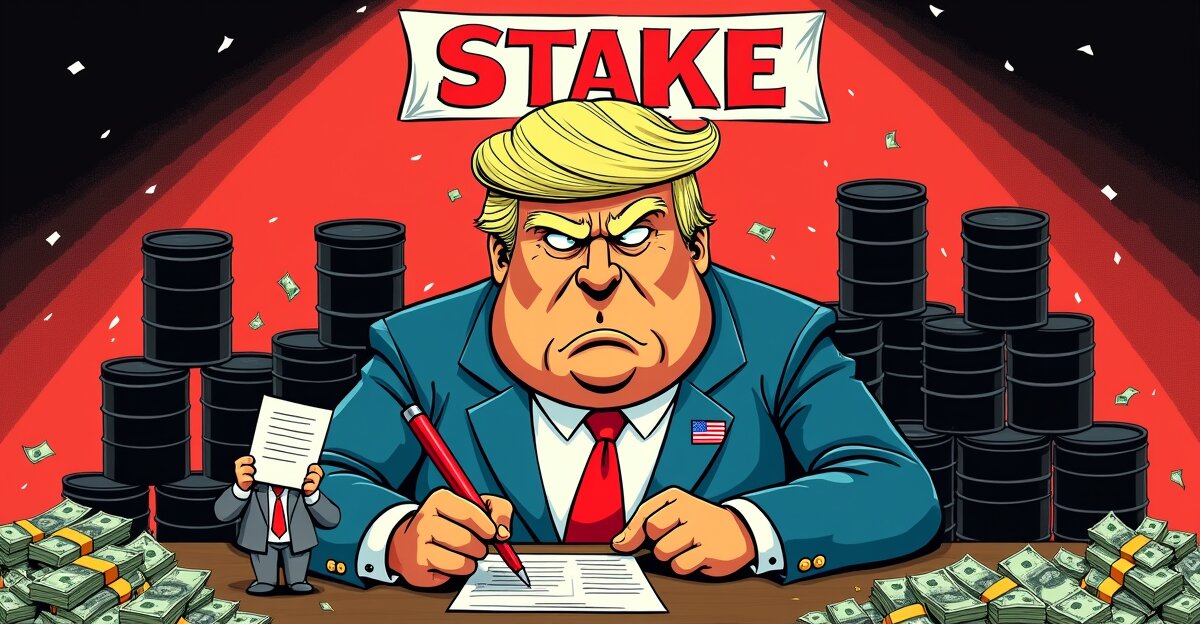
The White House sold the biggest oil deal in world history. The fine print was drafted so that nobody can undo it but the people who made it.
"THE BIGGEST OIL DEAL IN WORLD HISTORY!"
— President Donald Trump, Truth Social, August 28, 2026
On the night of August 28, President Donald Trump posted the sentence above, and for two days it was the only news that mattered in Washington. The White House fact sheet that followed read like a sales flyer: majority control of more than 65 billion barrels of Venezuelan oil, energy dominance for the next century, a 35% equity stake "at no cost to the American taxpayer," and the promise of "hundreds of billions" in value and dividends. Two days later, Secretary of State Marco Rubio, Defense Secretary Pete Hegseth, and a 46-year-old Venezuelan oilman named Alejandro Betancourt signed an 18-page strategic partnership agreement.
For two months, the full text was one of D.C.'s most sought-after secrets. This week ProPublica obtained a copy. The gap between the sales flyer and the contract is roughly the distance between a promise and a private estate plan.
The fact sheet's headline number is a century. The contract says 50 years. American purchase rights expire at half the timeframe Trump advertised, and the underlying 100-year concession granted to Betancourt's firm, North American Blue Energy Partners (NABEP), appears to violate Venezuelan law, which caps concessions at 25 years.
The structural trick is more interesting than the date error. The United States is not investing in a Venezuelan government program. It is buying 35% of a parent company registered in Barbados, and the document does not identify the other shareholders. Barbados corporate law provides almost no mechanism to force that disclosure. The government will pay $0.01 per warrant share, nothing up front, and the option stays alive for 75 years. A seven-member board will run the venture for an initial 15-year term: a majority must be U.S. citizens, the government gets one non-voting observer seat, and the only director named anywhere in the document is Betancourt, who is also locked in as chief executive. No Venezuelan government seat is required. Ousting Betancourt, changing the board, or transacting with any shareholder's "immediate family members" requires a five-vote supermajority.
Plainly: the deal was designed to outlive every future president who might want to unwind it.
One person familiar with the negotiations told ProPublica that "the governing structure was intended to ensure maximum control by the people making the deal and to insulate them from future administrations seeking to reverse the agreement or call it into question."
The economics have the same shape. Trump's pitch is cheap oil: the U.S. may buy 20% of NABEP's production at $30 a barrel, less than a third of recent market prices. But much of Venezuela's crude is so heavy it cannot flow through a pipeline without first being blended with 20% or more of thinner products, and the contract does not assign the cost of importing those blending materials to anyone. The White House also touts an estimated $200 billion in royalties and taxes that will flow back to Venezuela; the document lists that number as expected, not guaranteed.
The scale is modest, too. NABEP currently produces about 200,000 barrels a day, roughly what the United States burns in three days. The plan is 500,000 by the end of 2028. Beyond the discount, the U.S. gets "first priority" on the company's remaining output for 50 years, an irrevocable right to buy its entire supply in a national emergency, and "most favored nation" status that forces NABEP to match any better terms it grants anyone else.
The U.S. is buying a discount on a price that is not actually a discount.
Then there is the question former ambassadors keep circling: who is Alejandro Betancourt? By his own account and his lawyers', he is a self-made billionaire and Venezuela's second-largest private oil producer. He is also, by the accounts of ProPublica, Reuters, The Washington Post, and El País, a man who has faced money-laundering investigations in three countries: a suspect in the major U.S. probe known as Operation Money Flight, the subject of a Spanish investigation, and the target of a Swiss extradition request that left him confined to his 300-acre Oxfordshire estate, his Venezuelan and Italian passports locked down, and his British driving privileges suspended. He could fly to his $46 million London residence by helicopter.
The Washington Post reported that senior officials, including Deputy Secretary of State Christopher Landau, former Attorney General Pam Bondi, and then-Deputy Attorney General Todd Blanche, petitioned foreign counterparts to let Betancourt travel and close the investigations. Reuters reported that Betancourt provided information that helped U.S. forces seize Venezuelan oil tankers and fed the planning before the January capture of Nicolás Maduro. María Corina Machado, the leading opposition figure in exile, told the New York Times he had been involved in "obscene corruption."
The man who could not fly out of England over a Swiss warrant is now the designated steward of 65 billion barrels.
On August 5, before the deal was public, Betancourt walked into an auxiliary Pentagon office in the old Greyhound Bus Terminal in downtown Washington, where officials lined up to shake his hand. He was accompanied by the chief executive of Erebor Bank, the first new bank chartered since Trump returned to office, backed by Peter Thiel and Palmer Luckey. By the time the deal was public, the majors were out: one person familiar with the process said NABEP "was given priority" while Exxon, Conoco and the rest "were treated as second class." A former State Department analyst offered a practical justification: "The main thing I found promising is that the fields are producing." And one person close to the deliberations noted the advantage a publicly traded firm could never offer: "For example, Chevron couldn't give 35% of their shares to the Pentagon."
The contract also decides in advance who gets to argue. Any dispute between the company and the United States must be settled under U.S. law, and the document specifies that civil cases and arbitration go before the U.S. District Court for the Northern District of Texas, where, as the New York Times has documented, the Trump Justice Department has repeatedly found favorable rulings. Where federal law does not reach, Texas state law applies. Venezuela cannot challenge the deal in its own courts.
The document is stamped "sensitive," a designation used to shield everything from personnel records to active law-enforcement operations, and it bars Betancourt's company from disclosing the "existence and terms" of the agreement. In late September, Senate Democrats wrote to Rubio, Hegseth, and Energy Secretary Chris Wright demanding to know why the public should back "a relatively unknown foreign oil company that lacks the capacity or credibility to develop oil fields of the magnitude described" and whose leadership "has faced international criminal investigations." They estimated it could take "up to a decade" before Americans see any tangible benefit. Democrats on the Senate Armed Services Committee went further, saying they believe the Pentagon office executing the transaction lacks the legal authority to contract with a foreign entity operating in a country under U.S. sanctions.
When in doubt, the contract sends the argument to Texas.
The administration's answer: the benefits cannot be captured in a legal document. "This historic deal marks a major step toward stabilizing Venezuela's economy," said White House spokesperson Taylor Rogers. NABEP's spokesperson, Terry Wade, noted that much of the company's crude comes from fields needing little or no blending, and that "our barrel economics are strong." Interim President Delcy Rodríguez, the Venezuelan leader Trump backs, called the accord "historic" and insisted the country keeps sovereignty over its resources.
But the contract reads as though its authors already did the math on who pays. One person who reviewed parts of the document summarized Venezuela's side of the bargain: "I gave you 20% of my production at 'cost plus,' fine. I gave you all of my production if there's a national emergency, OK. ... So what do I get in exchange?"
Former Ambassador James Story, who ran the U.S. embassy in Caracas from 2018 to 2023, supplied the question the next Congress will start with. "Question number one in a new U.S. Congress will be: Why Betancourt?" he told ProPublica. "Why did he get this deal? And was he involved in criminality? It seems reasonable to have a congressional hearing about those questions."
Trump is selling a century of energy dominance. The document he signed reads more like a will: a 75-year option, a 50-year priority, a board no foreign government can sit on, and a lockout clause on every future administration. The question is no longer whether anyone will ask why Betancourt. It is whether anyone will be free to unwind what he was given.
Comments (0)
No comments yet. Be the first to speak up.
Join the Riot
Login with Google to leave a comment.
Login to Comment