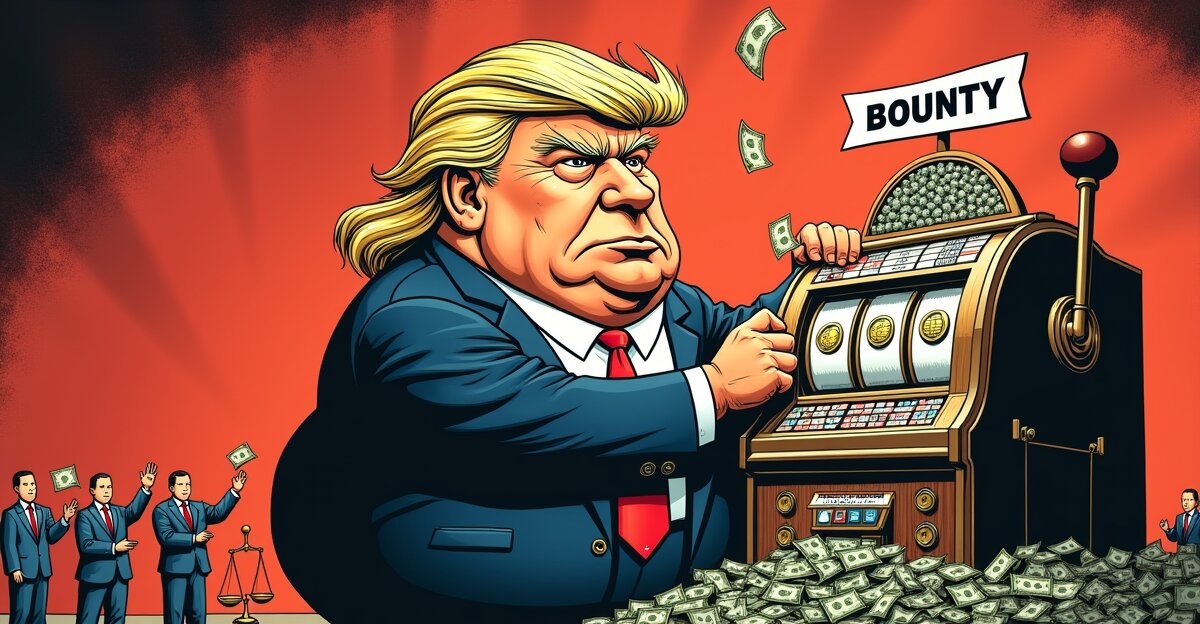
The president most widely considered corrupt in American history has launched a $25 million bounty program to catch fraudsters, and he has appointed himself the judge.
"I'd like to report a theft. A man inside our government illegally spent nearly $22 million in taxpayer dollars on bogus campaign ads praising himself. He now resides on 1600 Pennsylvania Avenue."
— Senator Bernie Sanders (I-VT)
On Tuesday, the Justice Department and its new National Fraud Enforcement Division unveiled the Fraud Whistleblower Incentive Program, which the department has lovingly nicknamed WHIP. The details, straight from the press release, read like a parody of the administration: the Treasury Department is committing $25 million, tipsters whose information leads to criminal charges will receive awards of $10,000 to $30,000, reports go to a dedicated government website, and payments are made up front rather than after the case finally winds through the courts. Attorney General Todd Blanche pledged that "protecting the American people from fraud remains a top priority for the Department of Justice" and "urged all Americans to use this program and play an active role in bringing fraudsters to justice."
The program covers federal health care offenses and fraud on benefit programs run by eight agencies, including the Departments of Agriculture, Labor, Health and Human Services, Housing and Urban Development, Education, Veterans Affairs, War, and the Small Business Administration. It was announced nineteen days after the division's own internal directive ordered staff to design whistleblower incentive programs. That speed is worth pausing on. The bounty machine was not built to fill a gap. It was already built, and it was waiting for a Tuesday.
The fastest way to understand the program is to look at who runs it. When reporters pressed the president on the structure of the new payouts, Trump said he would "be the arbitrator" of who gets rewarded. And the first reward has already been handed out, to far-right YouTuber Nick Shirley, whose viral video about Minnesota childcare facilities the administration seized on as a pretext to cut off funding to the states. Shirley accepted the cash at the White House and told the press that "there's never been an incentive for anyone to ever expose fraud."
Translation: the most famous fraudster in America now runs the anti-fraud hotline, and the first prize went to a man whose video served as the excuse for slashing state benefits.
The $22 million in bogus ads Sanders is pointing at is not a rumor. An NPR analysis found that nearly $22 million in taxpayer dollars has been spent airing a run of federal television spots praising the president, and the ads kept running even after a judge ordered the campaign to stop. The New York Times reported that Trump personally instructed his budget director to use taxpayer money for the spots. Critics and members of Congress called the campaign unlawful. The ads did not stop because the law said so. They stopped when the money ran out.
So the setup is this. The same government that illegally spent nearly $22 million of your money on a commercial praising the man who spends it is now offering $30,000 to anyone who reports fraud. The hotline is a line that reaches in every direction except the one that matters.
The perfect working example of the new tipline in action was published the same day as the WHIP announcement. The New York Times reported that the family of Julio Herrera Velutini, a Venezuelan banking billionaire, hired Alina Habba, the president's former personal lawyer, to become general counsel of Concord Partners, a mysterious Florida company his daughter created in October 2025. The deal: $10 million a year for four years, plus bonuses, a package reported at more than $50 million. Even people familiar with the Herrera family's sprawling business interests were apparently unsure what Concord Partners actually does.
The timing is the story. Habba signed within days of the company's formation, while still serving as acting United States attorney for the District of New Jersey. When a court ruled her appointment to that post unlawful, she kept a senior advisory role at the Justice Department and an office inside the building. She formally joined Concord Partners on January 1. On January 15, two weeks later, Trump granted Herrera Velutini a full and unconditional pardon, erasing a conviction he had pleaded to after originally facing federal bribery charges over a scheme to pressure Puerto Rico's governor into removing a financial regulator who was investigating his bank. Five days after that, the White House issued an amended clemency order specifically covering his offense.
For context, the sequence began when Herrera's daughter donated $3.5 million to a Trump-aligned super PAC, followed by the decision to put the president's own former lawyer on one of the largest salaries in the legal world. The pardon came shortly after.
Everyone involved denies any connection. Habba told the Times her outside work was "vetted and disclosed to the DOJ" and called any suggestion that it secured a pardon "false and defamatory." The Justice Department told the newspaper that Habba never discussed clemency with anyone there. The White House said she played no part in the president's decision and that the administration followed protocol. Protocol, it should be noted, is a word for a process. What is on the record is a Justice Department office, a $50 million contract with the family of a man seeking a pardon, a pardon, and then a fix to the pardon.
Naomi Seligman, president of the advocacy group Whistleblower Aid, made the case better than most. "If the president is truly interested in rooting out wrongdoing," she said, "Whistleblower Aid invites him to start by examining the violations perpetrated by his own administration, including senior officials." Sam Stein of Bulwark took a simpler route: "Someone should send this to the new Trump fraud tipline."
Translation: the first test of the program is not a billing scheme in some distant county. It is already sitting in a file.
What the program actually pays for is narrower than the press conference suggested. The covered areas are health care fraud and benefit-program fraud across eight agencies, with priority given to hospice, home health care, day care, and special services fraud. Those are real problems, and the people getting hurt by them are real people. The issue is not that the money should exist. The issue is who holds the purse, who owns the phone line, and who declared himself the final authority on whether a tip is worth the bounty.
A fraud-fighting program is only as credible as the people it can point at. In a normal government, that sentence is an abstraction. In this one, it is the entire operating model. The whole-of-government Task Force to Eliminate Fraud is chaired by Vice President Vance, the Fraud Division launched in April, and now the public can call in tips for a chance at a fast check while the president, the "arbiter," decides which fraud is fraud.
The hotline is open. The first prize has been paid. The list of eligible tipsters is theoretically unlimited, which is why the first eligible tip matters. According to the president's own spending, the reporting of The New York Times, and the words of a senator who would like to report a theft, the case file already exists. It is about a man on Pennsylvania Avenue, the payout is $22 million plus interest, and the judge has already recused himself from everyone but himself.
The president most widely considered corrupt in American history launched an anti-fraud hotline and appointed himself the judge. The only question left is whether anyone is brave enough, or foolish enough, to pick up the phone.
Comments (0)
No comments yet. Be the first to speak up.
Join the Riot
Login with Google to leave a comment.
Login to Comment