
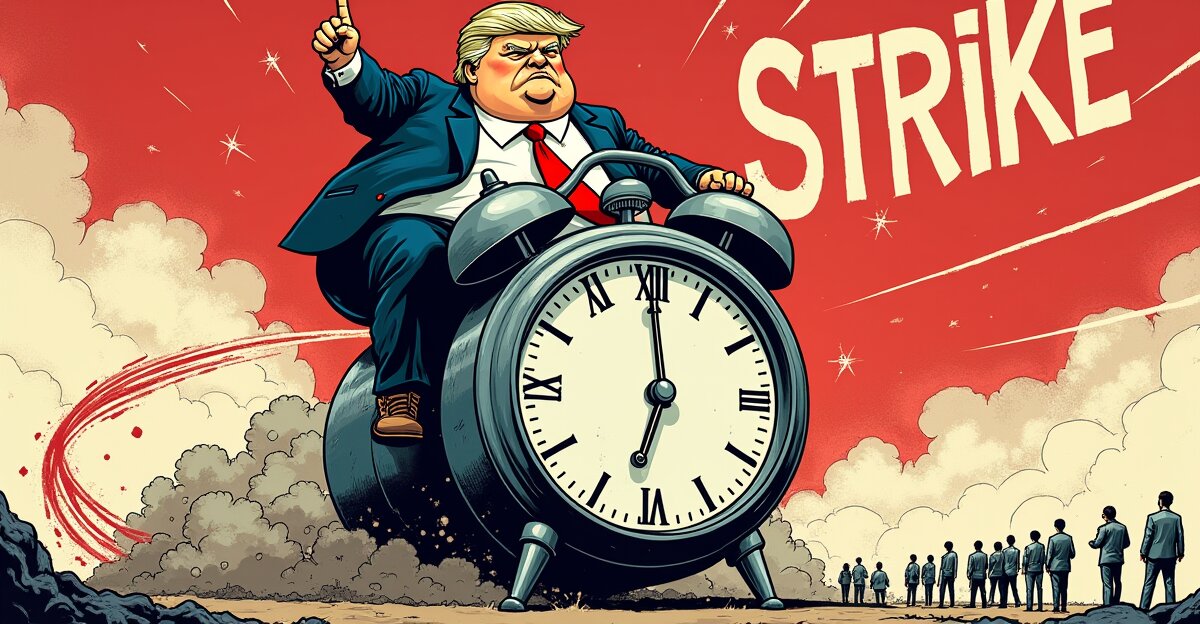
The most powerful government on Earth has agreed to a ceasefire with an expiration date, and the date is your election.
"Hunting season is open as soon as the elections end and it's obvious that they're not going to wait long."
— One Israeli source, speaking with ABC News about plans to resume the war in Iran
The White House gave the American people a rare gift on Thursday: a promise. "The United States will not be attacking Iran at any time prior to the midterm elections," White House spokesperson Anna Kelly told ABC News. Read plainly, that is a ceasefire. No bombs before November 3. A quiet stretch before the biggest midterms in eight years.
But do not call it peace. According to the New York Times, which first reported the planning, and to NPR, the Israeli Defense Forces and the U.S. military have drawn up plans to renew joint strikes on Iran in early November, immediately after the midterms. The pause is real. The restart is real too. What the pause is for is the story.
A war with Iran is now being scheduled around a congressional election. That is the headline. Everything else is context.
The timing details are almost funny, if they were not also alarming. Israel wanted to resume the major operations in mid-October, just before its own parliamentary elections, according to NPR. President Trump reportedly rejected the idea and opted to wait until next month. Israeli sources told ABC News the strikes would "almost certainly" take place after the U.S. midterms, citing the president's reluctance to further destabilize oil markets in the final days of the campaign.
The decision, both sources said, is "only for Trump to decide." Prime Minister Benjamin Netanyahu is firmly in favor of renewed action, and one source summed up the whole enterprise in two parts: the Israeli government's top goal is regime change, not a negotiated deal, and "the only question is the timing."
Translation: the bombs were not being held out of mercy for the people of Iran, or the people of the United States. They were being held for the oil market, and the oil market was being held for the election.
While Washington waits out the calendar, the machinery runs. Defense Secretary Pete Hegseth made an unannounced visit to Israel earlier this week, where new intelligence was shared between the two sides. The U.S. military has been repositioning personnel at bases across the Middle East, and one source familiar with the moves told ABC News it resembles the quiet shuffling that happened before the war started in February. The State Department ordered non-essential personnel and their families out of Saudi Arabia, citing the Houthi threat after the Houthis struck King Khalid Airport in Riyadh on October 8.
And on Monday, dozens of Israeli fighter jets and refueling tankers flew over Syria and Iraq all the way to the Iranian border, a "power projection" operation in which the aircraft turned around and flew home. Some U.S. sources told Axios they "had the impression that Israel was hoping the Iranians would fire at the aircraft, providing a justification for launching strikes against Iran."
The pause is on the strikes, not on the strategy. The jets are already flying; only the launch button is on a schedule.
What the new strikes are supposed to accomplish is described in the reporting in language that reads less like a war plan and more like an economic threat. The goal, the Times reported, is to push Iran to the brink of economic collapse and force huge concessions in later negotiations. Targets could include missile and drone arsenals, the petrochemical facilities that are crucial to Iran's oil industry, and nuclear sites such as the one at Pickaxe Mountain.
The line on civilian infrastructure is the part that should keep lawyers up at night. The Times reported that power plants could be among the targets. Deliberately targeting civilian infrastructure is largely considered a war crime. One Israeli source told ABC there are no plans to strike civilian infrastructure like power plants. Which version is true is precisely the question a war crimes tribunal asks later, when the people who assured the other side are the people on trial.
Even a former Biden administration Middle East official could not find a strategy in the plan. "At this point in the war, what is clear is that the conventional military campaign waged to date, and the current punishing economic sanctions and American naval blockade, have not brought the regime back to the negotiating table in a meaningful way," Dana Stroul told the Times. Neither Trump nor Netanyahu, she added, "has made a compelling case for how more war would change this strategic dilemma."
Set that against the man's own words and the picture completes itself. The war began on the last day of February, when the United States and Israel attacked Iran, killing Supreme Leader Ali Khamenei. In March, Trump predicted the war would be over in "four weeks." In September, in a 75-minute Time interview, he said it was "possible" he would "annihilate" Iran. Asked about his own earlier words, he replied: "Yeah, I would do that. It's possible."
In March, the war was four weeks. By October, it was a pending "big decision" about the fate of a country, waiting on a calendar.
The voters have spoken about all of this, in the only way they can before November 3: in polls. A survey by the Associated Press and NORC, published in early October, found that 68 percent of voters say the next Congress should make ending the war with Iran one of its highest priorities, and another 24 percent say it should be a priority at all. An Economist and YouGov poll of 1,403 registered voters, conducted October 10 through 12, found that 56 percent call the decision to go to war the wrong decision, against 29 percent who call it right. Fifty-three percent say the war is hurting the U.S. economy "a great deal," and a combined 58 percent reject the president's framing that the cost is "a small price to pay for keeping the world safe."
And then there was the most remarkable question of the cycle. Asked whether they think President Trump will resume bombing of Iran after the election in November, 60 percent of registered voters said yes.
That 60 percent is the number to circle. It is a prediction Americans are making about their own government, and the reporting suggests they are right.
On Wednesday, asked about negotiations, Trump first said talks are going on "a little bit," then, moments later, said "I think we're not negotiating." He added: "We are going to have something one way or the other that'll happen fairly soon." And, of course: "Most people seem to think it's after the election, and we're going to see what happens."
Across the water, Tehran is reading the same calendar. Reuters, citing Iranian officials this week, reported that Iran is "preparing for renewed Israeli and US attacks, not for a deal." Everyone is waiting for November 3. The only people for whom the pause actually stops the war are the ones in the poll, and they do not get to vote.
So the question is not whether the war will resume. It will. The question is what the pause was for, and the answer is already on the record. The ceasefire was not for the people of Iran, and it was not for the people of the United States. It was for the calendar. The most powerful government on Earth agreed to a ceasefire with an expiration date, and the date is your election.
Comments (0)
No comments yet. Be the first to speak up.
Join the Riot
Login with Google to leave a comment.
Login to Comment