
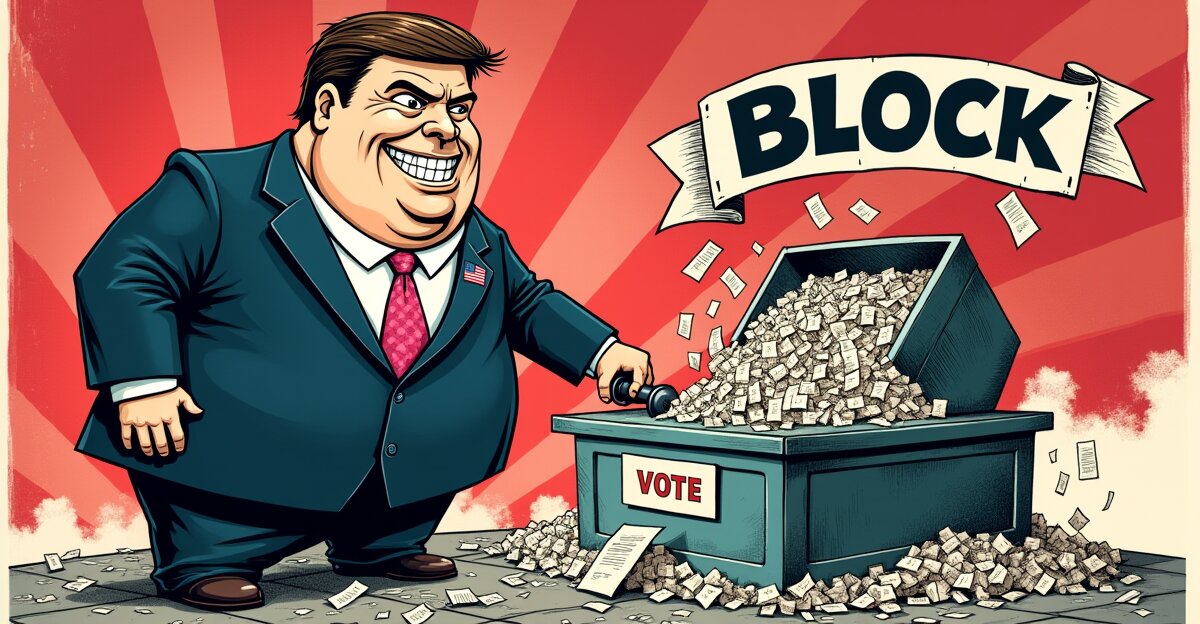
The attorney general of the United States has told the country that the Justice Department is ready to break the November elections, should the count come out wrong.
"Of course there are scenarios that we could all come up with hypothetically, some doomsday scenario, for example."
— Attorney General Todd Blanche, to reporters on October 22, asked whether the DOJ might block a state from certifying its election results
On Thursday, in a week when the Department of Justice is supposed to be about as neutral an institution as American politics has left, its head answered a reporter's question the way a burglar answers "do you ever break into houses": he refused to rule it out.
Asked whether the department might try to stop a state from certifying its November results, Blanche said that "of course there are scenarios that we could all come up with hypothetically, some doomsday scenario, for example," in which the DOJ might need to intervene. "I don't think it's proper to make any kind of conclusory statements about what's going to happen in the future because I have no idea what's going to happen in the future," he continued. "It is not DOJ's intention, and it's never our intention, to improperly interfere with elections or the state certification process, but to say that there's no circumstances that we would ever do that, of course I'm not going to say that."
Then, for good measure: "But am I planning my days around the election to be somewhere to not certify? Of course not."
Blanche, who served as President Trump's personal attorney before leading the Justice Department, spent the week before that making clear how he understands his own job. On the New York Post's Miranda Devine podcast on Wednesday, he dismissed the "misperception" of DOJ independence and declared, flatly, "I work for President Trump."
Translation: the department that is supposed to referee American elections has told the American people it is prepared to break one.
The hypothetical did not stay hypothetical. The same day Blanche was fielding questions, the department filed a lawsuit against the state of Alaska and its elections officials, effectively suing a November election that has not happened yet.
The premise is almost too strange to summarize. Alaska's Senate ballot carries four names, two of them Dan Sullivan. Incumbent Republican Senator Dan S. Sullivan faces Democrat Mary Peltola, Republican Gerald Heikes, and a minor candidate out of Petersburg, Dan J. Sullivan. Alaska uses ranked choice voting in its general election, and the state has already tried to prevent the obvious mix-up: the two Sullivans are differentiated by middle initial on the ballot, and the senator is marked as the registered Republican incumbent.
None of that matters to the administration. "The sole purpose of [Dan J. Sullivan's] candidacy is to benefit the Peltola campaign by reducing the number of votes for Senator Sullivan," the federal government alleges. Its theory of the case: if the senator loses to Peltola but would have won had every vote cast for Dan J. Sullivan instead gone to him, the result is tainted by "voter confusion" in violation of the National Voter Registration Act.
The remedy the DOJ asks U.S. District Judge Sharon L. Gleason to grant is the kicker. The department wants a court order stopping Alaska from "certifying any result that may be impacted by voter confusion," pending a federal investigation into whether voters who meant to pick the senator accidentally picked the other Dan Sullivan.
The votes in that race will not be cast for eleven days. The Justice Department has already decided what it will do if it loses, and it has asked a federal court to hold a November election in escrow until it is satisfied with the result.
Alaska is not an isolated experiment. It is the newest front in a campaign that has been running for months, built on a premise the numbers refuse to support: that noncitizens are voting in meaningful numbers.
The DOJ has sued California to keep ballots from more than 20,000 registered voters from being counted, on the largely unsubstantiated theory that the voters are noncitizens. Armed agents from Homeland Security Investigations have been going door to door in California and other states, questioning residents about their citizenship and voting histories. On Wednesday, a federal court ruled that the operation likely violates the Voting Rights Act's prohibition on voter intimidation and put a stop to it. In the words of one voting rights advocate, the department "built its lists on bad data, never checked how often it was wrong, and recklessly sent agents to people's homes weeks before an election."
The backdrop is a long one. In January, FBI agents seized 2020 ballots and records from a Georgia voting hub in an attempt to manufacture legitimacy for fraud claims that had already been investigated and found wanting. The president has threatened to "nationalize" the election against federal law. And Blanche and Homeland Security Secretary Markwayne Mullin have declined to rule out placing immigration agents at polling places, notwithstanding a federal law that bans "troops or armed men" from the vicinity of places where elections are being held.
The doomsday scenario the attorney general describes does not require a collapse of the electoral system. It requires only that a majority of Americans vote, and that their party loses.
The response from election law experts has been uniform and flat.
Lauren Miller Karalunas, senior counsel for democracy at the Brennan Center for Justice, emphasized Friday that "the state certification process is just that, a state process. There is no role for the federal government to play that's not inherently improper." She added that state certification processes were, in her words, "created to meet this moment," because centuries ago, state legislatures "recognized that bad actors could use the process to manipulate election outcomes," and they "built in safeguards specifically designed to stop that from happening."
Max Flugrath, communications director for Fair Fight Action, said Blanche's remarks were unprecedented. "I don't know of another U.S. attorney general who has publicly entertained using the DOJ to block states from certifying an election," he said.
The irony is worth sitting with. The federal government is suing to intervene in the very procedure that the states designed, generations ago, to keep bad actors out of their own election outcomes. The guardrail the department is now asking a court to saw through is the one the system already built.
Senate Democrats are not buying it. Senator Chuck Schumer answered that Democrats "have been preparing" for potential "election shenanigans" by the Trump administration "for months, and will be ready for whatever they try." "As Trump and his cronies attempt to steal this election, we are fighting them at every turn," he wrote.
Senator Brian Schatz of Hawaii, on CNN, put the defensive playbook on the record: "We've got litigators ready... we've got organizers ready in case things get difficult... and so we're not going to have a failure of imagination in terms of what people are capable of in terms of overturning an election." He added the part of the strategy aimed at the actual voters: "Part of the game here is that people are desirous of making voters feel like their vote won't count," and the answer is to "get out there and vote in large enough numbers that these little marginal moves that they could or may or may not make won't work."
The election is November 3.
Blanche keeps calling the possibility of intervention a "doomsday scenario," as if the word were a shield rather than a confession. But doomsday, strictly defined, is an end state: the point after which the count is final and the country has to live with it. Everything the department has done this week, from the Devine podcast to the Alaska complaint to the court order that had to be unmade, suggests the scenario the Justice Department is most afraid of is not a breakdown of the system at all. It is the system working, producing a result the president dislikes, and holding.
The question is not whether the Justice Department can be trusted to referee an election. The question is why anyone is surprised that the referee has already picked a winner.
Comments (0)
No comments yet. Be the first to speak up.
Join the Riot
Login with Google to leave a comment.
Login to Comment