The floor of American politics keeps dropping, and this week the president put his name on it.
"It's not easy for a mother to say this, but Amy has a serious problem. She is a liar. She lies about her past."
— Donna Arthur, from a one-minute attack ad produced by the Ramaswamy campaign, Ohio 2026
On Monday night, October 19, a one-minute video with no paid-for disclosure started circulating in the feeds of Ohio political bloggers. Donna Arthur, Amy Acton's estranged mother, looked into the camera and did the thing mothers don't do: she weaponized her own estrangement. Her daughter, she told Ohio voters, has a serious problem. She lies about her past. Don't vote for her.
The video spread because the internet rewards cruelty with reach. By Tuesday, the campaign of Vivek Ramaswamy, the 41-year-old former biotech executive running for Ohio governor with Donald Trump's endorsement, confirmed the ad was theirs. The campaign also announced plans to spend $4 million making sure it kept spreading, and it offered one mitigating detail by way of a fine print: the woman in the ad was not paid.
The fine print is the part that should worry you. The mother was free. The price was somewhere else.
What the ad doesn't say, because a political ad can't say it and keep its hands clean, is why Donna Arthur and Amy Acton have not spoken in 48 years.
Amy Acton was 12 in 1978 when she was removed from her mother's home. Her stepfather, Cledith Arthur, had been charged with raping her. Court documents describe a series of assaults between December 1976 and April 1978. After her biological father reported them, Cledith Arthur was arrested in July 1978, pleaded not guilty, was indicted that September, and then disappeared before his trial ever took place. He was never tried. He died in 2004.
That is the version the ad never runs. It is also the version the paper trail supports. FactCheck.org pulled court records that tie Cledith Arthur to the same campground where Acton has always said her family lived, which directly undercuts the one factual claim Arthur makes in the ad: that Acton invented her own past.
Acton, 60, a physician and former director of the Ohio Department of Health, the state's public health agency, has never hidden her story. She is running for governor with it, in a way. Her brother, Philip Stearns, ran the answer ad this week. "I got a lot of abuse too, but Amy always got the worst of it," he said. "She kept taking it because she knew she had to protect me."
Translation: the ad doesn't reveal a secret. It reopens a case file the country already closed.
The defense was quick, and so was the split.
Ramaswamy told reporters at a campaign stop that the ad "had nothing to do with childhood abuse," which is a sentence that only works if you already agreed not to think about it. Senator JD Vance, running in the same state on the same coattails, said he was "a little bit disgusted" that Republicans were "whining" more about the ad than about what congressional Democrats were trying to do to the country, and that Ramaswamy "had the nerve" to run it.
The people who should know better were less charmed. Governor Mike DeWine, who endorses Ramaswamy, called the ad "deeply, deeply troubling," urged the campaign to pull it, and then kept the endorsement. That is the Republican version of saying I disapprove of the murder but I still love the family. Senator Jon Husted said he would not have run the ad. Secretary of State Frank LaRose said he probably would not have run the ad. The pile-on from the other side was faster: Nikki Haley called Ramaswamy "a bad guy" and said "it's a shame he keeps getting away with it." Meghan McCain called the ad "dastardly." Former Senator Sherrod Brown called it "disgusting."
Even the audience the ad was built to impress found it off-putting. Casey Putsch, the YouTube provocateur Ramaswamy beat in the Republican primary, said the ad was "pretty damn low" and that he'd vote for Acton.
Here's where the story stops being about Ohio.
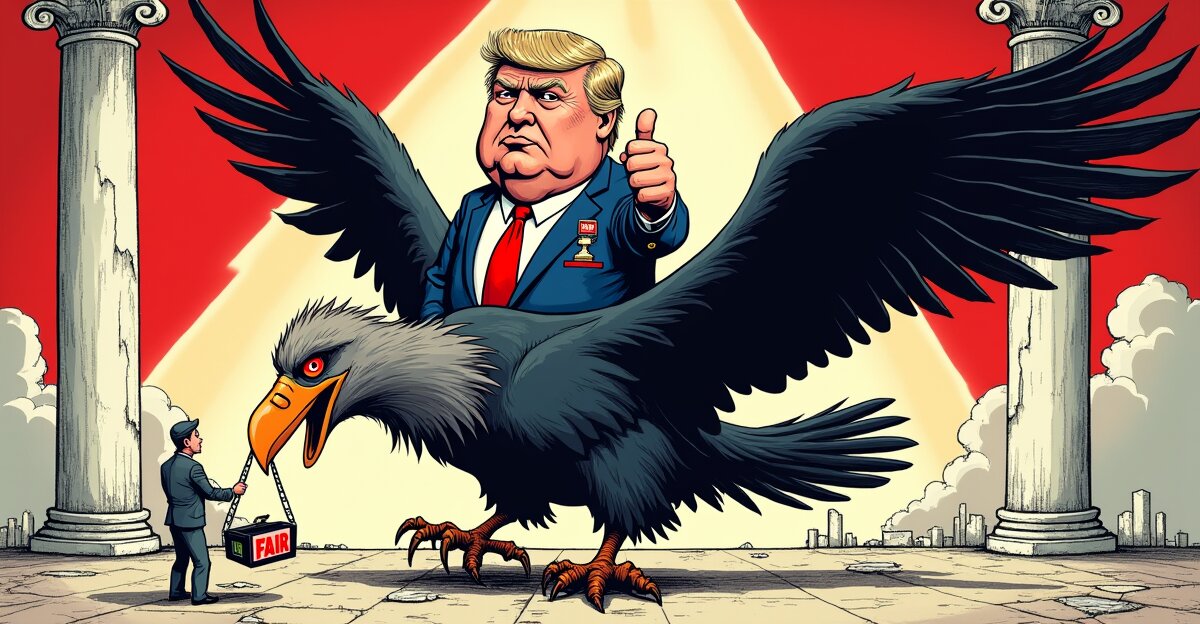
On Wednesday, asked about the ad, the president of the United States said he knew nothing about it. The mother, he said, had "gone completely rogue," and the whole thing had nothing to do with Vivek. A day later, at a rally, he said something different. He said Acton is "fair game." He called the ad "very powerful." He told Ramaswamy to keep running it.
Translation: the president who claimed ignorance on Wednesday is the one who named it on Thursday.
That's the move to understand. An Ohio ad becomes a national story the moment the man who runs the party stops pretending he didn't see it. Whatever the polling says, whatever the law says, whatever floor the party has left, an endorsement from that man is a permission structure. From now on, every attack ad in the country gets priced against his approval. And on this one, he approved.
Michael Wolff, who spent a decade inside this orbit, called the endorsement a "perverted Hail Mary pass." The Daily Beast's headline was blunter: Why Trump Will Pay the Price for MAGA's Most Disgusting Ad. The trap in the framing is that the president can no longer be detached from the ad. He didn't just support it. He named it. He rated it. He gave it a glowing review from the top of the building.
The numbers have started to answer.
Cook Political Report moved the Ohio governor's race from leans Republican to tossup, and then, on Friday, to leans Democrat for Acton. More than 676,000 Ohioans had already cast early ballots, which means the ad landed in an electorate that wasn't a blank slate. It was a moving target that had already started voting. Billionaire Michael Pritzker sent $500,000 to Acton's campaign within days.
And on Saturday, quietly, the Ramaswamy campaign began rotating in a shorter 30-second version of the ad. A 60-second ad cut down to 30 seconds is not a creative decision. It is a campaign that heard the sound the ad was making and started turning the volume down.
One more number for the record: this is the first time in two decades a Democrat can win the Ohio governor's mansion. If Acton takes it on November 3, the streak ends in the middle of a scandal her opponent's president personally endorsed.
The floor of American politics has been dropping for a long time, and people keep insisting there is a floor. This week there were two of them: a candidate who found a way to spend $4 million on a 12-year-old's case file, and a president who looked at the file and said it was powerful.
The question is not whether the ad was vile. Everyone in Ohio knows it was. The question is who put his name on it.
Comments (0)
No comments yet. Be the first to speak up.
Join the Riot
Login with Google to leave a comment.
Login to Comment