
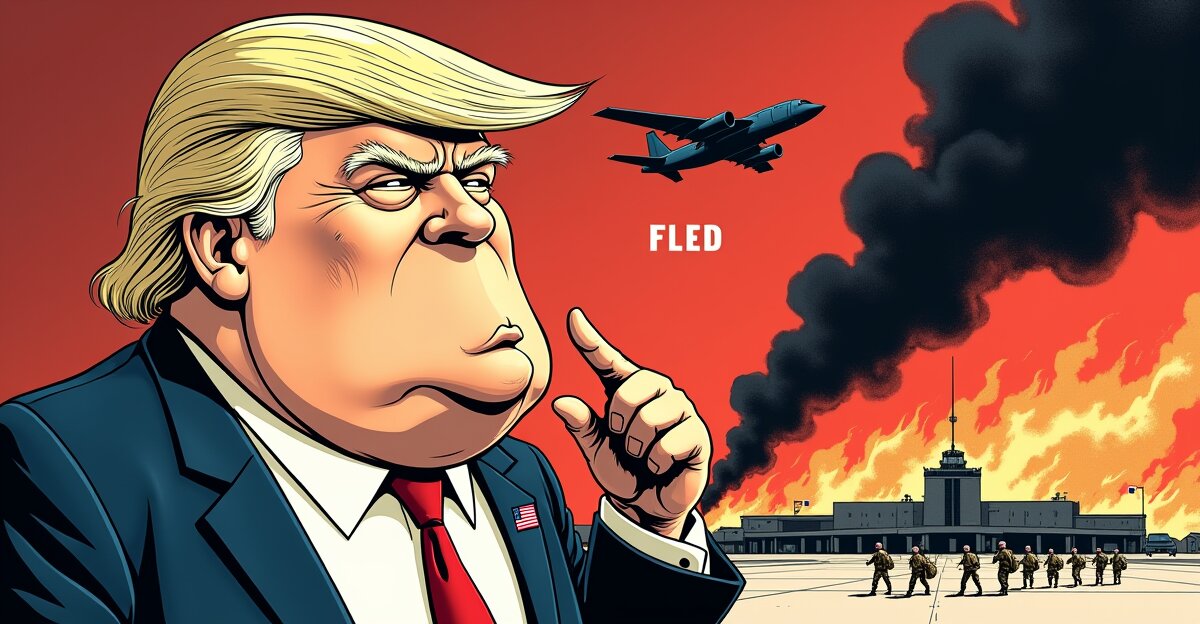
The United States has been winning this war so completely that its own long-range bombers packed up and left the country that was hosting them.
"I'm not concerned at all."
— Adm. Brad Cooper, CENTCOM commander, on CBS's "60 Minutes," on the state of the military's depleted interceptor stockpiles
In July, the Trump administration announced the end of the war with Iran. It was a particular kind of end, a rebrand. Operation Epic Fury, the bombing campaign that began on the last day of February, was "concluded," and the war that had come with it was rebranded into a quieter, less wounded thing.
Eight weeks after the declaration, the most powerful military on Earth could not keep its own bombers on the ground in Britain.
On Sunday, twelve B-1 long-range bombers parked at RAF Fairford, a base northwest of London, were flown home to the United States. The reason, according to a U.S. official, was a "sophisticated plot" to attack the base with "multiple drones," a plan the official suggested Iran's Islamic Revolutionary Guard Corps may have recruited British nationals to carry out. The Pentagon took the extraordinary step of removing the bombers rather than defending them.
President Trump, asked about it on Monday, said there "were some threats," and added that leaving the aircraft in place would only tempt a strike. Translation: the country that hosts the American bombers is now a country where the American bombers are not safe.
The evacuation of Fairford is not an outlier. It is the newest data point in a trend line the Pentagon has spent eight months trying to flatten. Since February 28, when the United States and Israel launched strikes on Iran, the official casualty count stands at 19 American troops killed and close to 880 more wounded or dead. The administration announced the war "over" on July 7. In the twelve weeks since that announcement, more American troops have been killed or wounded than in the entire eighteen weeks before it. Of the 880, 444 came after the war was "concluded."
September alone added nearly 100 more. Twenty-nine Navy sailors and eight Marines were entered into the official tally last week, after an Iranian cruise-missile attack in the Strait of Hormuz; the Marines, two U.S. officials said, may have suffered brain trauma.
The war that was over is the war.
The administration's description of the conflict has taken on a life of its own. The president calls it "small potatoes." The vice president says it is not a "war." The commerce secretary announced there "haven't been American deaths," adding that it is "really just an economic choke-out."
There have been American deaths. The Port of Shuaiba in Kuwait, hit by a drone on March 1, is where six U.S. troops died, the deadliest Iranian strike on American personnel of the war. Muwaffaq Salti Air Base in Jordan, struck in July, is where three more died. Erbil Air Base in Iraq is where a 30-year-old Army sergeant from Fayetteville, North Carolina, died last month "during a controlled detonation" of an Iranian attack drone. The Pentagon's list of the dead is still missing at least one of them, a New York National Guard signals officer the military claims was "part of another mission."
When The Washington Post reported that the Pentagon was suppressing the casualty numbers, the war secretary called the coverage "DISGUSTING and FAKE."
The inventory tells the same story in a different language. In the first sixteen days of the war, the United States and its allies burned through more than 11,000 munitions. Between February and July, roughly 65 percent of the country's Patriot interceptors were spent, leaving fewer than 830 of the 2,330 in the pre-war stockpile. THAAD interceptors fell from more than 450 to fewer than 270. Air Force personnel, according to the service's chief of staff, endured more than 1,200 "alarm reds," the official code for an imminent attack, in a single 38-day stretch. Explosive-ordnance-disposal technicians walked out onto the rubble more than 420 times.
The commander of the war, asked on camera about the depleted stockpiles, said: "I'm not concerned at all." CENTCOM did not answer the question of whether he would resign if the next strike killed a soldier.
The withdrawal from Iraq is the clearest picture of all. Last week, U.S. forces left the country, ending more than two decades of occupation. The Revolutionary Guard published a statement touting "the expulsion of America from Iraq." The Iraqi prime minister declared October 1 a "Day of Sovereignty and Independence." The country that hosted the longest of America's wars has now sent America home.
To the east, the Houthis have taken virtually all of Yemen's Red Sea coast, including the Bab el-Mandeb shipping lane. To the south, the Navy's Fifth Fleet headquarters in Bahrain was hit so hard in February that the acting navy secretary said they "blew the hell out of Bahrain," and a Wall Street Journal investigation pegs the rebuild at more than $400 million. The Navy now feeds its carrier groups from Diego Garcia, more than 2,000 miles away, on 14- to 18-day logistics cycles.
The war that was "concluded" has, in eight weeks, pushed the United States out of a country, out of an ally's air base, and out to the middle of the Indian Ocean.
And now it wants to go back. At a rally in Florida on Wednesday, President Trump said, "We may do another little Epic Fury," after claiming not to know about a possible strike on Iran. He had earlier promised no further military action before the midterms.
The word doing the work is "little." The war that killed six in Kuwait and three in Jordan and one in Erbil. The war that burned through 11,000 munitions in sixteen days. The war that got the bombers out of Britain. It is, per the man who is running it, little.
Iran is betting on exactly that. Its strategy, one U.S. official said, is "go for broke": it can absorb economic ruin longer than the United States can sustain a war this expensive and a blockade the fuel prices say is not working. The commander of Iran's army called this week for "any creative act capable of disrupting the enemy's calculations."
The enemy's calculations, at this point, consist of a man in a Florida arena saying "little," a commander saying "not concerned at all," and a fleet sailing 2,000 miles to resupply.
The war with Iran was declared over on July 7. Since then it has cost more American lives than the war it was meant to conclude. Its bombers have left Britain. Its ground forces have left Iraq. Its missiles are running out. And its president, a day before the midterms the pause was supposedly for, promised "another little" of it.
The most powerful military on Earth has spent eight months learning a lesson it has learned before, in other wars and other deserts: you can declare the war over. You cannot declare the war gone.
The bombers know this. They are already in the air, heading home.
Comments (0)
No comments yet. Be the first to speak up.
Join the Riot
Login with Google to leave a comment.
Login to Comment