
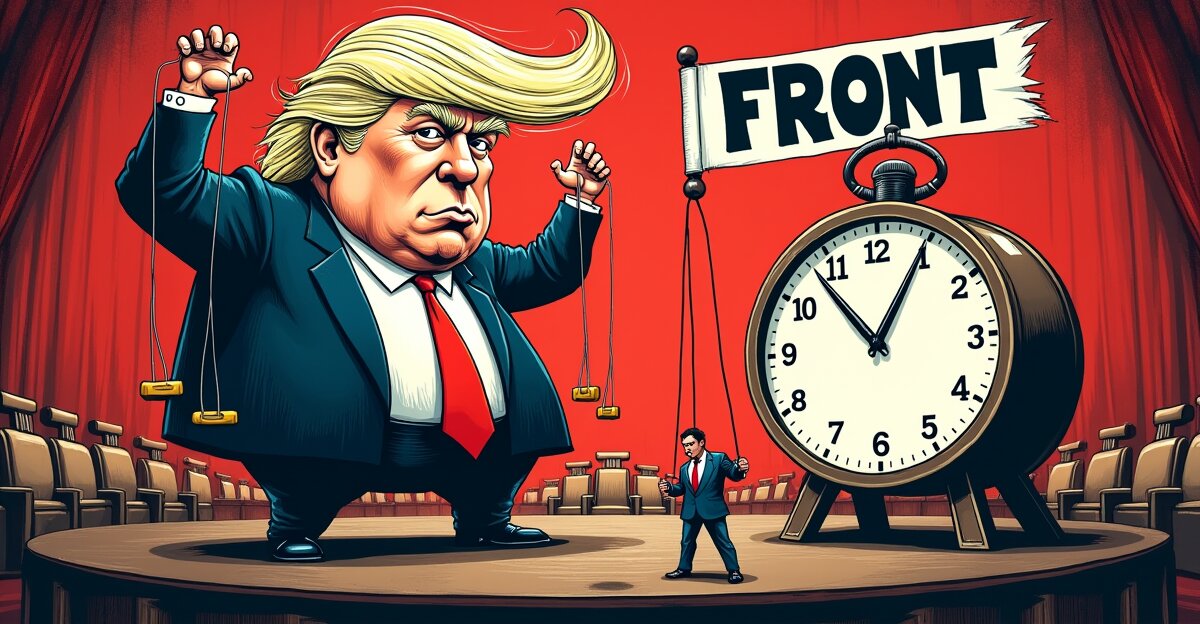
The president who started a war on a whim has now given it a calendar: November, after the votes are in.
"I think war is going to end immediately after the election because they can't hold out any longer. They're desperate to try and affect the election."
— President Donald Trump, Dallas, September 9, 2026
On a Wednesday in Dallas, President Donald Trump did what so many war-making presidents have done before him: he gave the war a schedule. Speaking at the kickoff of the Republican convention, he said he expected the war with Iran to end "immediately after the election," meaning after the November midterms decide whether his party keeps Congress. Not after Tehran gives up its nuclear ambitions. Not after the Strait of Hormuz is safe for tankers. After the polls close.
This is not the first deadline Trump has set for this war. He has set them before, the deadlines have come and gone, and the war has continued. It began on February 28, when U.S. and Israeli strikes on Iran started what the Pentagon calls Operation Epic Fury. It is now six months old, and according to the Wall Street Journal, senior White House advisers, including Vice President JD Vance and Secretary of State Marco Rubio, have privately warned Trump that the conflict could run through the rest of his presidency, to January 2029. That warning has not been made public. In public, the war has an election date.
The public seems to have noticed the switch. The war is broadly unpopular, and a growing share of Trump's own voters have soured on it, driven by fuel prices. His approval rating sits at record lows.
Translation: the war's end date is no longer a strategy. It is a focus group.
Meanwhile, the war has opened a new front that does not need a calendar to expand. On Thursday, Houthi forces captured Mocha, a key port city on Yemen's Red Sea coast. On Friday, they claimed Perim, a barren volcanic island inside the Bab el-Mandeb strait, one of the world's most critical shipping lanes. It is the rebels' largest territorial gain in years, and it puts them directly on Saudi Arabia's route to market for its crude.
The United Nations Security Council convened in an emergency session. The U.N. special envoy for Yemen, Hans Grundberg, told members the country has entered "a new and more dangerous phase." Washington calls the Houthis "agents and tools of Iran." Iran's Revolutionary Guard says any settlement with the United States must include Yemen. The Houthis vowed "escalation for escalation" and declared that "maritime navigation is safe for all companies except for Saudi vessels."
More than 46,000 Yemenis have fled in a single week, and the U.N. migration agency says the number has more than doubled and could climb sharply. "You see the fears in their eyes, and people are scared," the agency's chief for Yemen said.
The war the president scheduled has already outgrown the calendar.
There is an official price tag for this war, at least the part the Pentagon is willing to print. Since February 28, 776 U.S. troops have been killed or wounded: 18 dead and 758 injured, according to the Defense Casualty Analysis System. Roughly 345 of those casualties have come since a second ceasefire collapsed on July 7. Last week, the military disclosed an additional 60 wounded in a single update, a move one government official called "an accounting trick," accusing the Pentagon of "slow-walking" the total "after the really devastating attacks."
The numbers have problems of their own. The official wound count has actually shrunk in recent weeks: 500 on July 21, now 431. On April 21, the count dropped by 15 with no public acknowledgment. The military has quietly begun buying the trappings of a long war: mortuary contracts at Robins Air Force Base in Georgia, at Aviano Air Base in Italy, a key hub for the conflict, and at Fort Knox in Kentucky, where the remains of the war's first Kentucky death passed through.
The Iranian military that Trump and War Secretary Pete Hegseth repeatedly described as annihilated has struck roughly a dozen U.S. outposts across the Middle East since early July, overwhelming air defenses that were supposed to be impregnable. On the other side of the desert, the World Health Organization puts the Iranian toll at roughly 37,000 casualties, including 3,375 dead.
The only number the Pentagon has managed to shrink is the one counting its own wounded.
The war is also, as wars do, making people very rich. Brent crude is back above $100 a barrel. Only seven ships crossed the Strait of Hormuz on Wednesday, half the 10-day average, in a strait that carried about a fifth of the world's oil before the war. Bab el-Mandeb traffic is down roughly 60 percent since 2023.
ExxonMobil and Chevron together reported $26.5 billion in net income for the second quarter, a haul the Financial Times described as "cashing in on surging crude and petrol prices caused by Donald Trump's Iran war." A Guardian review found the world's top eight oil companies made more than $90 billion in the spring quarter, more than $700,000 of profit every minute. Treasury Secretary Scott Bessent has said on camera that he does not "understand" the oil price spike. ExxonMobil's CEO, Darren Woods, has collected more than $113 million in compensation since 2023. There are growing calls for a windfall tax on wartime profits that, one estimate says, would raise tens of billions and "deliver rebates of a few hundred dollars each to U.S. households."
The gas pump is the tax being collected now.
The war's only consistent winner files quarterly earnings reports.
The new front is also exposing the limits of the war. A senior Yemeni military official told the Associated Press that Riyadh was stunned its air force did nothing to stop the fall of Mocha, which sits just 50 miles from the strait. His assessment: Saudi Arabia "didn't get a green light from the U.S." to mount a large-scale air campaign. Iranian and Yemeni officials say Tehran pushed the Houthis to take the ports and strike the kingdom. The Saudis, for their part, bombed Mocha's airport, and their southwestern city of Khamis Mushait issued four emergency alerts in 24 hours after Houthi attacks wounded 73 people across four cities.
So here is the architecture of the week. The president sets the date. The Pentagon counts its wounded in numbers that move in both directions. The oil majors book the profits. The Houthis take the port. And the people who appear to know the war is not ending on schedule are two senior advisers who have said so privately and not once publicly.
The president sets the date. The allies set the limits. The clock sets neither.
Trump started this war with the confidence of a man who believed he had already won it. Six months in, with a new front on the Red Sea, a record-low approval rating, a war chest for Big Oil, and a casualty list the Pentagon is still "slow-walking," he has found something rarer than a victory: a deadline.
The question is not whether the war ends after the midterms. It is whether the midterms survive the war.
Comments (0)
No comments yet. Be the first to speak up.
Join the Riot
Login with Google to leave a comment.
Login to Comment