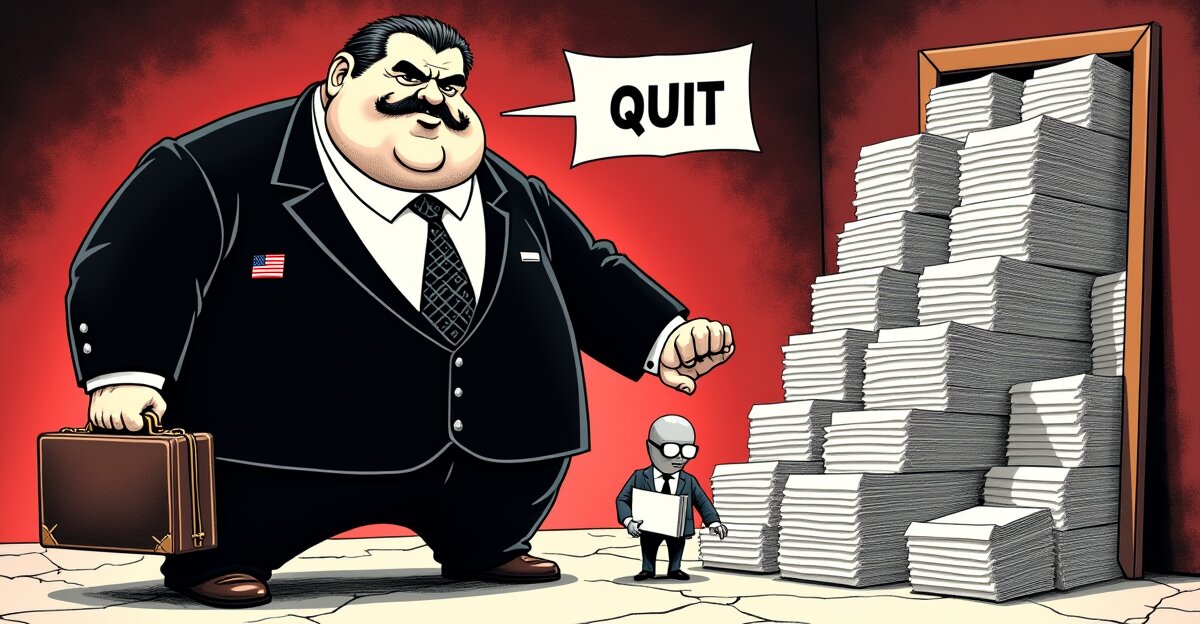
The White House installed its most devoted conspiracy theorist to turn the "witch hunt" against Donald Trump into a real criminal case, and five months later he walked out, leaving one line behind that explains the entire project.
"If you want indictments where there's no evidence, you have an ethical problem."
— Joe diGenova, to the New York Post, the day he resigned from the Justice Department
At 3 p.m. on Thursday, Joe diGenova sent a letter to Attorney General Todd Blanche and ended his time as the man in charge of the Justice Department's probe into the officials who investigated Donald Trump. "I did resign today by letter to the attorney general. I said that it was a privilege and an honor to serve the president and the department, and I was very grateful," diGenova told ABC News. "I'm not going to say anything further. I wish them well."
He had been running the probe, known inside the administration as the "grand conspiracy" investigation, for five months. In that time, no one was indicted. The Associated Press put the ledger plainly: a year in, no charges have been brought, and it "remains unclear whether any will be." NBC's summary was shorter. The prosecutor who led the grand conspiracy probe resigned without charging anyone.
Five months at the helm. Dozens of subpoenas. Zero charges.
The ending, according to people familiar with the matter, was not a quiet retirement. Sources described a man who had pitched himself to the president as the one who could speed up the investigation, then failed to produce it. The New York Post reported that diGenova had been "slow-rolling" potential indictments and getting lost down "rabbit holes," that he had been sharing "unrealistic expectations" with the White House about what the case could become, and that the friction had produced a confrontation with Blanche. Prosecutors sent down from the Justice Department's main office in Washington, the Post added, found themselves sidelined on arrival in Florida.
Asked whether he had lost focus, diGenova did not push back gently. "If you want indictments where there's no evidence, you have an ethical problem," he told the Post. When reached again by the Associated Press, he said the comments had been taken out of context, then added: "There's plenty of evidence in all of these cases to prove the theories of prosecution. It just takes time to get there, and some people want to get there a little faster than others. And you can't do that."
Translation: the people he worked for wanted a verdict. He kept insisting on a trial.
The probe he left behind was always a tall order, in the Associated Press's words. Its theory, as the White House has described it, is that the separate, unrelated investigations of the president over the past decade, the Russia interference assessment, the Mar-a-Lago documents search, the impeachments, the lost 2020 election, were in fact one criminal conspiracy by law enforcement and intelligence officials. Subpoenas have gone out to dozens of former officials, including former CIA Director John Brennan, former DNI James Clapper, and former FBI officials Peter Strzok and Lisa Page. This summer, CIA Director John Ratcliffe referred Brennan to the FBI for a criminal investigation after a House intelligence committee report accused Brennan and Clapper of an "atypical" and "markedly unconventional" role in drafting the 2016 intelligence assessment. Ratcliffe's summary of the matter: "This was Obama, Comey, Clapper and Brennan deciding 'We're going to screw Trump.'"
But the government's own record has not cooperated with the theory. The special counsel investigation found no criminal conspiracy between Moscow and the Trump campaign. The Justice Department inspector general found significant errors and omissions in the FBI's handling of the Russia probe, but no evidence of criminal conduct by senior officials. The probe's original sin is a conclusion in search of evidence.
The personnel record of the investigation is where the story actually lives. Last November, a federal judge dismissed the first attempt to indict former FBI Director James Comey and New York Attorney General Letitia James. In early April, Trump fired Attorney General Pam Bondi, and diGenova later told an interviewer that the president was "ripping mad about the fact that there was no progress on the lawfare investigation in Miami." Days later, a career assistant U.S. attorney handling the Brennan case was removed after resisting, CNN reported, "pressure to quickly bring charges." DiGenova was sworn in on April 20, and that same day, on a Baltimore radio show, said the president had "personally asked" him to take the job he called the "Russia hoax investigation."
A second indictment of Comey followed in late April, this time over a 2025 social media post the government characterizes as a threat to the president. By the end of May, the lead prosecutor in the case had withdrawn. In July, Comey asked a judge to dismiss the charges, alleging grand jury violations and, CBS News reported, "illegal electronic surveillance" of him by the Secret Service at the government's request. Brennan, for his part, sued the Justice Department to force it to preserve its own files, warning he would challenge any indictment on vindictive prosecution grounds.
The irony is not accidental. DiGenova was not hired to discover the conspiracy. He was hired because he had already written it. The 81-year-old former Reagan-era U.S. attorney for the District of Columbia spent the past decade as its most devoted preacher: a 2018 Hillsdale College speech treating the FBI as an instrument of Democratic treachery; calls for Chris Krebs, the cybersecurity director fired for refusing to bless the stolen election, to be "drawn and quartered, taken out at dawn and shot"; a demand, on the radio, that "people need to go to prison."
Lawfare's analysis last spring put the problem bluntly. The man appointed to prosecute the grand conspiracy was its biggest liability, because a decade of his public statements already stood in evidence of the exact kind of prosecutorial animus a defense lawyer needs to win a vindictive-prosecution dismissal. He had called Comey a "dirty cop." He had called Brennan a "traitor." He had been part of the 2019 Ukraine operation, the one that produced the first impeachment, meeting with Rudy Giuliani and his associates in a restaurant inside Trump Tower. He and his wife, Victoria Toensing, later represented the fugitive oligarch Dmitry Firtash, who told the New York Times he paid the pair $1.2 million.
The probe is not over. A special grand jury is still empaneled in Fort Pierce, Florida, and the targets keep suing, moving, and testifying. But the leadership vacuum is real, and the pattern of departures is not. The career prosecutor left. The attorney general left. Now the loyalist has left, and each departure has carried the same reason, stated or not: the evidence was not there.
Trump, for his part, has said nothing about the resignation.
The witch hunt that defined his presidency needed one ingredient the government could not manufacture: a crime. Subpoenas, firings, indictments, hearings, all of that can be produced. Evidence cannot. The man the administration finally sent to find it looked at the files and said what everyone in the building already knew. There is nothing to indict. And if there were, that would be the crime.
Comments (0)
No comments yet. Be the first to speak up.
Join the Riot
Login with Google to leave a comment.
Login to Comment