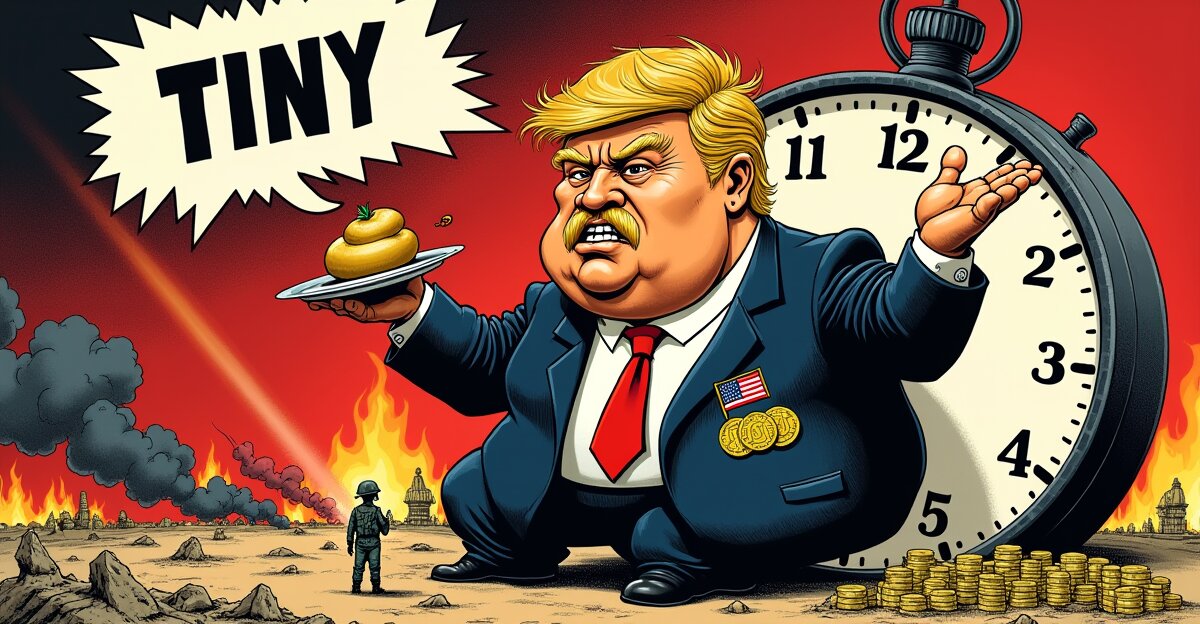
Six months into a war he said would last "four to five weeks," the man who started it is now describing it as "small potatoes."
"I call it a military conflict because it's small potatoes for us. It's not a big thing."
— President Donald Trump, Oval Office, September 4, 2026
The phrase does a lot of work. "Small potatoes" is the vocabulary of a parent who has just discovered the family dog has gotten into the kitchen trash. It is the register of a man who is trying very hard to talk the room out of a problem he does not want to name. And that is precisely why it landed the way it did: not as an observation, but as a confession.
Six months after the United States and Israel launched a war against Iran on February 28, the president of the United States stood in the Oval Office and told reporters that the conflict, which has cost taxpayers more than $37.5 billion and killed 18 service members, is not a big thing. He said U.S. strikes are now "intermittent." He said "a lot of people don't call it a war."
Two days earlier, Vice President JD Vance sat at a White House podium and said it more carefully, but said the same thing: "I wouldn't call it a war. Right now, there is no active shooting." He was asked whether the fighting would be over before the November 3 midterms. He steered clear of the question.
The administration is not describing the world as it is. It is describing the world it wants the news cycle to be.
Here is what the world actually is. The war is in its seventh month. After a month of relative quiet, U.S. forces struck rocket launchers on Iran's Larak Island over the weekend, and Iran answered with missiles aimed at Jordan and the United Arab Emirates. On Tuesday, American planes hit new targets around the Strait of Hormuz. On Thursday, Iran fired at U.S. Gulf ally Kuwait.
That is not "no active shooting." That is not "small potatoes." That is a tit-for-tat exchange that has not stopped for six months, and it is being managed, according to four people familiar with the discussions, by a quiet internal project: keep the Iran war from getting louder before November.
"We are keeping the pressure on Iran," one White House official told Reuters. "But November is a priority."
Translation: the war is not over. It is on the calendar, and the calendar is now a weapon.
The arithmetic of the administration's position is not hard to follow, and it is not flattering. A late-August Reuters/Ipsos poll found that 31 percent of Americans support the war and 63 percent oppose it. Trump's own approval rating has slid from 40 percent to 33 percent since the fighting began. Gas topped $4 a gallon for the first time in August.
The war was never popular. What changed is that the war now has a price the administration can feel, because the war has a date on it. Republicans are trying to hold narrow majorities in both chambers. A war that keeps making headlines with the price of gasoline, the name of a dead service member, or the footage of a bombed wedding is the worst possible backdrop for that effort.
So the aides want quiet. What they are not saying, out loud, is why.
The quieter the war, the more the administration leans on the one tool it claims will end it without another strike: economics. Treasury Secretary Scott Bessent has laid out a strategy of crushing sanctions and a naval blockade of the Strait of Hormuz, designed to force Tehran back to a negotiating table that months of bombs could not reach. The White House is threatening severe penalties against any country that trades with Iran.
But sanctions are a familiar failure. Iran has lived under U.S. and international sanctions for decades, and the numbers of its leaders never changed course. And China, which Washington wants to bring into the pressure campaign, has simply declined to play. "Iran is concerned about it," said Alex Plitsas, a senior fellow at the Atlantic Council, "but China has already indicated that it's not willing to play ball, which calls into question how effective it will be."
There is a second, more physical reason for the pause, and it is the one the administration would least like printed. The military is running low. In August, Reuters reported that stockpiles of certain precision missiles were "virtually all" consumed. On Sunday, the Washington Post reported that Army, Navy, and Air Force service leaders told Secretary of Defense Pete Hegseth, in writing, that continuing the war was unsustainable and would degrade readiness in other theaters.
A "pause" is not only political cover. It is also the sound the resupply trucks make.
Trump, of course, is not a man who sits still for a pause. On Tuesday he threatened escalation on Truth Social: "If the failed Nation of Iran retaliates for this very justified attack, they will be hit again at a much harder and higher level, but it will not be the biggest attack of them all, that is waiting in the wings." He is famous for changing his mind as events arrive, and a volatile president is a standing threat to any strategy that depends on calm.
His defenders in the White House frame the picture in the cleanest possible terms. Spokeswoman Olivia Wales said Trump "has destroyed Iran's military capabilities" and is "crippling what's left of its abysmal economy with the most powerful naval blockade in world history." Regional diplomats, some of whom had pushed for aggressive action against Tehran in the early months, are now urging de-escalation.
The gap between those two descriptions is the whole story. One says the war is won. The other is trying to buy two more months.
The funniest detail in all of it is the comparison Trump used to justify "small potatoes." He held up 18 American deaths against Vietnam's "100,000." The National Archives figure for Vietnam is 58,220. He got the number wrong, and the miscount is itself the point: when the death toll is the thing making the war feel big, you do not get to be loose with it.
Six months in, the administration has a war it cannot win, a cost it does not want to acknowledge, and a date it needs to survive. It has chosen the only tool left that lets it say all three things at once: minimize the scale, stretch the economy, and hold the line until the votes are in.
The question is not whether the administration knows this is a midterm strategy. It does. The question is what happens in November, when the war is no longer "small potatoes" and the calendar stops being an excuse.
The war was always going to end on the date of the election. It just hasn't admitted it out loud yet.
Comments (0)
No comments yet. Be the first to speak up.
Join the Riot
Login with Google to leave a comment.
Login to Comment