
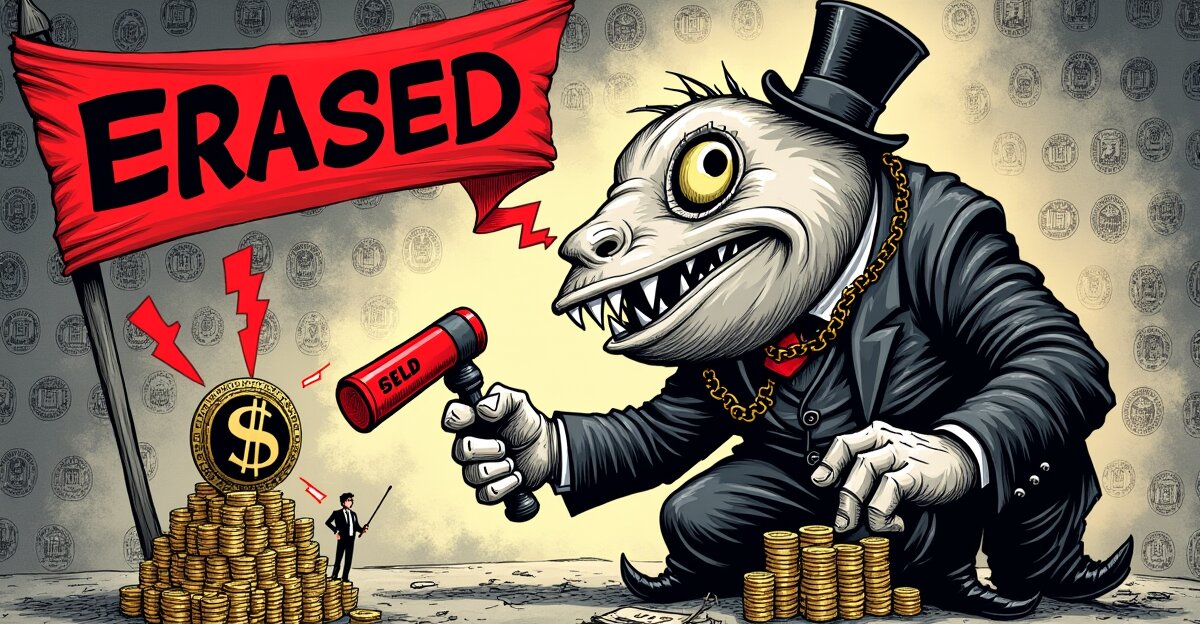
An agency built to stop bribes is now doing away with the rule that keeps the bribes from becoming legal.
"The SEC is proposing to rescind a rule that prevents so-called 'pay-to-play' practices by investment advisers, where advisers make political contributions to government officials in the hopes that those officials will select them for the lucrative assignment of managing public pension funds."
— Benjamin Schiffrin, director of securities policy at Better Markets
The Securities and Exchange Commission proposed on Thursday to delete one of the quietest but most consequential anti-graft rules in the American financial code. The target is Rule 206(4)-5, the 2010 "pay-to-play" regulation that has barred an investment adviser from collecting fees from a government pension fund for two years after making political donations to the officials who hand out those contracts.
The rule is not a curiosity. It is a scar. It was written into law in direct response to the 2009 New York State Common Retirement Fund scandal, in which then-Comptroller Alan Hevesi and his chief political adviser Henry "Hank" Morris extracted millions in bribes, kickbacks, and sham placement-agent fees from firms desperate to manage the state's pensions. The rule did one simple thing: it made the check that buys the contract illegal to cash in, even when no one could ever prove a wink.
Translation: the whole point was to stop the bribery from looking like a bribe. The Trump-era SEC wants that point erased.
Chairman Paul Atkins framed the rescission as a speech issue. In a statement, he argued the rule is "overly prescriptive" and that it "has effectively resulted in the suppression of political speech," punishing advisory firms "for an employee making a donation even before joining the business." His conclusion was that political contributions "are more properly governed by local ordinances, state laws, and federal election regulations, not by the SEC."
On paper, that has the ring of a clean, libertarian line: let the states handle their own campaigns. In practice, it removes the only bright-line, proactive shield standing between campaign cash and billions in public retirement money. Pension advocates and former regulators have long argued the rule matters precisely because proving an explicit quid pro quo, a specific exchange of a check for a specific contract, is so rarely possible once the fact is that the money moved and the contract followed.
Schiffrin cut through the framing without much patience. "Chair Atkins says the SEC is proposing to rescind the rule because it 'has effectively resulted in the suppression of political speech.' Not so. It has resulted in the suppression of corruption."
The stakes are not theoretical, and they are not small. Public pensions are one of the largest pools of investable assets in the world, and the advisers who manage them do not get hired on some meritocratic lottery. They get hired by the people who control the money. The rule's two-year "time-out" was the mechanism that kept a $300 contribution to a state senator from quietly becoming the price of a management mandate.
Strip that mechanism away and the game does not vanish. It just moves into the shadows where it was born, back inside the statehouse. Atkins insisted that rescinding the rule "would not open the door to fraud because sufficient protections exist," pointing to the Advisers Act antifraud provisions and fiduciary duties. But those are back-end tools, meant to catch fraud after it has already stolen the pensioner's savings. The pay-to-play rule was a front door. This proposal is a suggestion that the front door was, in the end, an inconvenience.
The irony is sharp enough to cut with. This is the same financial watchdog that the administration's top Democrat accused of "rigging our markets to work for the wealthy and well-connected while working people pay the price."
The lobbying paper trail tells you who has been waiting for this moment. BlackRock Funds Services Group, a subsidiary of the world's largest asset manager, spent more than $1.5 million in 2025 lobbying the SEC, Congress, the White House, and other regulators on the pay-to-play rule, among other matters, according to disclosures reported by Katya Schwenk and Freddy Brewster of The Lever. When a regulation exists, the money with the deepest pockets has an incentive to keep it; when it is a speed bump, the money with the deepest pockets has an incentive to remove it.
Under the Biden SEC, the rule actually had teeth. The agency brought several enforcement actions in 2023 and 2024 against advisers who violated it, including a 2024 fine against Obra Capital Management for continuing to serve a government client after an associate made a disqualifying campaign contribution. Earlier industry "sweeps" in 2017 and 2022 netted a dozen firms in total. The rule is not a dead letter. That is exactly why the people who profit from it being gone want it gone.
Senator Elizabeth Warren, the top Democrat on the Senate Banking Committee, put it in terms that read like a headline. The rescission, she said, is "another example of how Donald Trump and his administration are rigging our markets to work for the wealthy and well-connected while working people pay the price." The rules being targeted, she added, exist to stop "elected officials from rewarding wealthy campaign donors with lucrative contracts to advise government investments."
Once the proposal is published in the Federal Register, it will face a 60-day public comment period. That is the procedural window where the argument still lives, where state pension officials, watchdogs, and former regulators can pile on the record. But a proposal is only the opening move. The message it sends is immediate and legible: the front door is being taken off its hinges, and the justification is that the people behind it were being a little too chatty.
The question is not whether removing the pay-to-play rule makes buying politicians easier. It already does, in practice. The question is whether an agency sworn to protect ordinary Americans from the people managing their retirement will quietly hand the key to the lock to the highest bidder.
The rule was born from a pension fund that was robbed in the open. The proposal is a wager that, as long as no one is watching the moment the money changes hands, nothing has been stolen at all.
Comments (0)
No comments yet. Be the first to speak up.
Join the Riot
Login with Google to leave a comment.
Login to Comment