
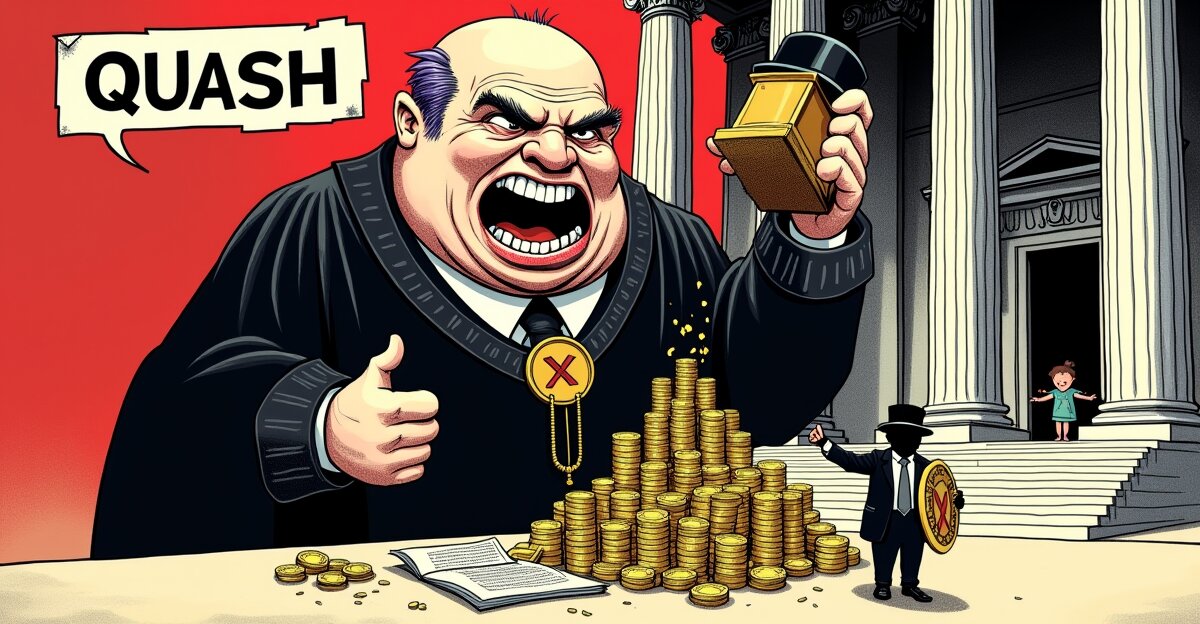
An agent shot a man through the door of an occupied house with two toddlers inside. The government decided, over a prosecutor's screaming objection, that the only crime was the lie he told afterward.
"This is being directed by the Main Justice and the US Attorney. I objected in the strongest possible terms and fought it as hard as I could. It wasn't enough."
— Matthew Evans, assistant U.S. attorney in Minnesota, in an email to the family's lawyers
When Christian Castro fired through the closed front door of a Minneapolis duplex on January 14, the shot punched a hole in the wall of the downstairs apartment and lodged in Julio Cesar Sosa-Celis' leg. Two one-year-old children were in that apartment. State charging documents say Castro knew the house was occupied by several people. Then, after the shooting, Castro told an FBI agent an entirely different story: that he'd been beaten for several minutes by three men with a broom and a shovel and fired in self-defense.
On Friday, prosecutors unsealed an indictment charging Castro, the 52-year-old Immigration and Customs Enforcement agent, with six counts of making false statements, one for each alleged lie. He turned himself in, pleaded not guilty in Texas federal court, and was released on a $75,000 unsecured bond with a GPS ankle monitor. That is the full extent of what the federal government is willing to do, and the reason it is remarkable.
Castro was shot with a service weapon while chasing, then shooting, in the middle of Operation Metro Surge, the administration's immigration blitz that dropped thousands of masked agents into Minnesota. This was the first time the Justice Department has charged any officer for on-duty conduct during those operations. The first. And the charge was not for what he did to a man's leg. It was for the story he told afterward.
The civil rights charges, the kind of color-of-law deprivation case that carried Derek Chauvin to prison for George Floyd, were being prepared. Federal prosecutors in Minnesota had the file ready. Then, according to an email reviewed by ProPublica, the decision got overruled from Washington.
"It has been an honor and a privilege to try to get justice for your clients," Evans wrote to the families, a sentence that reads less like a resignation than a funeral note. DOJ has not confirmed the internal fight. A DOJ official told reporters that any charging decision is "collaborative and deliberative and adhere[s] to the facts and law." That is the phrase every department uses the moment the department stops being a neutral arbiter and becomes a stakeholder in its own verdict.
The result, if you squint, is a perfect indictment of the logic. The government has decided that the shooting of an immigrant through an occupied door, in a city that has now seen three shootings by immigration agents in a single month, is not a color-of-law crime. What is a crime is the paperwork. What matters to Washington is not that Castro fired. It's that Castro didn't fill out the after-action report truthfully.
Translation: the agent got to shoot. He just wasn't supposed to lie about it.
The context, once you line up the pieces, is not subtle. A ProPublica analysis from earlier this year found that in almost every instance of immigration agents shooting people, the administration blamed the injured and the dead within hours. In many of those cases, federal and local police declined to open an investigation at all. The pattern here is not an accident of one bad agent and one overzealous prosecutor. It is a system, tuned by someone, toward a single output: the immigrant as threat, the agent as hero, and the paperwork as the only place the truth is allowed to go.
DHS had called Sosa-Celis and his co-defendant "violent criminal illegal aliens." Federal prosecutors charged the two men with assaulting an officer, on the strength of Castro's story. A month later the charges against both men were dropped, and the video that DHS had ignored did its work. "Video evidence has revealed the sworn testimony of the two agents appeared to be false," then-acting ICE director Todd Lyons admitted, a rare concession that the agents' own narrative had collapsed under the weight of the footage it was supposed to justify.
The shooting was not an isolated misfire in a chaotic stop-and-chase. It was the third shooting by immigration agents in that city in a matter of weeks, and the other two were fatal.
The parallel that everyone in Minnesota is already drawing is the one the DOJ has been most aggressive in refusing to see. A week before Castro shot Sosa-Celis, another ICE agent, Jonathan Ross, shot Renee Good in her car. The official line was that Good had driven toward the agents. The video showed her wheels turned away. Federal authorities initially agreed to a joint investigation. Then DOJ officials walked it back and told state police the review of a fatal shooting was unnecessary.
Hennepin County Attorney Mary Moriarty, who is prosecuting Castro on the state side, put it plainly when asked about the blocked federal charges: this was the same reflex, the same hand reaching from Washington to keep the agents out of the room where accountability is supposed to happen.
Castro, for his part, was never quite in Minnesota. After leaving the state for Texas, Minnesota asked Abbott to extradite him. Abbott refused. He sat in a Texas jail for 90 days while the two governors played a game of federalism for an audience of one, then he walked. Moriarty said she worried Castro would flee to Mexico. He got a $75,000 unsecured bond instead, with an ankle monitor and a promise.
The state charges remain. The federal color-of-law case, the one that would have matched the gravity of a man shot in the leg by a federal agent through a door, is on pause.
And here is the twist that makes this story about more than one agent and one man's leg. Matthew Evans, the prosecutor who fought the order, who wrote that email, who "objected in the strongest possible terms," has been fired. CNN reports he is now under investigation for alleged obstruction of a grand jury probe. The person who tried to do the job the way the job is written has been removed from the room.
That is not a detail to gloss. It is the point. A department that charges an agent for lying, but not for shooting, and then fires the one prosecutor who wanted the shooting charged, has not made a decision about a case. It has made a decision about a principle: that the only offense the system will punish, in these operations, is the one that can be filed under seal in a Texas federal courthouse while the man walks free on bond.
Robin M. Wolpert, Sosa-Celis' lawyer, said it more directly than the indictment ever did: "Mr. Castro has been indicted for making false statements. But he made them to cover up the fact that he shot my client through the door of an occupied house without a self-defense justification... the federal government has grossly undercharged this case."
The door is closed. The shot went through. The toddler is still in the apartment. And the only crime on the books is the lie.
Comments (0)
No comments yet. Be the first to speak up.
Join the Riot
Login with Google to leave a comment.
Login to Comment