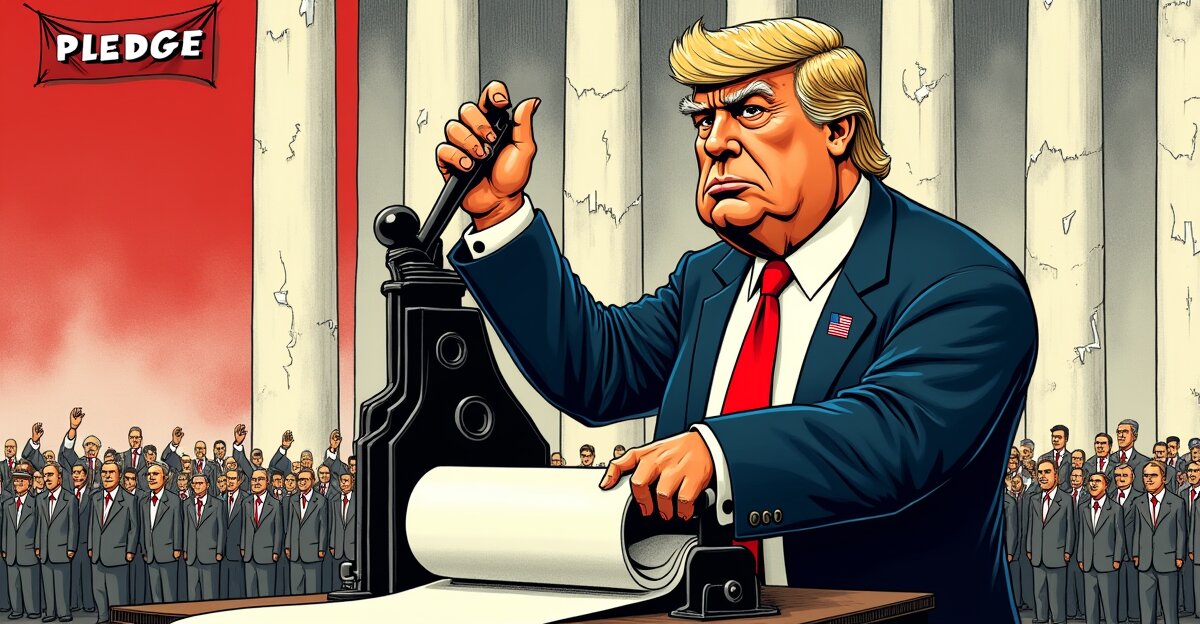
The Republican Party's first midterm convention in the modern era ended the only way it could: with the president asking a half-empty arena to raise its hands and swear an oath of fealty.
"Please raise your right hand. I pledge to the greatest president in the history of the United States that loves us so much he can't even breathe that I will go out with my family, my friends, I will do it any way, I don't care if I'm registered or not, I'm going to try and cheat like hell, to vote on November 3."
— President Donald Trump, closing the 2026 Republican midterm convention in Dallas
On the final night of the event the party billed as "Trumpalooza," the president did something no modern president has done from a major party stage: he led the audience in a personal oath, feeding them the words until they chanted back, and warned that failure to follow through would carry consequences. Not legal ones. Existential.
The venue was the American Airlines Center in Dallas, and the event was a category error: national conventions nominate a president and draft a platform; midterm conventions are so rare they need explaining. The historian Heather Cox Richardson wrote that Trump has turned the Republican Party into a vehicle for his own power. Or, with his approval at a reported new low, he wanted cheering crowds again.
The arena did not fill: the Wall Street Journal reported that many who showed up had free tickets from state parties or groups such as Moms for Liberty, and that "everyone wanted to watch another episode of the Trump show."
The numbers the party kept out of the arena were not subtle: FiftyPlusOne's aggregate found 49.9 percent of voters would back the Democratic option in November, against 43.5 percent for the Republican, with the House trending Democratic and the Senate a toss-up, in a year that should have been a gift to the party holding the White House.
The reason was at the gas pump. The war that began in February had driven diesel to record highs, $5.88 a gallon the week before the convention and $6.06 by the day after, up 60 percent since the first strikes. Crude briefly touched $110; regular gas sat above $4. In the days before the rally, Iran-backed Houthi fighters swept Yemen's Red Sea coast, capturing the port of Mocha, then the town of Dhubab and the island of Perim at the mouth of the Bab el-Mandeb strait, the chokepoint Saudi Arabia used to move its crude after the Strait of Hormuz closed. The 750-mile East-West pipeline carrying that oil across the peninsula was shut down after its pumping stations were struck, by projectiles apparently originating in Iraq.
The bill landed on American kitchens: fuel accounts for roughly 15 to 30 percent of the total cost of food, the Independent Grocers Alliance says. One analysis estimated Americans had already paid $72 billion extra at the pump, while the war added as much as $15 million to the president's own oil and gas stock portfolio.
The party's own people said the rest. Axios, citing internal GOP polling, found incumbents fretting that fuel prices would sink them, with voters blaming the war. "Diesel's at an all-time high," one Republican operative told Axios. "Gas is about $4 a gallon. We can't message that away." Another source: "We have no choice. We're stuck on the boat with him whether we like it or not."
Transportation Secretary Sean Duffy, asked about diesel on Fox News, said you have to look at "Russia and Ukraine," then added that only President Trump was trying to drive prices down. The party had spent years demanding the country trust the markets; that month, the markets agreed with the polls.
Before the oath, the program did its older work: fear.
Vice President JD Vance, in the process of arguing the party was not racist, invoked the oldest racist trope in the book: "We were tired of being called 'racist' for noticing that our country was becoming dirtier, and poor, and less safe, and less prosperous," thirty words of defense that never once named the argument. NPR framed the speech as another step in Vance's positioning as a potential 2028 frontrunner, rehearsing for the next office while the current one burns.
Texas Sen. Ted Cruz spent his time on Democrats: New York City Mayor Zohran Mamdani "wants to seize the means of production," and Michigan Senate candidate Abdul El-Sayed, based on comments he once made about his own faith, apparently has an "obligation to Sharia Law." Then an audience member shouted that the two "should be shot," and Cruz, despite brief pauses that gave him every opportunity, did not object.
El-Sayed answered on CNN: "This is what has become the norm in our politics." Politicians like Cruz, he said, should "learn to disagree agreeably." A vice president defending the ticket with a dog whistle, a senator standing silent under a call for political violence, a president closing with an oath: the program was not built to persuade anyone. It was built to make fear look like fealty.
The crowd chanted dutifully after him, and when the oath turned on the Democrats the register changed: "I'm going to try and cheat like hell, like they do, they'd never, there's never been bigger cheaters, they don't care." The applause was the loudest of the night. The oath ended with a deadline: "we are going to vote on November third or we are going to vote before that!"
"You know what happens if you don't vote, you go to hell, you know that, okay?" Trump added, a sentence somewhere between the pastoral and the prosecutorial. The party also reiterated its $5,000-per-adult check promise, a plan that would cost over a trillion dollars and runs afoul of two federal statutes forbidding paying people to vote.
The "I don't care if I'm registered or not" clause deserves a moment: a man whose second presidency has been built on the conviction that any election he does not win has been stolen, standing at a podium telling the country that irregularity is the patriotic path. Translation: the pledge is not really about November 3. It is about building a firewall out of the base, a human barrier between the party and its own polling.
The oath did not appear out of nowhere; it was the capstone of a season. Through the summer, the administration moved to station ICE agents and federal officers at polling places, a plan now challenged in federal court: "The specter of armed officers at polling places threatens the freedom of this upcoming election." Raw Story found Trump allies describing a federal presence at the polls as a way to "sow chaos." The same summer, federal agents in Danbury, Connecticut, seized parents from school bus stops, and a New Jersey federal judge upheld an order keeping ICE out of state buildings. The machinery is being assembled; the convention was its dress rehearsal.
Even inside the party, the discomfort was audible. In late August, a GOP strategist told Truthout that members of his own party worried the "Trumpalooza" convention could hurt in November. "Why are we doing this? What's going on?"
The morning after, on the 25th anniversary of the attacks that have served as the alibi for the war, the project produced its perfect image: all four living former presidents at Ground Zero while Trump spoke from the Pentagon, tying his war in Iran to 9/11. Defense Secretary Pete Hegseth supplied the theology: "We're still sending terrorists where they belong, to hell. And tankers to the bottom of the ocean where they belong."
So here is the project in one picture: a party losing the polls; a war the country is paying for at the pump, in groceries, and in the president's own stock portfolio; a convention invented to explain why a party needed a platform; a vice president defending the ticket with a dog whistle, a senator who could not find the words to condemn a call to shoot two of the country's most visible politicians, and a president who closed not with a policy, a record, or an argument, but with the one thing a party in power usually stops needing: an oath.
The oath is the tell. A party that can sell its war, its prices, and its nominees does not ask its base to raise their hands; it asks because it has run out of everything else. On November 3, the gesture comes back: the country raises its hands, marks its ballots, and says what it thinks of the pledge. The question is no longer whether the Republican Party has become an institution that requires devotion. It asked, on camera, with the applause of a half-empty arena. The question is whether a republic still knows what to do with the hand it has been given.
Comments (0)
No comments yet. Be the first to speak up.
Join the Riot
Login with Google to leave a comment.
Login to Comment