An 80-year-old president spent a weekend coloring in an empire on social media, and the most unsettling reaction to the map was not outrage. It was agreement.
"That's not insanity. That's intention."
— Dr. Brian Goldman, Canadian emergency physician, on Trump's map of the Western Hemisphere
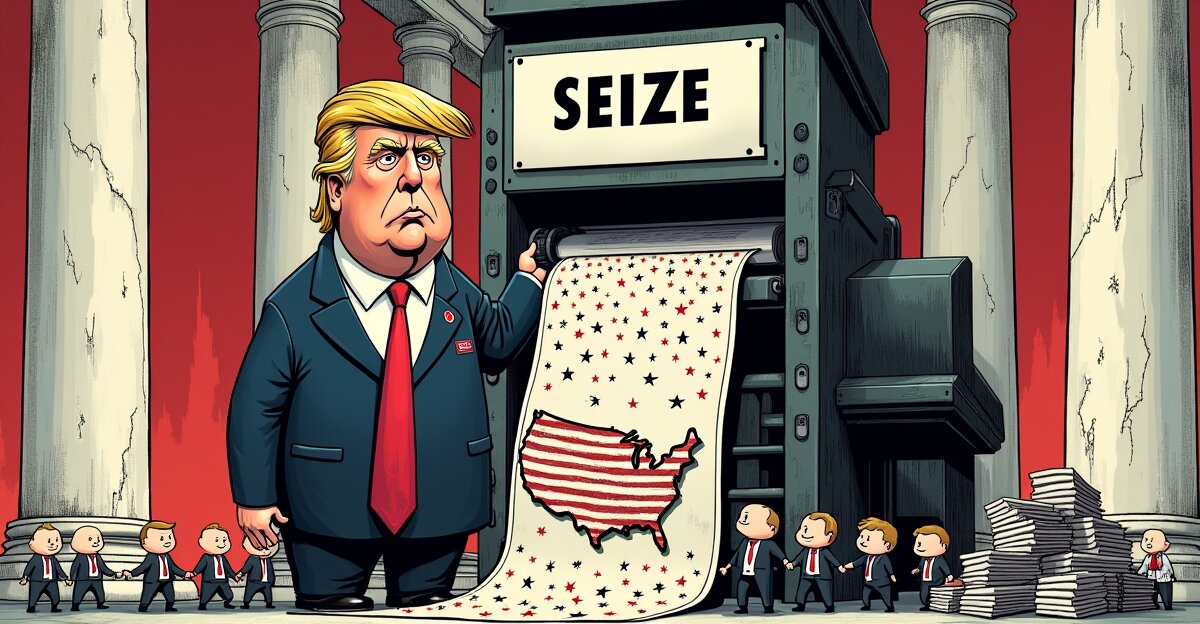
On Monday, Sept. 7, President Donald Trump posted a map to Truth Social. It showed the North American continent with a few additions. The United States was there, of course, but so were Canada, Mexico, Greenland, Iceland, much of Central America, and the Caribbean, all draped in stars and stripes, all labeled "United States of America." There was little commentary to the image. The flag did the talking.
The map arrived at the end of a weekend that had its own geography of mania. On Sunday, Trump declared that "many people" had suggested renaming New Mexico "New America," calling the state "one of the great vote cheating states of all time" before blessing the new name. "So much more prestigious and beautiful for the people of that potentially incredible State. Wow, I Love It!!!" The idea had been seeded by a debunked hoax, a fake post claiming the president had already signed an executive order changing the state's name. No such order exists. Trump did not correct the record. He adopted it.
The week before, he had renamed Lake Ontario "Lake America," prompting an objection from Canada's prime minister, Mark Carney. The Monday frenzy produced an AI image of himself arm wrestling the late Hulk Hogan, another of the Iranian navy resting on the ocean floor, and a third of Barack Obama staring into a mirror that reflected Trump, captioned "Mirror, Mirror, on the wall, who's the greatest president of them all." For Labor Day, he wished the "Radical Left Lunatics, Communists, and Dumocrats" a happy holiday and promised to "win the Midterms, BIG, and SAVE AMERICA!"
The map was condemned quickly and across the usual lines. Rep. Jonathan Jackson (D-Ill.) called it "unacceptable." The journalist Stephen Robinson noted that "another world leader posting something like this would have to apologize before their immediate removal." Amy McGrath, a retired Marine fighter pilot and former Senate candidate, asked what Americans would do and say if the Chinese president posted a map of China taking over the Western Pacific. Carl Bildt, the former prime minister of Sweden, widened the frame: if Xi Jinping posted a map of China having absorbed all of East Asia, or Putin one of Russia having swallowed Western Europe, "It would have been seen as either insane or dangerous, or both."
Mexico did not wait for a formal response. President Claudia Sheinbaum did not name Trump. She did not need to. "We reaffirm," she wrote, "that Mexico is neither nor will be a colony or protectorate of any foreign country. Proudly we are a free, independent, and sovereign nation."
New Mexico's governor, Michelle Lujan Grisham, aimed at the New America plan and the map in one shot. The state's name, she wrote, "has been ours since before the United States existed," and while the White House "wastes time coloring on maps, Nuevo México is busy doing the work."
The dominant frame in American commentary, though, was mental health. Progressive influencer Harry Sisson declared, "This man is unwell. 25th Amendment NOW." The Daily Beast ran a headline about a "crazed map-changing meltdown." Critics on social media called the president "absolutely bonkers" and "f*cking insane."
Insanity is the easy diagnosis. It lets you stop asking what the map means.
Consider, then, the response that should have been louder: the map is a plan.
Democratic strategist Michelle Kinney said of it: "As always, he is telling us what the plan is. We must take it seriously." Dr. Brian Goldman, a Canadian emergency physician and broadcaster, pushed back on the insanity frame directly. "That's not insanity," he said. "That's intention."
The case for intention does not require reading the president's mind. It requires only reading what his own people have said on the record. Last January, White House deputy chief of staff Stephen Miller sat down with CNN's Jake Tapper to explain that "the US is using its military to secure our interests unapologetically in our hemisphere. We're a superpower and under President Trump we are going to conduct ourselves as a superpower." On Greenland, Miller went further: "Greenland has a population of 30,000 people. By what right does Denmark assert control over Greenland? The United States is the power of NATO. Greenland should be part of the United States." The actual population is about 56,000, a correction no one in the room pressed him on. "Nobody is going to fight the US militarily over the future of Greenland," he added.
Rep. Seth Moulton (D-Mass.) offered the cleanest translation of the interview: "sovereign countries don't get sovereignty if the US wants their resources." Sen. Bernie Sanders, watching the same exchange, called Miller's rant "a very good definition of imperialism."
The map, in other words, is not a document that needs explaining. It is a summary. It is the Donroe Doctrine, the second-term update of the Monroe Doctrine of 1823, drawn by a man who has stopped needing the prose. The doctrine has been operating for months in the ways that leave bodies and ledgers: the invasion of Venezuela and the abduction of its president, done, by one economist's estimate, to secure $100 billion to $150 billion a year in oil. The more than 225 people killed in the administration's boat bombings in international waters. The threats against the Panama Canal, Colombia, and Mexico. The Gulf of Mexico relabeled the "Gulf of America." The tease, in the middle of a war with Iran, that the Strait of Hormuz should be declared a US territory and named after the president. The fight to put his name on the Kennedy Center.
The map did not announce the doctrine. It simply stopped pretending the doctrine was secret.
There is a timing question, and it is a political one. The map landed with roughly two months left until the midterms, in a week when the president's approval sat around 33 percent, a record low, and the GOP's first midterm convention in Dallas was being filled with a free-ticket lottery and unsolicited "FREE TICKETS" text messages, while many of the party's own lawmakers opted to skip the event.
Former Rep. Charlie Dent, one of the few Republicans willing to say what the rest are thinking, told MSNBC the renaming spree was "not helping the president or his party. It's hurting his own team." He went further: "It's almost like there's an intentional act to undermine your own party's prospects in the midterms."
The renaming theater is cheap. It costs nothing, offends everyone equally, and owns the news cycle for a weekend. Annexation is expensive. It requires wars, occupations, and the governance of millions of people who have no interest in being governed. A man who cannot win the midterms on gas prices can at least win the map.
Empires, historians will remind you, begin as maps. The European scramble for Africa was conducted in drawing rooms, with colored pencils and straight lines drawn through other people's countries. The Monroe Doctrine was itself a map, a hemisphere declared off limits. What is new in the Trump version is not the color but the confidence, and the delivery mechanism: no treaty, no declaration, no war required. A morning post on a private network, and the whole hemisphere redraws itself under one flag.
Melanie D'Arrigo, executive director of the Campaign for New York Health, put a finger on why the American reaction has been so dazed. "The reason why Republicans attack education is so that people don't recognize the history that repeats itself."
And the history, for the moment, is doing exactly what it does. It repeats.
The map matters less, in the end, than the habit. An administration that renames lakes, threatens neighbors, abducts a foreign president, and then posts the entire continent under its own flag has stopped hiding anything at all. The question was never whether the map was serious. The question is why anyone was surprised.
Comments (0)
No comments yet. Be the first to speak up.
Join the Riot
Login with Google to leave a comment.
Login to Comment