The most powerful man on earth flew to Ireland to play golf at a course he owns and, at a press conference beside the taoiseach, suggested the borders of the United States' oldest ally could be redrawn on his say-so.
"I don't want to cause any problems, but I'd love to see it unified. I think it would be a fantastic thing."
— President Donald Trump, joint press conference with the Taoiseach of Ireland, Dublin, September 12, 2026
On Saturday morning, in a press conference room at Farmleigh House in Dublin, a reporter asked the president a question every American president before him had politely declined to answer: what does the United States think about a united Ireland?
Trump did not decline.
"I don't want to cause any problems," he said, seated beside Taoiseach Micheál Martin, whom he described as "the right man over here to get it moving." "I think it would be a fantastic thing. Now the UK will have something to say about it, obviously. But I think it would be a great thing. I mean, how can it be bad?"
Reunification, he added, was "going to happen eventually," and "it may as well happen now." He and the taoiseach, he said, were "actively talking about it." He had "friends on both sides, great people."
The United States has an official position on Irish reunification. The position is neutrality, held by Democrats and Republicans alike for close to three decades. In roughly ninety seconds of a Saturday press conference, in a country the president was visiting partly to play golf, that position was gone.
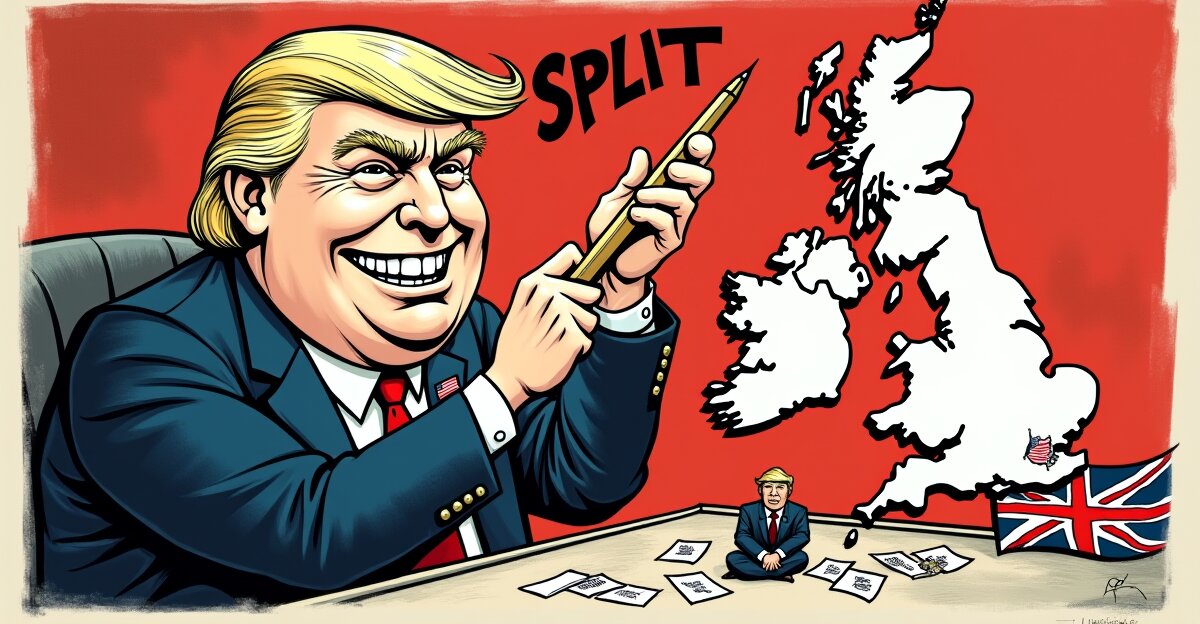
Understanding the size of what he touched requires a map.
When Ireland was partitioned a century ago, six counties in the north with a Protestant majority stayed in the United Kingdom. The division produced three decades of violence. In 1998, the Good Friday Agreement ended the so-called Troubles and left the island split: Northern Ireland's constitutional future would be decided by its people, in a referendum that could only be called if a majority was likely to vote for unification.
The United States was no bystander in that settlement. President Bill Clinton helped broker it, and American neutrality on the border question was the price of that role. The guarantor does not pick a side.
It took a weekend, on camera, with a golf tournament forty minutes away, for a sitting American president to do what no predecessor did.
Translation: the peace deal the U.S. helped sign comes with a lock, and the sitting president of the United States just told the world he thinks the lock is optional.
The British reaction over the following hours was the story's odd detail.
Prime Minister Andy Burnham, a Labour man, did not respond directly; his office pointed journalists to his statement from last month that a unity referendum was "off the table" and that Britain would only consider one when public opinion has changed. Kemi Badenoch, the Conservative leader in opposition, called the remarks "loose talk about the future of democratic countries" that was "deeply unhelpful" and created "unnecessary tension."
Nigel Farage, the Reform UK leader and one of Trump's most reliable allies in Britain, broke with him. "Northern Ireland is a proud and integral part of the United Kingdom," he said. "The people of Northern Ireland neither want a referendum, nor unification."
Inside Northern Ireland, every unionist party lined up against the American president. The Democratic Unionist Party's Gavin Robinson pointed to "the settled democratic will of its people." The Ulster Unionist Party's Jon Burrows: "the only people whose decision counts are the people of Northern Ireland." The Traditional Unionist Voice's Jim Allister saw the bigger picture: "Northern Ireland is not a pawn in Trump's fall out with the UK."
There is a word for a foreign-policy position that unites Labour, the Conservatives, and the far right against the sitting president. It is called a red line.
The question everyone is now asking is why.
The United States and Britain are not currently warm. The same weekend Trump floated a united Ireland, he was pressed about the Falklands, the British overseas territory whose future is now in question, and spoke of a "potential disaster" he expected to be "called" into. British commentators framed the remark as payback. Rupert Lowe, leader of Restore Britain: "He should not be aiming to permanently damage our country to get back at the current malign Labour Government. Whether it's a unified Ireland, or failing to support us properly on the Falkland Islands."
The BBC's White House correspondent Tom Bateman offered a different theory, and it has numbers behind it. The midterms are less than two months away, and polling suggests Republicans are on track to lose one or both chambers. There are an estimated 31 million Americans of Irish descent, concentrated in the exact states where the party needs every vote, from Maine to Pennsylvania. The president had just offered $5,000 to every adult American if the G.O.P. keeps Congress.
A casual endorsement of Irish reunification, delivered where 31 million potential voters will see it on the news, is not a foreign policy decision. It is a campaign ad wearing a blazer.
Meanwhile the visit continued on schedule, which is its own statement.
After the press conference, Trump flew to Doonbeg on the west coast, where the Irish Open is being held at his own golf links. Play on the course stopped so Marine One could land. Air Force One flew low overhead, and spectators scrambled for photos. The Irish police described the visit as "one of the biggest security and policing operations" in their history. Asked about the president's itinerary, Tánaiste Simon Harris said he was "very much looking forward" to the golf.
The Irish Open is the second major European Tour event this year to be played at a Trump property; in July, the Nexo Championship ran at his course in Aberdeen. On Sunday, at a business speech in the U.S. ambassador's residence, Trump conceded there was "no good answer" to the reunification question. Then he went back to the course.
The fairway diplomacy, as always, runs one direction.
The Irish irony is hard to overstate.
The president's host, Irish President Catherine Connolly, is a former protestor who blocked his 2019 visit and has called him a "bully." In their meeting, she conveyed "the strong view of the Irish people that the normalisation of war and genocide can never be accepted," and gave him a collection of poems by the late Michael Longley that includes a sonnet titled "Ceasefire." That afternoon, more than 10,000 people marched through Dublin, a line so long it took 31 minutes to pass a single point. A masked group burned a U.S. flag.
Even the government of the country he is courting pushed back. Foreign Minister Helen McEntee said his views were "his own opinion" and that "something to this magnitude can only happen where there's consent from the Irish people on the island."
And yet the nationalists are cashing in. Sinn Féin's Mary Lou McDonald said the "conversation on Irish unity has shifted" and that the onus is now on Taoiseach Martin to begin planning for constitutional change. "The only person who doesn't seem to take that on board is Micheál Martin," one of her party's protesters told the BBC. Fine Gael is due in November to present a blueprint for what a united Ireland may look like.
Whatever happens next, the pressure has changed. The question used to be whether the people of Northern Ireland would ever vote for unity. Now it is also whether the world's most powerful state will keep asking.
The Good Friday Agreement gave the border a lock, and it gave the key to the people of the island. The lock has not opened. The vote, under the rules, cannot even be called yet, and most of Northern Ireland still prefers the Union.
But maps don't move when the ink dries. They move when somebody with a pen starts talking.
The question is not whether Northern Ireland will leave Britain. It is what the United States will ask for next, and which ally will finally say no loudly enough to matter.
Comments (0)
No comments yet. Be the first to speak up.
Join the Riot
Login with Google to leave a comment.
Login to Comment