
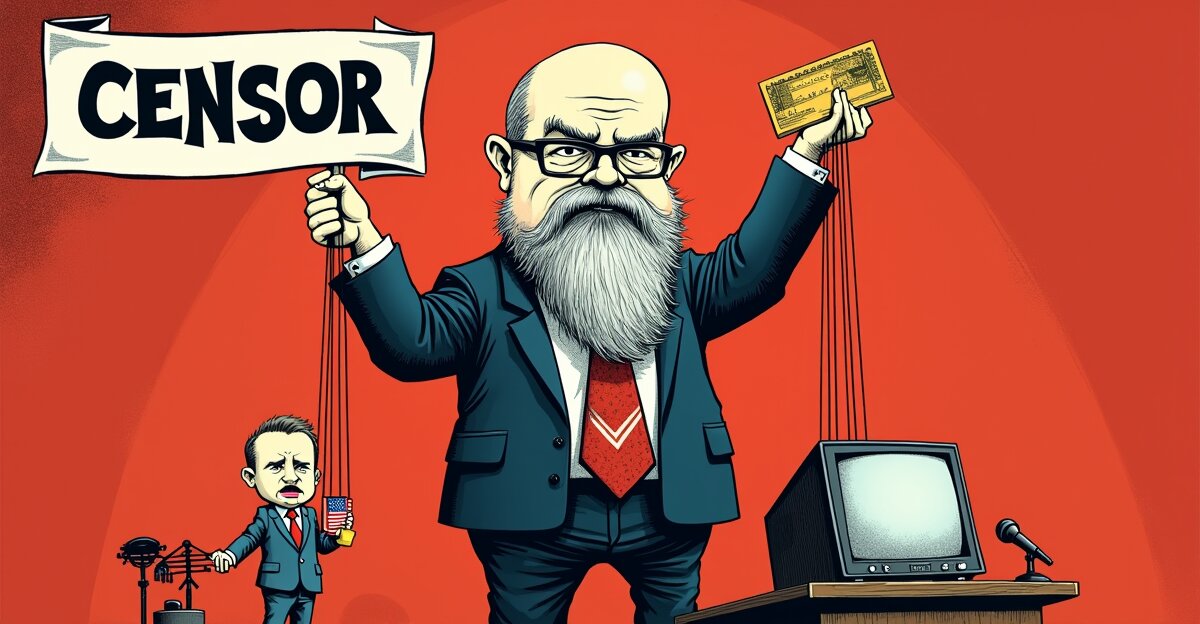
The government of the United States threatened to revoke a television station's license for the crime of interviewing a candidate, and the interview it could not kill got 7 million views.
"He's banking on people not understanding the statute or operating as partisan lemmings."
— Brendan Carr, FCC chairman, in a post on X, about the James Talarico interview
The Federal Communications Commission was created to make sure the public airwaves serve the public interest. This week it made clear the public is not who it is serving. On Wednesday, Jimmy Kimmel told his viewers that ABC would not air a scheduled interview with Texas Democratic Senate candidate James Talarico. The reason, he said, was a threat from the FCC: air the segment, and the agency would bring its equal-time rule, and the licenses that back it, down on the network and its affiliates. The interview happened anyway. It just happened on YouTube, where 7.3 million people had watched it by Sunday.
The mechanics were simple, and almost comic if you have ever studied the Communications Act of 1934. The equal-time rule requires a broadcast station that airs one candidate to afford equal opportunities to all candidates for that office. It is an old rule, from the era of radio and three channels, when the fear was favoritism on the airwaves. It exempts bona fide news, and since 1984 the FCC has treated late-night talk shows as close enough to news to qualify. That changed in January, when Chairman Brendan Carr issued a directive that a program "motivated by partisan purposes" loses the exemption.
The first test case was a candidate. In February, CBS pulled Stephen Colbert's interview with Talarico from the nightly broadcast. The network said it did not block the segment, but gave producers "legal guidance that the broadcast could trigger the FCC equal-time rule." In May, after Talarico appeared on ABC's The View, Carr threatened to revoke the show's exemption, and the FCC directed ABC's Houston affiliate to file a petition on whether the appearance violated the rule. Then it was Kimmel's turn.
"We are being targeted by the FCC for the crime of interviewing political candidates," Kimmel said Wednesday. "And so tonight, we are bypassing the public airwaves and hosting this interview on YouTube, even though our government would clearly prefer that we not do it at all."
The FCC's stated concern was not Talarico. It was ABC's local stations. Airing the interview could force the network's Texas affiliates to offer equal time to every candidate on the Texas Senate ballot, seven of them. Kimmel put it better than anyone at the agency: "The FCC wants to make it impossible for me to interview candidates by requiring that I interview every candidate on the ballot who asks for equal time."
Translation: under the current interpretation, a late-night host's guest list is a regulated campaign-finance decision, and the station's license is the price of a mistake.
This is not new behavior. In September 2025, Carr threatened to pull Kimmel off the air, and ABC took him off it for a week after a joke about the slain conservative activist Charlie Kirk. On a podcast, Carr offered broadcasters the choice: "We can do this the easy way or the hard way." This spring, the FCC called in the broadcast licenses of ABC's eight owned-and-operated stations for review years ahead of schedule, what one free speech group called "illegal jawboning." ABC sued the agency and Carr in federal court last month, alleging an "extraordinary assault" on its First Amendment rights and arguing the "true target" of the license review is content, not employment. The FCC asked a judge to dismiss the case on September 3. Its position, in one sentence: a regulator threatening to cancel your license is not retaliation if it is doing its job.
The White House offered its own account. A spokesperson, Davis Ingle, told The Wall Street Journal that "Chairman Carr has not threatened him regarding interviewing James Talarico, or any other candidate," and called Kimmel's version "play-acting." The denial has the shape of a press release: it specifies exactly who was not threatened about what, and declines to address the pattern. Even Talarico's opponent in the race, Senator Ted Cruz, called the threat "dangerous."
Carr did not bother with the legal nuance. On Saturday night he posted a 479-word essay calling the interview a "hoax," Talarico "just running the same hoax he did a few months ago on Colbert for the purpose of getting clicks and donations." The post included a meme: Kimmel riding a bicycle with Talarico strapped in a baby carrier, poking a stick into the spokes, going down. When University Democrats at UT Austin noted that a Republican senator had spent ten minutes on ESPN's College GameDay while a Democratic candidate was barred from Kimmel, Carr answered with a lecture on the difference between broadcast spectrum and cable. Their reply, in its entirety: "ok brandon."
The equal-time rule, in Carr's own framing, "is about more speech, not less." He is technically correct, which is precisely the problem. The rule exists because Congress believed broadcasters hold a public property, licenses worth billions, and must behave like it. Carr leans on this in every interview: the public airwaves, the government-sanctioned monopoly, the public interest. What he has not addressed, as far as the record shows, is the inconvenient half of the bargain. The public, which actually owns the airwaves, was not invited to this conversation.
The interview the FCC preferred "we not do it at all" got 5 million views in its first 24 hours. A typical Kimmel broadcast draws about 1.5 million viewers. The censorship that was supposed to keep a partisan candidate off the airwaves produced the most-watched appearance of the candidate's campaign. The Streisand effect is a cliché, but it is the one law of media the government has never once respected.
What remains is a question the FCC has no answer for. Talarico, in the interview: "We're not just going up against the most corrupt politician in Texas. We're going up against this entire corrupt system." The system he named now includes the agency that regulates the airwaves, its chairman, and the president who appointed him. The station that refused to air the candidate is in federal court over the licenses it holds. The rule that made the refusal possible is nearly 90 years old and has not been rewritten for the world it now governs.
The government threatened a license. It got a link. The thing it could not keep off the air is the thing 7 million people watched, and the thing the FCC cannot take down, cannot regulate, and cannot give equal time to.
Comments (0)
No comments yet. Be the first to speak up.
Join the Riot
Login with Google to leave a comment.
Login to Comment