
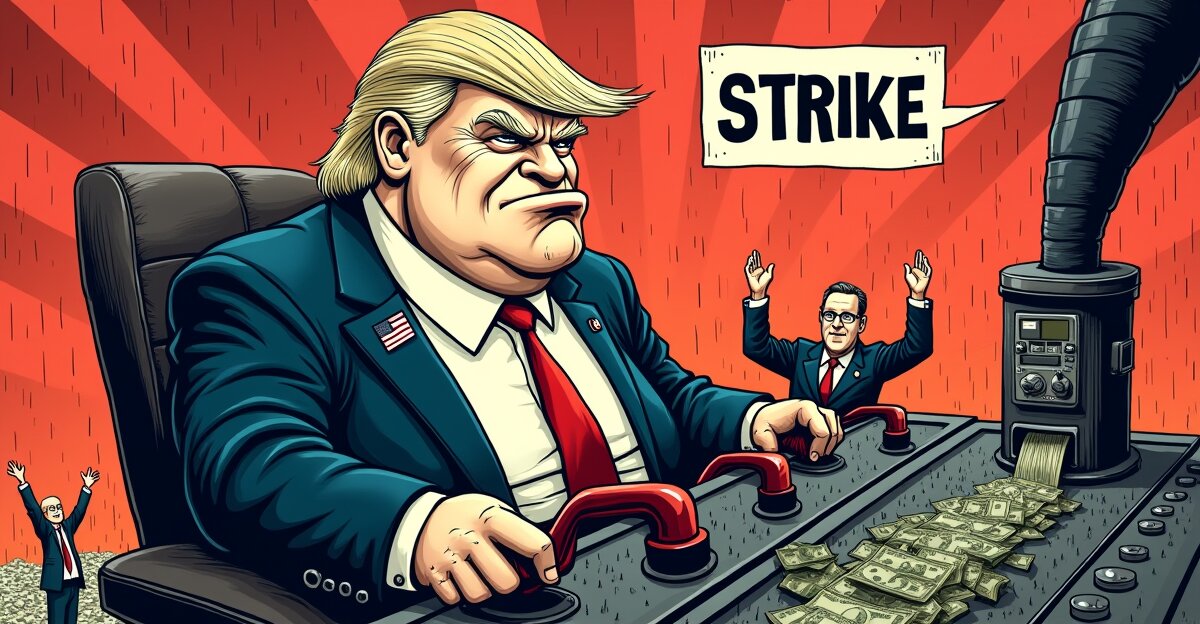
The Pentagon declared the Iran war over on July 7. The White House is now scheduling the next one for the week after the midterms, and the households footing the $1,100 fuel bill get to vote in between.
"You'll see Iran in a couple of weeks, if you don't mind."
— President Donald Trump, to a rally crowd in Lubbock, Texas
At a rally in Lubbock, Texas, the president of the United States did what presidents usually do only in classified briefings: he gave a rough schedule for the next war. "You'll see Iran in a couple of weeks, if you don't mind," Donald Trump told the crowd, in the tone of a man booking a timeslot, not a commander in chief ordering strikes on a country of 90 million people.
The casualness was the point. Reporting from The Wall Street Journal, CNN, and The Associated Press confirms the promise is being taken seriously: the administration has told several Gulf Arab states to be ready for a "short, intense military campaign" against Iran once the midterm elections are over. CENTCOM and the Pentagon, CNN reported, are assembling "a wide-ranging target list, which includes Iranian energy infrastructure, military sites, and nuclear facilities." The White House has, in other words, not committed to anything, a posture that one senator who sat through the closed-door briefings described differently. He called it "insane."
Translation: the war the Pentagon said it finished on July 7 is being rebranded, retooled, and booked for an encore aimed at the power plants and refineries that keep a country running.
A plan to restart a war is, of course, also a plan to restart a war that is already going badly. On July 7, the administration announced the "conclusion" of Operation Epic Fury, the bombing campaign it launched on Iran on February 28. It turned out to be a rebrand, not an ending. In the 12 weeks since, U.S. forces have suffered more casualties than in the entire 18-week run of Epic Fury. Of the 880 troops killed or wounded in the war so far, 444 came after July 7, according to the Pentagon's own tally.
And that tally is suspect too. The official death count stands at 19, eleven of them killed by hostile fire, yet the casualty database that tracks it has been quietly revised. Maj. Sorffly Davius, a New York National Guard signals officer killed in Kuwait on March 6, does not appear on the Pentagon's list of the dead. When the Washington Post reported that the department had suppressed casualty numbers, War Secretary Pete Hegseth called the coverage "DISGUSTING and FAKE." One current U.S. official attributed the lags to a mix of incompetence and "deliberate slow-walking of casualty data to manage public fallout."
Meanwhile the cabinet has moved on to the next layer of denial. Trump calls the conflict "small potatoes." Vice President JD Vance insists it isn't a "war." Commerce Secretary Howard Lutnick announced that "there haven't been American deaths, it's really just an economic choke-out."
The war that was officially finished in July is now producing more casualties than the war it replaced. That is not a statistical anomaly. That is the war.
Iran has been answering in kind. Across the eight months, Iranian missiles and drones have hit more than 15 U.S. bases across the Middle East, damaging or destroying hundreds of facilities in Bahrain, Iraq, Jordan, Kuwait, Oman, Qatar, Saudi Arabia, and the United Arab Emirates, according to Central Command. One February 28 attack destroyed Navy facilities in Manama, Bahrain, the region's most critical American logistics hub. Acting Navy Secretary Hung Cao eventually conceded that Iran "blew the hell out of Bahrain."
Senator Chris Murphy, a Connecticut Democrat, traveled to the Gulf states this month to see the damage firsthand, then sat through a classified briefing on what a post-election restart would look like. At a Middle East Institute event, he offered the assessment. "I will just say this, their plan is insane." The administration's pitch, he said, is a "short-duration plan," the same phrase the White House used before the last one. "It will lead to devastating escalation and the likely destruction of our commitment to the rule of law," Murphy warned. "There's been open reporting as to what we may be planning and the civilian infrastructure that we may be targeting."
Here is the part that should concern anyone who fills up their car: the bill is falling on households, and the profits are flowing up. Americans have paid an extra $148 billion for gasoline and diesel since the war began, about $1,100 per household, according to a New York Times analysis. Moody's Analytics puts it at $1,184 per household once jet fuel is counted. Pump prices have sat above $4 a gallon for the longest stretch on record, and inflation has climbed to 3.6 percent, in part because of the war's energy shock.
Meanwhile, the 50 largest U.S. oil and gas companies have booked more than $130 billion in profits between April and September. That is nearly three times last year's total, and the figure is conservative: it skips two months of the war. ExxonMobil more than doubled its third-quarter profit to $17.5 billion; Chevron nearly tripled its to $10.4 billion. Both are on track for record full-year profits. "Over time, all the excess cash we're accumulating will ultimately be directed toward our owners," Valero Energy's chief financial officer told Wall Street analysts, in what was either a joke or a confession.
Trump, personally invested in the industry, has not been subtle. "Because of the price of oil, Texas and Oklahoma and North Dakota and all these places, we're making a fortune," he told a rally in Arizona. Then, in Georgia: "I can just see the fake headlines: 'President Trump is talking about all the money they're making while people are suffering at the pump.' But I said, 'I don't give a damn. I'm gonna say it. We're making a freaking fortune.'"
The arithmetic is simple: a war that is bad for America is good for 50 executives, and the president is saying so out loud.
There is a thin off-ramp. The Journal reports that Vance, with Trump's approval, sent a letter to Mohsen Rezaei, secretary of Iran's Supreme National Security Council and the former commander of the Islamic Revolutionary Guard Corps, in a bid to reopen talks. "Vance is testing whether Tehran and Washington could find enough common ground to persuade Trump not to give a final order for a short, intense attack on Iran in the coming weeks," the paper wrote. Trump publicly denied that he ordered the outreach.
Iran's foreign minister, Abbas Araghchi, wrote in the Financial Times that Tehran is committed to "a dignified peaceful resolution" but "fully prepared to defend ourselves." He added the part that should give the White House pause. "To state the obvious, we have no trust whatsoever in the sincerity of the US administration's professed desire for peace with Iran."
The stakes now extend beyond conventional bombing. More than 200 global civil society groups, members of the Back From the Brink Coalition, sent Congress a letter this week asking it to assert its constitutional war powers and "make clear that it does not authorize or condone the use of nuclear weapons in Iran." "The use of even a single nuclear weapon in Iran would destroy a taboo that has held since Nagasaki," the groups wrote, noting that Trump said in October he would not use nuclear weapons against Iran and then kept threatening to "hit Iran hard" after the midterms. Tehran, for its part, is currently holding a "Civil Defense Week" focused on preparing the public for that exact scenario. A War Powers Resolution passed earlier this year ordered Trump to end hostilities. In the history of the United States, none of those resolutions has ever actually stopped a war.
The midterms fall next Tuesday, and the administration's theory is now visible in plain sight: let the voters finish their work, then deliver the "short, intense" second war the first one didn't produce. That isn't strategy. That is a schedule.
The people who will pay for it are the same ones paying $1,100 more at the pump, and the executives who will profit from it have, in the words of one of their own finance chiefs, already told you exactly where the money is going. The question isn't whether the plan exists. Trump has outlined it to rallies, briefed allies on it, and, per the Journal, his vice president is currently testing whether Tehran can talk him out of it. The question is whether the country accepts that the most dangerous week of his presidency gets scheduled for right after the voters are supposed to have had their say. One senator who sat through the plan called it insane. What isn't insane is how much of it is already on the record, in public, where anyone can read it.
Comments (0)
No comments yet. Be the first to speak up.
Join the Riot
Login with Google to leave a comment.
Login to Comment