The AI industry spent $50 million trying to buy the midterms, then quietly walked out of the general elections because it finally noticed its own product was the scandal.
"Something's clearly not working. I don't think spending money on politics is what's going to make people feel better about it."
— Sam Altman, OpenAI's chief executive, to Politico, October 5
The AI industry spent 2026 building the most powerful new lobby in American politics, and by last week it had learned the one thing no one in Silicon Valley wanted to learn: the voters are real, and they do not like what the lobby sells.
Two super PAC networks, bankrolled by the top of the industry, launched in 2025 to steer AI regulation. Leading the Future, the pro-industry side, was funded by OpenAI president Greg Brockman and his investors, including Marc Andreessen and Ben Horowitz, with a war chest in excess of $100 million. Its rivals, Public First and its allies, were bankrolled by Anthropic: CEO Dario Amodei put up $1 million personally, and the company gave a nonprofit arm millions more, stipulating the money never be used on elections. The playbook was copied from crypto's Fairshake PAC, which spent tens of millions in 2024: amass a war chest, punish the candidates who would regulate you, reward the ones who will not, and stay loyal to no party.
The two networks plowed $50.7 million into this year's primaries. And $21.3 million of that went to a single race.
The target was Alex Bores, a New York State Assembly member who did the one thing the industry could not forgive: he wrote a bill to regulate AI. Leading the Future turned its firehose on the Democratic primary for New York's 12th Congressional District. Bores lost in June, to his Assembly colleague Micah Lasher, and the industry booked a win.
It was also a catastrophe. The spending put AI, and the industry's war chest, on the front pages of a primary no one was watching. "Down to the wire, they were sweating," Bores told The Intercept. "I think people who have been in politics for a while will realize that their spending really served to elevate the issue of AI."
Translation: the industry that could have bought every ad slot in America instead bought the one issue it most wanted kept off the ballot.
The retreat started right after. The Intercept's analysis of Federal Election Commission filings, cross-checked against independent race ratings, found that only 5 percent of the AI PACs' direct expenditures have gone to contested general election races. Public First had spent nothing on general election races until a few days ago, when a modest $1.1 million, as of October 26, finally appeared. Leading the Future, with $34 million in cash on hand, had spent just $7.4 million on general election races, and only 31 percent of that in competitive districts.
Leading the Future is spending in a contested general election race only because one of its candidates is in one: Sen. Darline Graham, R-S.C., who filled her late brother Lindsey Graham's seat and is facing an unexpectedly fierce challenge to hold it in ruby-red South Carolina. Everywhere else, the money is in safe seats, or nowhere.
Puck News, reviewing the same FEC data across all AI-aligned groups, put it: the industry side has spent just shy of $80 million all year, about three-quarters of it before the primaries, and the pro-safety coalition Team Safety has outspent Leading the Future's network, $40 million to $36 million. The retreat, in the words of a strategist quoted by Puck, is a "feature, not a bug": partisan AI ads would backfire with voters and antagonize the Democrats who will likely run the next Congress.
A Public First spokesperson was blunter. "Leading the Future is going dark. Its biggest backers are walking away." The Brocmans' $25 million, the New York Times reported in September, is being pulled out. Political groups Meta had funded returned some $25 million to the company in recent weeks, state and IRS filings show.
A kingmaker with a $34 million war chest is spending the fall like a shoplifter: small purchases, no eye contact.
The reason the money went quiet is the reason no one in the industry wanted to print. Americans have spent the year watching data centers go up in their towns: bills, power, water, broken promises of jobs, and machines that the same industry says will automate them anyway. A Data for Progress poll of more than 3,000 likely voters in Iowa, Michigan, and Ohio, commissioned by the pro-regulation Guardrails Alliance, found roughly three-quarters of voters are less likely to support a candidate they know is backed by an AI super PAC, and were more worried by AI company spending than by crypto, or AIPAC.
In Michigan's 7th District, one of the closest and most expensive House races in the country, Democrat Will Lawrence has made the data center buildout a leading issue. "The politics of this are terrible," he told supporters at a recent town hall. "Eighty percent of everybody is against it, whether you're a Democrat, independent, or Republican." Neither AI PAC network has intervened in his race, one of the tightest on the ballot. (Elon Musk, who runs the AI company xAI, has spent against Lawrence through his America PAC, records show.)
Rick Claypool, a research director at Public Citizen, did the arithmetic in one sentence: "Essentially these companies underestimated how much the public despises the data center buildout, and the inescapability of AI systems that no one asked for that say they will automate jobs and maybe kill us all."
The industry spent millions to keep regulation off the table and instead manufactured one of the few genuinely national issues in American politics. It cannot buy its way back.
So where did the money go? Much of it went somewhere the FEC, and the voters, cannot see: Delaware.
Leading the Future has routed more than $30 million through newly minted Delaware corporations, watchdogs say. Its affiliate for Republican candidates, American Mission, spent $17.4 million through a Delaware limited liability company, Summit Ridge Media Group. Its affiliate for Democratic candidates, Think Big, spent $21.3 million through a different Delaware corporation, Lantern Production Consultants. The filings describe grab bags of media placement, ad production, and consulting, the giveaway, as Shanna Ports, senior legal counsel at the Campaign Legal Center, put it, that the shells exist to hide the real vendors. "There's no way of knowing what is motivating this arrangement," Ports said, "but I know there is backlash to AI. It is possible that the vendors who are working with American Mission and Think Big don't want to be identified in FEC reports."
The Campaign Legal Center filed a complaint in May alleging the practice is a flagrant violation of FEC guidelines requiring campaign organizations to disclose which consultants, pollsters, and advertisers they are paying. There may be little recourse for now: the FEC sits short of the quorum to act at all. The money that wanted to buy Congress now wants Congress to stop seeing it.
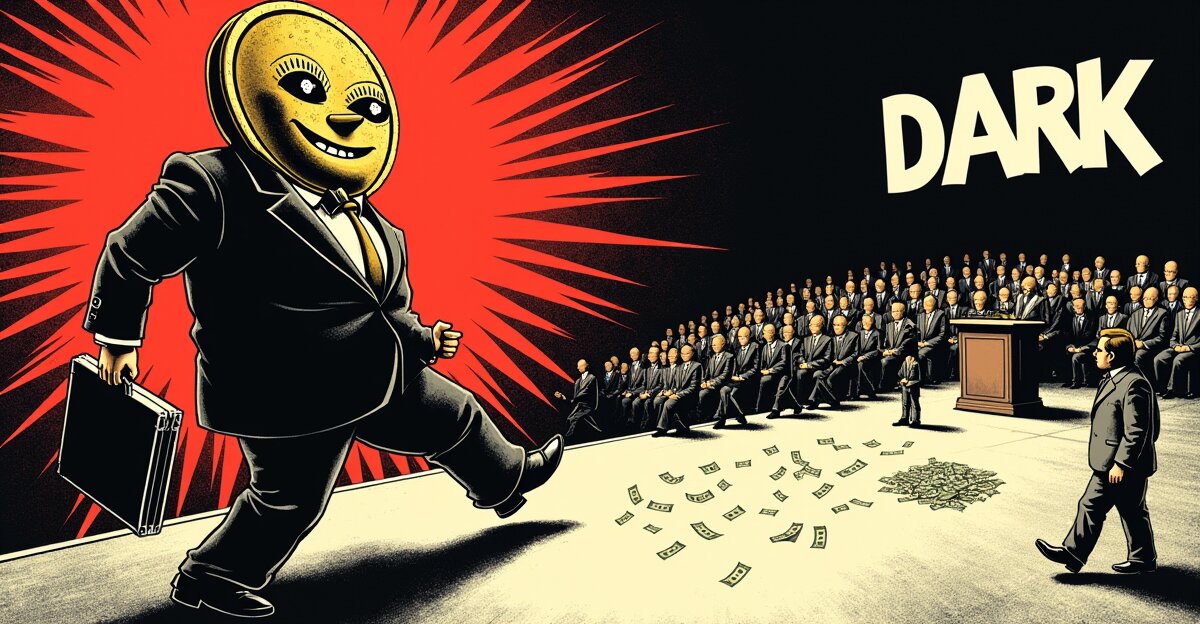
The new tactics have a name, and the name is dark. Public First's dark-money affiliate has donated $3 million since August to a super PAC backing California state Sen. Scott Wiener, one of two Democrats vying to replace Nancy Pelosi. Leading the Future, meanwhile, gave a pro-data-center nonprofit called Build American AI $500,000 on October 9. Shaunna Thomas, co-founder of the Guardrails Alliance, described the whole posture: "Their donors don't want to be associated, their candidates don't want their support, and their vendors don't want to be associated. If you were public, you are running away. If you are not, you are interested in not being exposed."
The crypto PACs of the last cycle proved the model: Fairshake spent, candidates listened, the industry got its deregulation. The AI industry copied the machine, with the money, and discovered the flaw in the design: crypto has no product, no smoke, no 3 a.m. server hum, no headline about a data center next to a school. AI has all of it, and the product is the thing voters hate.
Bores has a theory about what comes next. "I think they are going to continue to spend," he said. "I think they are going to try to do more and more spending that isn't as easily tracked, because they are such political dead weight."
That is the whole story of the AI midterms. The industry arrived with a war chest bigger than most parties and is leaving with a playbook, a pile of Delaware shell companies, and a silence where the ads used to be. The money did not quit the midterms. It just turned off the lights, and is now waiting to see if anyone notices.
Comments (0)
No comments yet. Be the first to speak up.
Join the Riot
Login with Google to leave a comment.
Login to Comment