
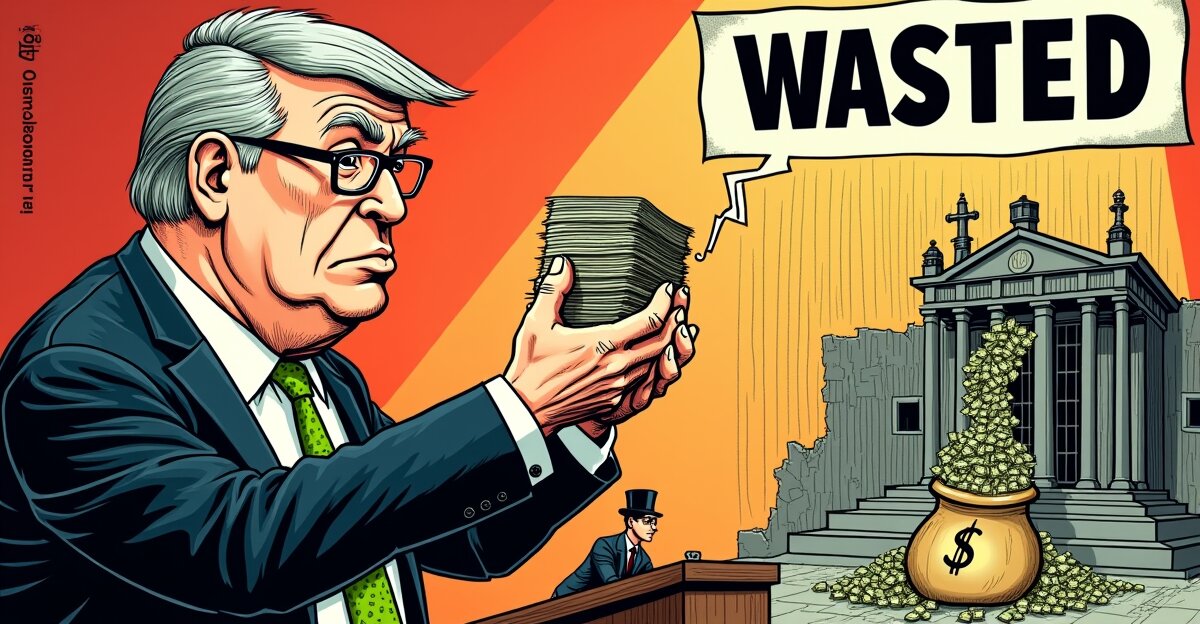
Treasury Secretary Scott Bessent declared a war on fraud, then called it a "waste of our time" to look into a $420 million overpayment his own agency just made.
"I don't know anything about that. What we are here to do is prosecute criminal fraud and any question like that that deflects away from it, I think, is a waste of our time."
— Treasury Secretary Scott Bessent, at the "Vice President's Fraud Task Force" press conference in Minnesota
It was a Friday press conference in Minnesota, and the set was deliberately theatrical. Standing behind a sign that read "the vice president's fraud task force," Treasury Secretary Scott Bessent and FBI Director Kash Patel took turns touting the administration's "war on fraud," a campaign they have spent more than a year building around a single state's welfare fraud scheme. Bessent had flown in to promise that Treasury was "employing every tool" to "hold perpetrators to account." Patel warned that "this FBI follows the money."
Then a reporter asked the one question the podium was not built to answer.
"If the administration has declared war on waste and fraud, could you explain the 420 million overpayment for a prison in Appleton, Minnesota, when the company offered it to the state of Minnesota for 75 million?"
Bessent's answer, delivered in the flat tone of a man closing a door he had already walked through, was that he did not "know anything about that," and that any question which "deflects" from prosecuting criminal fraud is, in his words, "a waste of our time."
Translation: the department sworn to hunt fraud will not touch the largest overpayment sitting in its own portfolio.
The overpayment is real, and it is documented. A local investigation by KARE 11, first published the previous week, traced the purchase. In August, Immigration and Customs Enforcement paid nearly half a billion dollars, roughly $496 million, for a vacant prison in Appleton, Minnesota. The seller was CoreCivic, one of the country's largest private prison companies and a longtime ICE contractor.
Here is the part that does not go away. In May 2025, CoreCivic had offered to sell that same facility to the state of Minnesota for $75 million. The state passed. Fourteen months later, the federal government bought it for more than six times the asking price. The gap, about $420 million, is the difference between a discount and a windfall.
The Department of Homeland Security, pressed on the finding, did not dispute the two prices. It said only that the federal purchase "was set through a different process" than the company's offer to Minnesota, and that CoreCivic's $75 million figure "was not based on replacement-cost analysis and did not reflect the intervening rise in construction costs or federal operational standards." In other words, the price went up because the rules changed mid-sentence, and the only party that benefited was the one holding the deed.
The prison is on the market for $75 million. The government paid $496 million. The difference went somewhere.
CoreCivic is not a stranger to the administration. It is one of the top contractors tapped in the mass deportation campaign, a major Trump donor, and a company that has, in a single transaction, converted a vacant building into a $75 million a year annuity. The company swiftly announced the new ICE contract to run the 1,600-bed facility, and it framed the deal the way it always frames them: as a public service.
"The 1,600-bed site gives ICE immediate capacity to detain and remove those who have no legal right to remain, protecting American communities and restoring the integrity of our borders without waiting years for new construction," the agency said.
Read that sentence again. The "immediate capacity" the administration was so eager to buy, at a price no state would come within a factor of six of matching, is the exact capacity that produces the overcrowding, the hunger strikes, and the bodies that fill the news cycle. The overpayment did not buy security. It bought profit, at scale, for a company that has been bankrolling the politicians who now employ it. Private prison companies and their executives have poured close to $1.2 million into this year's midterm cycle, according to Federal Election Commission records, and the Appleton purchase is what that relationship looks like when it stops being a campaign ad and becomes a line item.
The irony is not accidental. The press conference where Bessent brushed off the overpayment was itself about a fraud, the Minnesota welfare scheme the administration has used for over a year to justify an extraordinary range of actions against the state, its Democratic leaders, and the Somali immigrants Trump has openly targeted. "Operation Metro Surge," federal takeovers, open threats, a "fraud task force" with a sign and a budget, all of it built on the premise that the administration, and only the administration, knows how to follow the money.
So when the money followed a different route, out of a Treasury account and into a private prison, the premise ran into a wall. Bessent did not say the purchase was clean. He did not say it was investigated. He said he did not know about it, and that asking was "a waste of our time." That is not an answer. It is a perimeter fence, drawn around one number in one file in one building, with a sign on the gate.
The sign reads: fraud task force. The fence says: not this fraud.
This FBI follows the money. It just stops at the front door of the company that took it.
There is a tidy theory that explains all of it, and it is not a conspiracy. It is an incentive. A fraud task force that investigates other people's fraud is useful. It produces indictments, press conferences, and votes. A fraud task force that investigates its own agency's $420 million overpayment produces subpoenas, congressional hearings, and, eventually, a conversation about who profited and who signed. The first kind of fraud is a product. The second kind is a liability. Bessent was not wrong about one thing: the question "deflects." It deflects from the only conclusion the numbers support.
The war on fraud is real. So is the overpayment. The administration has chosen, in the same breath, to be the prosecutor of one and the alibi for the other. It is the same posture it has struck all year: point at a state, point at a community, point at a scheme, and never, not once, at the receipt.
The question was never whether the $420 million is missing. The question is why the people holding the gavel got to decide which fraud gets a name.
Comments (0)
No comments yet. Be the first to speak up.
Join the Riot
Login with Google to leave a comment.
Login to Comment