
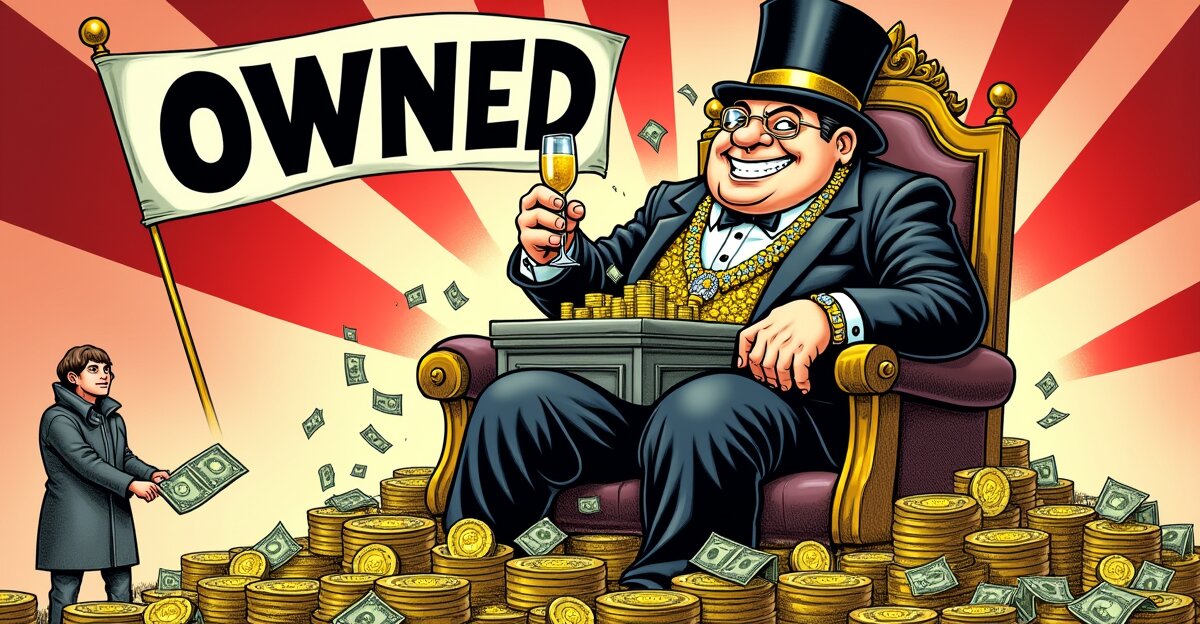
One person, one vote. That was the deal, until a few hundred billionaires decided they wanted a few extra votes each, and the Supreme Court made sure they could afford them.
"In a democracy, it's supposed to be one person, one vote. And the more one person can influence, the less egalitarian our system becomes."
— Ian Vandewalker, senior counsel at the Brennan Center for Justice
Tuesday's midterms will be remembered for a lot of things. They will be remembered for the map in the morning, for the state supreme court races, for the Senate seats in swing states. But the decisive act of this election cycle was not performed on a debate stage or in a polling place. It was performed in the ledgers, and the ledgers are now public.
A New York Times count published Sunday put just the top 20 donors at a combined $2 billion in federal races this cycle. The Brennan Center for Justice has a bigger number: the 40 largest individual donors had spent a combined $2.4 billion as of mid-October, the single largest amount of money ever spent on a midterm since the Supreme Court's 2010 Citizens United decision unleashed unlimited political spending. The Americans for Tax Fairness Action Fund has counted 172 billionaire families at more than $1.7 billion, a record for a midterm cycle. Public Citizen went further still: 515 superrich people have donated $4.2 billion to super PACs this cycle, which is 73 percent of all the money that individuals, corporations, and nonprofits have sent to those unlimited-spending committees.
Four organizations, four counts, one fact: this is the richest midterm in American history. The money is not an influence on the election. It is the election, and the voting is the ceremony around it.
The names on the checks are recognizable, and they are not evenly distributed.
Elon Musk is the single largest funder of the 2026 midterms by a wide margin, with nearly $450 million. That one figure is 10 percent of everything super PACs have raised this cycle. In 2024, Musk poured in about $300 million, roughly $120 million more than the next closest donor. This cycle, the next closest is the Uihleins, the Wisconsin industrialists behind the packing company Uline, at $150 million, followed by One Nation, the flagship GOP Senate super PAC, which has spent $138 million; venture capitalists Marc Andreessen and Ben Horowitz at $116 million; and hedge fund investor Jeff Yass at $110 million. All five of the largest individual contributors to this country's biggest midterm are pro-Republican.
The top spenders on the Democratic side are Majority Forward, the flagship Senate super PAC, which has spent $104 million, and George and Alexander Soros, at $103 million. That is real money, but the gap to the top of the list is itself the news. According to Brennan, donors loyal to the GOP now give more than three times what reliably Democratic donors give. ATF's count by family puts it at 113 billionaire families giving mostly to Republicans against 45 giving mostly to Democrats.
The Andreessen and Horowitz families, the top family spenders at a combined $149 million, are a different kind of case study. Their money flows to both parties, including to Leading the Future, the super PAC that opposes AI regulation. Some of the biggest checks of this cycle are not buying a party. They are buying an agenda, line item by line item.
How did it get this way? The plumbing is sixteen years old. Citizens United, in 2010, allowed outside groups to raise and spend unlimited sums, and the super PAC was the vehicle that made the unlimited practical. Since the ruling, billionaire political spending has grown 53-fold, ATF found, and this cycle, less than 20 percent of billionaire donations went to committees subject to contribution limits. Nearly all of it flows around the limits entirely.
The fundraising side is just as distorted. More than 85 percent of the money super PACs raised ahead of these midterms came from donors who gave at least $20,000, an amount Public Citizen notes is nearly a quarter of the median household income. More than 100 super PACs that raised at least $1 million this cycle took the majority of their funding from a single donor, collectively gathering more than $1 billion. Trump's MAGA Inc. super PAC has taken $405 million from just 102 contributors; ATF's count has one of every two dollars the PAC has raised since January 2025 coming directly from a billionaire. The Senate Leadership Fund alone has 61 million-plus donors and $496 million.
"Super PACs have helped create a political system where a small number of wealthy interests can spend unlimited amounts to influence elections and shape the choices voters face," said Lisa Gilbert, co-president of Public Citizen. "When 500 donors account for more than 70% of super PAC contributions, we should be asking whose voices our political system is prioritizing."
Translation: the grassroots money that is supposed to be the lifeblood of American politics now arrives, in most cases, in $20,000 minimum denominations.
The donor class itself has changed shape. The unions that used to occupy at least some slots in the top 40 are gone from the list, replaced by donors from the cryptocurrency industry. The cutoff to make the top 40 is now $25 million, ten times what it was four cycles ago. In dollars, the top 40 this year have given eight times what the top 40 had given by mid-October in 2014, the first full midterm cycle after Citizens United, adjusted for inflation. In 2014, a $2.5 million check made you one of the biggest donors in the country. In 2026, $25 million gets you in the door, and the room is eight times fuller.
And the billionaire checks are not the whole story. Public Citizen's separate count puts corporate political spending in the 2026 midterms at $737 million, 60 percent higher than in the 2024 presidential race. Dark money groups, which do not have to say who is paying, have poured more than $392 million into the four congressional leadership PACs this year. The money flows in from every direction except the median paycheck.
So what are they buying? On the Republican side, mostly insurance. The GOP is spending to hold the Senate and the House even as Trump's approval ratings plummet on the weight of gas prices, grocery prices, and the war in Iran. The billionaire war chest is, in effect, a hedge on the president: a bet that the party can outlast him, and that what the party owns, the rules and the maps and the access, is more durable than the man.
Paul Krugman, who wrote Monday that "oligarchy is on the ballot," blames the economy as much as the courts: decades of policy that rigged the benefits of growth toward the ultrawealthy, and the result is "men big enough to own the government of the United States." His verdict on the vote itself: "This midterm is a test of whether they will get away with it."
The question was never whether the midterms would be expensive. The question was whether anyone would ever know the price. Now we do: $4.2 billion, 515 names, one ballot box. Tomorrow, when 340 million one-person votes meet the wallets that have outspent them, the country will find out which one has more leverage. The receipts are public. The verdict is the election.
Comments (0)
No comments yet. Be the first to speak up.
Join the Riot
Login with Google to leave a comment.
Login to Comment