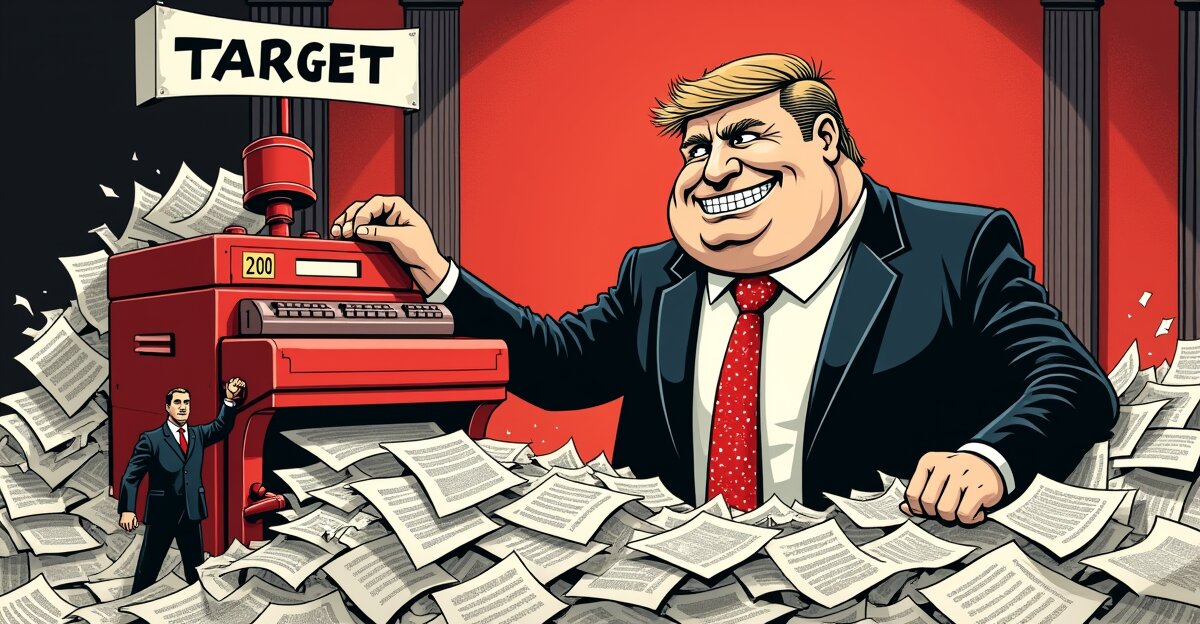
The House Judiciary Committee and the Justice Department have opened files on 65 local officials this year, and the charge in each one is the same: trying to make federal agents answer for their own violence.
"None of this is normal. What they're doing is taking mechanisms that are designed to uphold the rule of law and perverting them. And that is not normal, except for authoritarians."
— Parisa Dehghani-Tafti, prosecutor for Arlington, Virginia, under federal investigation
In the months before the 2026 midterms, the federal government got very specific about who its enemies are. Not the people crossing the border illegally. Not the mayors who refuse to hand over detainees. The targets are county attorneys and district attorneys: the officials elected to prosecute crimes when they happen in their own jurisdictions. According to a review of House Judiciary Committee and Justice Department documents, 65 state and local officials in 16 states have been targeted since January. The charge? Refusing to bend when federal immigration agents operate on their watch, or, in some cases, promising to hold those agents accountable.
The most striking feature of the campaign is its precision. The committee's letters, subpoenas, and interim reports do not merely criticize sanctuary jurisdictions in the abstract. They name individual prosecutors and single out specific non-decisions. In Arlington, Virginia, top prosecutor Parisa Dehghani-Tafti declined to charge an activist who handed out flyers containing the home address of Deputy White House Chief of Staff Stephen Miller. Her reasoning was a familiar one: doxing is not a crime, and speech is protected. Chair Jim Jordan called the decision "politically-motivated actions in a case involving a far-left agitator's disturbing campaign to threaten, harass, and dox a senior White House official and his family," and accused her office of having "sanctuary policies that prioritize illegal and criminal aliens over American citizens." Three letters, one subpoena, a September interim report. Then a referral to the DOJ's Civil Rights Division.
Translation: a non-prosecution decision grounded in the First Amendment is, at the federal level, evidence of corruption.
This reads less like a series of isolated investigations than like an operating instruction. On February 5, 2025, the attorney general's office issued "Sanctuary Jurisdictions Directives" telling the DOJ Civil Rights Division to "identify state and local laws, policies, and practices that facilitate violations of federal immigration laws" and to "take legal action to challenge such laws, policies, or practices" where appropriate. The same playbook shows up in Project 2025, the Heritage Foundation transition plan, which threatened to "initiate legal action against" prosecutors who refuse to follow administration priorities. The committee's own work product returns, over and over, to the same phrase: local law enforcement releasing "criminal aliens" back into "American communities."
By midyear the machinery had a full docket. In June, the Justice Department announced an investigation into Philadelphia officials, including District Attorney Larry Krasner, whose office adopted a policy prohibiting federal agents from wearing masks. On July 15, the committee subpoenaed Krasner, accusing him of declining to prosecute or under-prosecuting the conduct in question. On May 27, it opened a probe into seven New York City officials over their alleged "refusal to cooperate." On September 16, it re-subpoenaed Steve Descano, the top prosecutor in Fairfax County, Virginia, and went after the district attorney in Boulder, Colorado. Descano's original crime? A 2019 campaign promise to make "charging and plea decisions that limit or avoid immigration consequences." The committee's October interim report on Fairfax County, titled "Fairfax County, Virginia: The Dangerous Consequences of Sanctuary Policies," argues that a decade-old campaign pledge is discriminatory and violates federal law, and accuses his office of "efforts to erase national borders and undermine immigration enforcement."
A subpoena is a letter with a deadline. Send enough of them, and it starts to look like a leash.
The targets have not been quiet about what is happening to them. Dehghani-Tafti, who called the committee's moves "pathetic," believes the investigations exist because her political opponents cannot defeat her at the ballot box.
"They can't beat us at the polls, and so they're being undemocratic about it and trying to undermine the voters," she said.
Descano's office answered the committee's report with its own. "This 'report' is nothing more than recycled Republican talking points put out weeks before the midterm elections as a desperate attempt to distract from widely anticipated Republican losses," his chief of staff wrote. Mary Moriarty, the attorney for Hennepin County, whose jurisdiction includes Minneapolis, put it more bluntly: "No other administration has ever done things like this."
The roots of the fight go back to January, to Minneapolis. On January 7, ICE agent Jonathan Ross shot and killed Renee Good in her car during "Operation Metro Surge," a mass federal immigration enforcement operation. Days later, amid the protests that followed Good's killing, federal immigration agents shot and killed Alex Pretti, a U.S. citizen. That same month, Moriarty announced a state investigation into the Good shooting. Within days, the DOJ subpoenaed four Minnesota officials, including Governor Tim Walz and Attorney General Keith Ellison, over the operation. News reports at first named Moriarty among those subpoenaed, though it later emerged that she had not received one. She believes her name was released on purpose, to intimidate her.
In late January, prosecutors from Philadelphia westward formed a coalition called the Fight Against Federal Overreach, or FAFO, an acronym chosen with a deliberate wink at internet slang. Its stated purpose: to coordinate the prosecution of federal agents who commit crimes under state law. Less than a year later, nearly half of its founding members are under DOJ investigation.
The name was no accident. The response suggests it worked.
Experts describe the campaign as a constitutional experiment with a known result. Mona Sahaf, who directs the Reshaping Prosecution initiative at the Vera Institute and is a former DOJ trial attorney, says the prosecutors "are being intentionally intimidated by congressional and federal authorities." The use of the Justice Department to target perceived political opponents, she says, is "new. It's busting norms, and it's highly dangerous." Rebecca Roiphe, a law professor at New York Law School, called the investigations "a wholesale abandonment" of the separation between the Justice Department and the political branches. "The bottom line is that these federal prosecutions can end up threatening local prosecutors to fall in line with federal priorities, and that's illegitimate in our system," she said.
Sahaf's warning is the quiet part of the story. The entire structure of local accountability in this country rests on the assumption that somebody with the power to prosecute will actually do it. When county prosecutors start to fear that investigating a federal agent is itself a federal matter, the mechanism does not break all at once. It simply stops being used.
"The story is there: if you speak up and work to hold police accountable, we will come after you," Sahaf said.
The House Judiciary Committee says it is investigating sanctuary jurisdictions for endangering American communities. The prosecutors under investigation say the only thing that endangered them was doing their jobs. Sixty-five names, sixteen states, and the same arithmetic in every file: do what an elected prosecutor is supposed to do, and the feds come looking for you. The question is not whether the subpoenas are legal. It is what they teach every other prosecutor still reading them.
Comments (0)
No comments yet. Be the first to speak up.
Join the Riot
Login with Google to leave a comment.
Login to Comment