
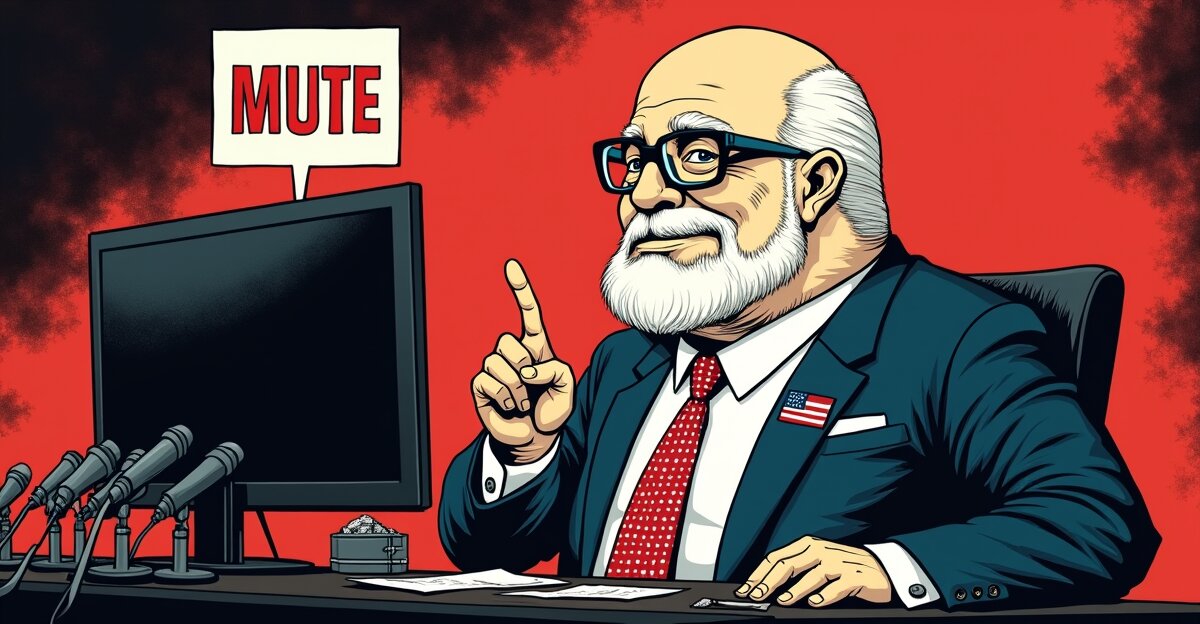
The agency charged with protecting free speech is being restaffed by the chairman's own lawyer, one lie at a time.
"...her role in FCC Chairman Carr's ongoing efforts to pressure and punish broadcasters that anger the president."
— Jessica J. González, co-CEO of Free Press
On November 18, the Senate Commerce Committee voted 15-0 to advance the nomination of Danielle Thumann to the Federal Communications Commission. All 13 Democrats on the committee stayed out of the room. The committee's rules have required at least one minority member in a quorum for nomination votes since 2005. Chairman Ted Cruz declined to honor that, and his office pointed to a procedural "cleansing clause" in Senate rules that shields the floor vote from challenge. The effect: a Republican-only vote handing the FCC chairman a 3-1 majority over the agency that licenses America's broadcast stations.
Because Cruz never passed new committee rules this session, his office argues the old quorum requirement never took effect. The committee, in practice, has operated under the prior Congress's rules "until today," as Maria Cantwell's spokesperson put it. The chair himself seemed unconcerned with the optics. "We're going to be doing our job today, even if the Democrats refuse to show up to do theirs," Cruz said before the vote. "Democrats will control the Senate, unfortunately, in January. But today is November 18."
Thumann is the chairman's own lawyer. The FCC's website describes her as senior counsel to Chairman Brendan Carr for matters before three of the agency's bureaus, Wireline, Public Safety and Homeland Security, and Consumer and Governmental Affairs. She has held the post for years and was nominated while still in it. That is what made the November 10 hearing awkward. Senator Ben Ray Luján (D-NM) asked her a direct question: "Do you support Chairman Carr's illegal campaign to remove Jimmy Kimmel from the nation's airwaves?" She answered: "I have not worked with the chairman on any media-related issues."
The records say otherwise.
Emails obtained through Freedom of Information Act requests by Protect Democracy, Democracy Forward, and The Intercept show Thumann working on precisely the kind of media matters she testified she had not touched. One email shows her approving the language for the FCC's response to consumer complaints about "news distortion" in a 60 Minutes interview with Kamala Harris. "Hi Kristi, I have confirmed with the Chairman and Erin that we would like for complainants to be encouraged to resubmit their news distortion complaints in the relevant ECFS proceeding," she wrote.
Luján, who had reviewed the records before the vote, wrote to Cruz on November 17 that Thumann "played a role in processing informal complaints related to" the 60 Minutes story and "apparently orchestrated the Commission's response to consumers regarding the Jimmy Kimmel controversy." In July 2025, the same day David Ellison's lawyers met with Carr, Thumann was asked to review a draft letter Skydance was filing in the FCC proceeding that could unite Skydance, Paramount, and Warner Bros. under one company. She sent it back with edits.
Translation: she was in the room, she just didn't talk.
When pressed in written follow-up, Thumann walked the testimony back in the narrowest possible way. She sometimes reviews "documents or filings in a matter outside of my designated portfolio," she said. But "I did not have any conversations with Paramount, CBS, or Skydance related to the merger." Luján's letter does not mince words: "It appears that Ms. Thumann misled the Committee and offered false testimony, seriously calling into question her judgment and character."
The reason Democrats want her blocked is not abstract. Carr has run what critics call a jawboning campaign: the use of the FCC's licensing power to punish broadcasters that anger the president. In September 2025, the FCC pressured ABC to temporarily pull Jimmy Kimmel's late-night show off the air after Trump threatened to revoke the network's license. In August 2026, the agency demanded that ABC and Disney submit their broadcast licenses for early review, amid a politically charged probe of "The View" and a diversity and inclusion investigation into Disney. The FCC does not regulate broadcast content. That power is not in the statute. It has been regulating it anyway, and the network that got caught in the crossfire sued. "The lawsuit from ABC would not exist if they thought Carr was following the law," said Chris Lewis, president and CEO of Public Knowledge.
Lewis made a second observation after the hearing. When Thumann was asked whether she disagreed with the chairman on any issues, she "didn't come up with anything." "I don't think she has been clear about her views, and whether they are independent from the chairman's, whose views we believe have violated the First Amendment," Lewis said.
The most painful irony of the vote belongs to Cruz. In September, he and Ron Wyden (D-OR) won committee approval for the JAWBONE Act, a bill designed to rein in jawboning: exactly the conduct free speech groups accuse Carr of. Cruz plugged the bill during the Thumann hearing. He did not mention Carr once.
The Democrats' letter to Cruz quoted his own words from 2014. Controversial nominees, he wrote back then, "should not be confirmed in the lame duck session of Congress by senators who just lost their seats and are no longer accountable to the voters." His answer, now, was to point at the calendar. The nomination goes to the full Senate, where Republicans hold the 51 votes, at least through the end of the year. The Democrats wanted the nomination paired with the renomination of Commissioner Anna Gomez, the agency's sole Democrat, whose term runs out at the end of 2027. Cruz rejected that. "There's nothing that requires the president to nominate in pairs," he said.
If Thumann is confirmed, Republicans hold three of five seats, and Carr's majority is locked in for the stretch of years when no one at the FCC is accountable to anyone at a ballot box.
Thumann is not the only name on Trump's lame duck list. The same week, Senate Health Committee Chairman Bill Cassidy abruptly blocked the nomination of venture capitalist Jim O'Neill to run the National Science Foundation, a man who is not a scientist and who was already installed by RFK Jr. as acting CDC director after Susan Monarez was pushed out for refusing to fire career public health experts. "I like Jim personally, but this time requires leadership and fortitude and standing up for what is right," Cassidy said. The White House pulled the FDA nomination of Heidi Overton, the physician who has called medication abortion "dangerous to women" and who flanked Trump as he described the MMR vaccine as "quite lethal." The country, for context, has officially lost its measles elimination status, in the middle of a resurgence, under a health secretary who spent his career arguing that childhood vaccines could be skipped.
Not everything in the rush succeeded. This one did.
The fight now goes to the full Senate, where free speech groups are calling for a no vote. The Democrats who lost the chamber are trying to make a record of what happened: a committee that bent its own quorum rule mid-vote, a chairman who greenlit a nominee a day after a colleague told him the nominee had lied, and a nominee whose defense of the lie is that she was present but silent.
The FCC's job, by statute, is not to decide what can be said on the airwaves. It is to decide who gets a license to say it. Those are not the same function, and the difference is the entire history of American broadcasting.
The question is no longer whether the agency is independent. The question is whether anyone watching the vote believes it could ever be again.
Comments (0)
No comments yet. Be the first to speak up.
Join the Riot
Login with Google to leave a comment.
Login to Comment