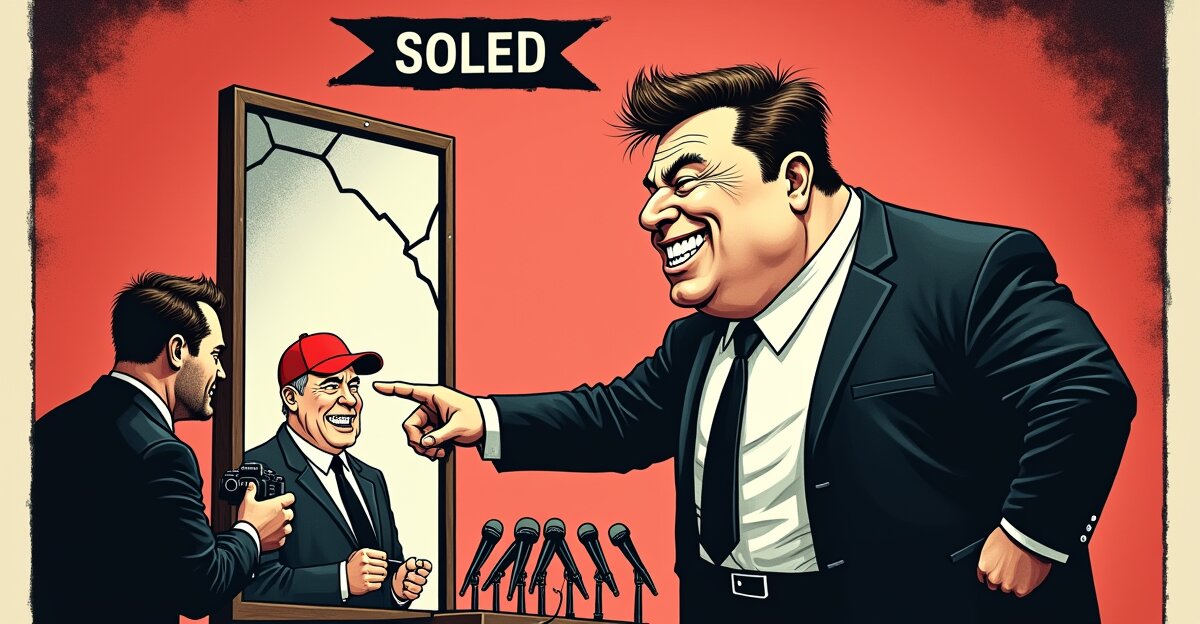
The richest man on Earth spent half a billion dollars making America great again. One bruised election night later, he is telling the country that he was never in the crowd to begin with.
"MAGA, to me, means something very specific, and when people veer from it, they don't do very well."
— President Donald Trump, in an interview with NBC News
On Wednesday, at the New York Times' DealBook Summit, Elon Musk sat down with the paper's columnist Andrew Sorkin and delivered a confession that would have landed as a joke if the speaker had not personally bankrolled the movement he was repudiating. "I mean, I'm not MAGA," Musk said. He was "not sure what MAGA means," he added, and if the phrase implies "blind adherence to a set of policies by the Republican Party," then he certainly did not have that. He described himself, with a modesty that should have been his greatest tell, as "quite moderate," a man who prefers "checks and balances."
This is not a man discovering a new position. This is a man watching his portfolio lose money and adjusting the narrative to match the mark-to-market.
The record is difficult to argue with. Musk was in the front row at Donald Trump's second inauguration in January 2025. He coined the phrase "Dark MAGA." He wore a black version of the red cap at CPAC and in Oval Office meetings while leading the administration's so-called Department of Government Efficiency, the role that made him the most visible figure in the government after the president himself. At a Trump rally the day after the swearing-in, he told the crowd that the election was "a fork in the road of human civilization" and that "the future of civilization is assured."
Then came the checkbook. Musk spent more than $400 million on Trump-aligned Republicans in this year's midterms, and some tallies put the figure near $440 million. Roughly half of it went to a single race: the Senate contest in Texas, where he bankrolled Ken Paxton's losing campaign against Democrat James Talarico by about a dozen points. The rest spread across down-ballot candidates and a cross-state blitz of anti-transgender advertising.
The money, in other words, was never a mistake. It was a strategy. Strategies lose, and strategies get rebranded.
The timing is the tell. The repudiation landed on the first full business week after Republicans lost control of Congress. Democrats, who spent the fall promising to investigate big tech's dealings with the Trump administration, take the House in January, along with a wave of statehouses. The word in Washington is that a congressional probe of DOGE and of the companies Musk runs is coming, and that it will come with subpoenas.
Musk appears to have done the math. A Quinnipiac University poll in September found that only 32 percent of Americans remained committed to MAGA, with 65 percent rejecting the label. The same poll found that 51 percent of voters said the brand made them less likely to support a candidate. A post-election survey by Politico found that 45 percent of self-identified MAGA supporters called themselves "losers" of the midterms.
The brand he helped build has become a toxic asset. So the founder is disowning it.
But a rebrand does not erase a paper trail, and the people who spent two years compiling their questions are not inclined to let the marketer off the hook.
"Elon is absolutely MAGA," wrote the journalist Nathan Newman, noting that the movement's core is "transactional deals with authoritarians around the world," and reminding readers that "this is the man who led effort to gut USAID and help murder millions around the world as food and medicine was cut off." Ezra Levin, co-executive director of Indivisible, put the proper sequence in a single breath: investigate, prosecute, imprison. Representative Yassamin Ansari of Arizona kept it short. "Yeah sure," she wrote, "but we're still investigating you, Elon."
Senator Ruben Gallego, also of Arizona, reduced the whole matter to a sentence that should probably be framed. "You are still getting a subpoena."
Trump, for his part, reacted with the warmth of a creditor who has just confirmed the debt. "He's a friend of mine," the president told NBC News, "and Elon's got very good intentions." Then, in a parting line that read less like a farewell than a threat, he added: "MAGA, to me, means something very specific, and when people veer from it, they don't do very well." That is not a man losing a friend. That is a man reminding you who holds the invoice.
Musk is not alone in the rebranding class. Palantir's Alex Karp, whose firm sells surveillance software to the Pentagon, told Politico this month that he has "been a Democrat my whole life" and grew up "in a far-left environment." He is "willing to support a Democrat for president in 2028." Karp, a donor to the White House ballroom project who has described his own business as "anti-woke," is not the first billionaire to unearth a long-forgotten progressive past the moment the wind changed.
The Gizmodo columnist Matt Novak made the obvious point. Men like Musk "just want to acquire more money and more control over our lives," and "most of them don't actually care that much if the politician they're glad-handing has a D or an R next to their name." He added the line that should end the debate: "None of these guys are going to change who they are. But their marketing materials could be altered dramatically as they try to pretend they didn't spend the past two years kissing Trump's ass."
A man can change his hat. He does not change his hands.
The genius of the not-MAGA line is that it is almost defensible. Musk did, in a recent interview, say he got "carried away" with the cuts to international aid, and experts have estimated that the DOGE reductions could be linked to 14 million deaths worldwide by 2030, including 4.5 million children. He did, in real time, watch the polling turn on the brand he had helped put on every red hat in the country. Anyone who has ever overpaid for a cause and quietly stopped defending it can recognize the feeling.
What does not work is the part where the consequences are supposed to vanish. The subpoenas do not un-draft themselves because the subject found a milder adjective. The investigations do not pause because the witness has discovered checks and balances. The $440 million does not come back just because the donor has a new story about why he spent it.
So here is the thing about a man who can tell you he was never in the room, after paying for every seat in it. The room remembers. The subpoenas remember. And the man who funded the whole thing to the last dollar is the last person who gets to decide what it was for. The question was never whether Musk is MAGA now. The question is what happens when the movement finally collects what it is owed.
Comments (0)
No comments yet. Be the first to speak up.
Join the Riot
Login with Google to leave a comment.
Login to Comment