
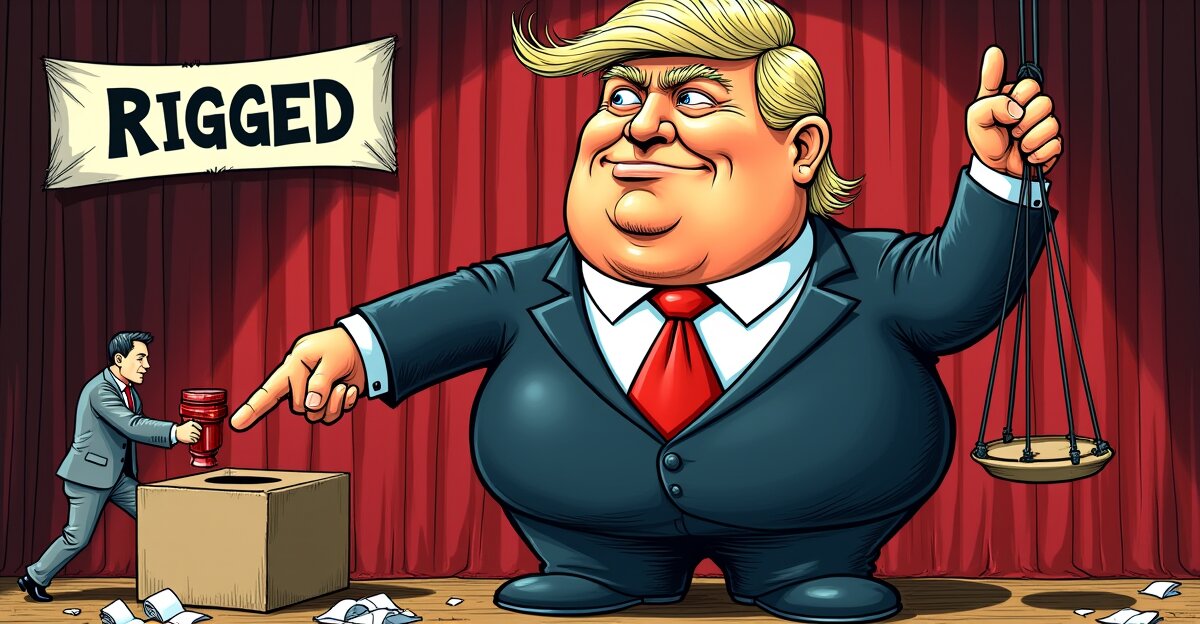
The most aggressive election crackdown in American history has produced exactly 28 suspects, 0.0001 percent of one state's voters, and a president who admits he ordered it.
"I'm the one that said do it."
— President Donald Trump, on the Department of Justice lawsuit against Alaska
On Thursday, the U.S. Department of Justice sent threatening letters to election officials in all 50 states. The message was simple: preserve the records, purge the names the White House calls noncitizens, sequester the ballots it claims are illegal, refuse ballots to the people on its error-riddled lists, and face criminal prosecution. On Friday, District Judge Trina Thompson of the U.S. District Court for the Northern District of California told the department to call the officials it had just threatened, and take it back.
The temporary restraining order came in a lawsuit brought by the SEIU, AFSCME, and a coalition of labor and voting-rights groups. Thompson wrote that "the public has a paramount interest in ensuring that election officials and workers are able to carry out their work in accordance with federal law," and that the balance of equities favored the plaintiffs because "the official day of the elections is only a couple of days away." Patrick Moran, president of AFSCME, called the ruling "a resounding win for the election workers who make our democracy happen."
Earlier in the week, a second federal judge had already said the same thing in so many words. Judge David Carter of the Central District of California threw out the DOJ's attempt to force the state to sequester ballots cast by 20,000 people the administration claims are not citizens. His ruling: the threats "must stop."
So what is the DOJ so afraid of? What is the fraud that justifies a fifty-state criminal threat in the final days before a federal election? The government's entire evidence base, as produced by the government itself, looks like this:
A list of 185 people in Nevada. All of them were later proven to be citizens.
A list of 28 people in California, suspected of voting before they were naturalized. That is 0.0001 percent of the state's registered voters.
A White House report claiming 24,000 noncitizens voted in the 2020 presidential election, deemed deeply flawed because of its unusual methodology.
Translation: the federal government's fifty-state crackdown on fraud is built on 28 names in one state.
The rest is what New York Times columnist Jamelle Bouie called "a fake problem made up by losers." Bouie pointed to a decade of studies on noncitizen voting. "The consistent answer no matter who you ask is that there is effectively none. Statistically equivalent to zero," he said. The Brennan Center for Justice counted roughly 30 instances across 42 jurisdictions in 23.5 million votes cast in 2016. "My odds right now of being struck by lightning three times in a row, higher than the rate of non-citizen voting, according to the conservative Heritage Foundation's data," Bouie added.
The DOJ demanded confidential voter roll data from the states last year. Dozens of officials rebuffed it. So the department and Homeland Security bought commercial data, stitched it together with federal records, built their own lists, and found 185 proven citizens. Federal agents have since been going door to door looking for the supposed noncitizen voters. The people with the ballots did not object. The people being looked for, apparently, do not exist.
The strategy is clearest in Alaska, where it stops being theoretical.
The state's Senate race is a three-way. Democrat Mary Peltola is neck and neck in the polls with incumbent Republican Sen. Dan Sullivan. A third candidate, also named Dan Sullivan, is running as an independent. The state initially kept the independent off the ballot, alleging he was designed to confuse voters. He sued, the state Supreme Court ruled his candidacy legal, and he made the ballot. The two Sullivans are distinguished on it: one is labeled the incumbent Republican senator, the other the independent, and both carry middle initials. Voters using ranked-choice voting can rank both Sullivans as first and second choices, so a vote for the first transfers to the other if needed.
Last Thursday, the DOJ sued anyway. The complaint demands that Alaska refuse to certify the Senate result if incumbent Sullivan loses. The suit says it is "vital" that the state "not certify any election result that may be impacted by voter confusion." Then it defines what confusion means. One of the conditions showing the outcome could be "impacted" is that "Senator Sullivan does not win the election."
Alaska's election officials responded Monday with a motion asking for immediate dismissal, filed by Carol Beecher, director of the Division of Elections, together with the state's elections boards. The filing says there is a "lack of evidence of any problems (or indeed, any legal cause of action)," and that the federal government "lacks authority to intervene in state elections at all, much less in support of a favored candidate."
The federal government's theory of the case is that a ballot with two Sullivans on it is a crime scene.
What makes the Alaska suit unprecedented is not the lawsuit. It is who ordered it.
"I'm the one that said do it," Trump told reporters last week, bragging about who decided the DOJ would file a suit against a state. In previous administrations, the Justice Department kept at least the appearance of independence from the president in which suits it filed and which people it charged. Under this one, the practice has been abandoned.
And the attorney general has not ruled out doing this everywhere. Todd Blanche was asked on a plane in Virginia on Thursday whether the DOJ could disrupt certification of the midterms after the votes are in. He said it is "not DOJ's intention" and "never our intention" to "improperly interfere" with elections or the certification process. Then he added that he might feel compelled to in a "doomsday scenario."
"To say that there's no circumstances that we would ever do that .... of course, I'm not going to say that."
The polling explains the doomsday clause. In a Washington Post/ABC News/Ipsos poll published this week, only 28 percent of voters said they were "confident" that Trump would accept the results of the midterms. Seventy percent said they were not. Back in February, Trump said he would only accept results he deemed "honest." If he does not believe they are honest, he said, "something else has to happen."
The context is worth stating plainly. Trump's approval rating is at a historic low. Republicans are facing voters with a war in Iran they backed, healthcare cuts they voted for, and violent mass deportation operations they funded. Polls show Democrats are likely to win the House and are within reach of the Senate. When a government knows it is about to lose, and knows the country knows it, the last tool is not persuasion. It is the threat of prosecution aimed at the people whose job is to count the votes.
The pieces are already in place: the fifty-state threat letters, now enjoined; the preemptive suit to block certification in a state where the incumbent is losing, fast-tracked by Judge Sharon Gleason with a motion to dismiss pending; federal agents knocking on doors to find a problem that does not exist in any meaningful number; and an attorney general publicly reserving the right to stop states from certifying a loss.
The courts, so far, are the only thing between the ballots and the doomsday scenario. And in some areas, the count itself could take three weeks.
The most aggressive election crackdown in American history, aimed at the midterm elections, has found exactly 28 fraud cases. The rest of the case is a president's word. The question is not whether the courts can keep up with the lawsuits. The question is what a "doomsday scenario" looks like when 70 percent of the country has already decided it will not accept the answer, and the only fraud the government can document is two men on one ballot who happen to share a name.
Comments (0)
No comments yet. Be the first to speak up.
Join the Riot
Login with Google to leave a comment.
Login to Comment