On October 24, a former president compared a gilded White House to a restaurant. By October 31, the sitting president, the Treasury Secretary, a cable news crew, and the right-wing blogosphere had declared war on the comparison. Inflation did not get the same response.
"They mobilized a whole-of-government response to that joke. Not to inflation, but to that joke!"
— Barack Obama, Atlanta, Georgia, October 28, 2026
It started, as these things do, with a sentence.
On October 24, at twin rallies in Ohio and Michigan, Barack Obama looked at the White House renovation, the gold and the chandeliers and the rooms that used to be called offices, and offered that the place was "looking like Saddam Hussein opened a Cheesecake Factory." It was one of many jokes about the same gilded hallways, and for a few hours it was exactly that, one of hundreds of lines a former president drops to a convention hall while the sitting administration tries to govern.
Then the right-wing media noticed.
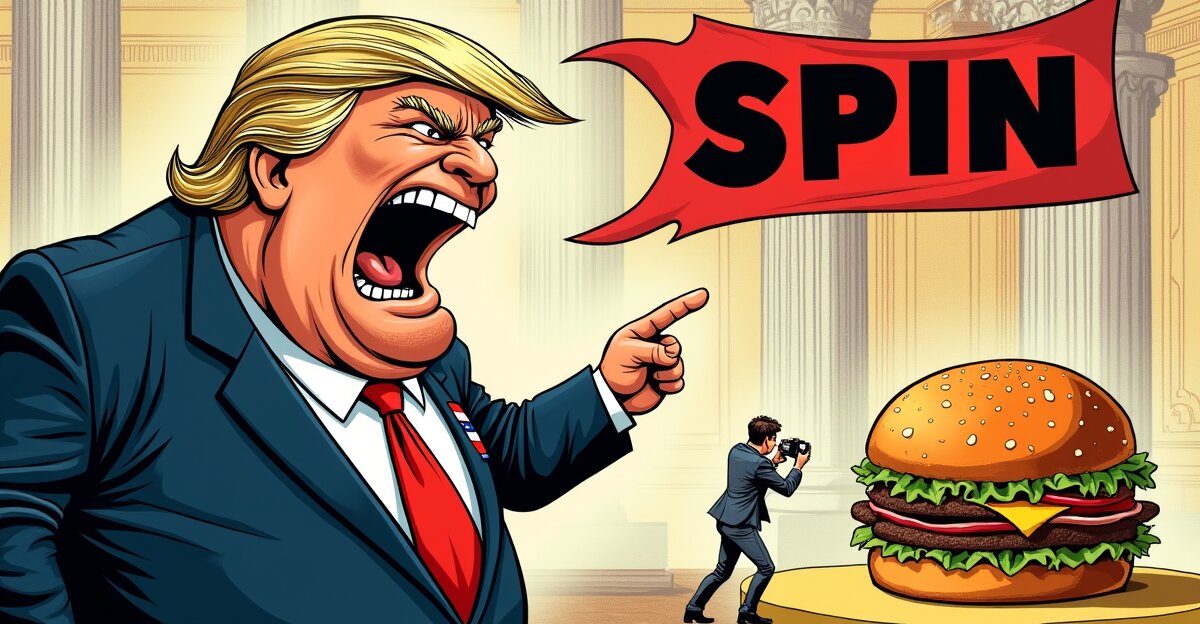
RedState ran the headline that set the tone: "Shrinking Obama tries to keep the Cheesecake Factory joke alive because that's all he's got." Within a day the joke had a press strategy, a rebuttal, and a hero. The hero was Treasury Secretary Scott Bessent, a former hedge fund manager worth roughly half a billion dollars, who appeared on camera before a Cheesecake Factory in the nation's capital for a staged Fox Business photo op. Bessent ordered a "delicious French dip cheeseburger." Not egg rolls. And he told the camera that the joke betrayed a failure to appreciate "the work of the artisans" inside the White House.
Translation: the administration's answer to a joke about office decor was a cheeseburger photo op.
The president took the bait himself. Trump called Obama "NOT SMART, LOUSY PRESIDENT!" in a fiery post about the joke. Obama supplied the footnote from Atlanta on October 28, rallying for Jon Ossoff and Keisha Lance Bottoms: "The president wasn't even mad about the comparison to Saddam Hussein. That part didn't bother him!"
At the rally, Obama laid out the arithmetic of the week, because the arithmetic was the point. The joke had forced the country to watch something unusual: a whole-of-government response to a punchline, while the actual economic agenda sat unaddressed. "They did not dispute," he said, "rising prices... tariffs... unprecedented levels of corruption."
On Friday, the House Judiciary Committee's Democrats put the week in a single Facebook post: "Republicans are demanding an apology to the Cheesecake Factory over a joke." The post asked the question the news cycle kept dancing around: why is the party so angry about a harmless joke, and so quiet about everything else?
Translation: the rebuttal to a joke about a restaurant chain was about artisans and craftsmanship. The rebuttal to rising prices was, as of Friday, silence.
The backdrop matters. The joke landed in a country where the cost of living is the reason Democrats are bracing for a blue wave in November. This month, Common Dreams ran a piece on the president telling voters they can't even afford a hamburger at his private club. Truthout did the math on the other side of the burger: Big Oil booked $130 billion in profit while American drivers paid roughly $148 billion more for gasoline. The administration's economic record, in the mind of the voter it is asking to return, is a tax on cheeseburgers.
And so the party is spending its final days before an election defending a restaurant chain.
Even the left's own blogosphere caught the juxtaposition. The week's roundup on Daily Kos ran the Cheesecake story next to the other story of the week: the House Judiciary Democrats' investigation into Jared Kushner and his "wildly dubious financial dealings with Gulf states," a probe the New Republic has headlined with the phrase "pawn of the Saudi Monarchy." The restaurant chain that has doubled for decades as the family eatery of the Trump in-laws is now the party's closing argument, while the in-law is the subject of a congressional corruption probe. The two stories do not contradict each other. They are the same story told twice.
Translation: the family's closing message is defend the restaurant. The family's other business, in the House's framing, is taking money from a foreign monarchy.
The BradCast called it what it is. Digby: "part of the Marie Antoinette-ization of the GOP, which is killing them in the polls." The reference does a lot of work. A ruling class so far from the price of a meal that "let them eat cake" stopped being satire and became a news report.
Daily Kos told it better and with less irony. "It's shocking how bad a campaign Republicans are running, which is compounded by how bad they are at governing. In a sane, rational world, Tuesday would be an extinction event for the GOP." The polls, the early vote, the economic data, and the special elections all lean the same way, and the party's answer is to keep the joke alive. "If the GOP wants their closing message to be 'Trump likes men's asses, high gas prices are amaze-balls, and the Cheesecake Factory is good,' who are we to stop them?"
So here is the joke, complete, with the response attached.
A former president compared a gold-leafed White House to a restaurant, on a night when the real story was the price of a meal. The sitting administration answered with a photo op, a cheeseburger, a lousy-president post, and a demand that the joke be apologized for. Nobody answered the prices. Nobody answered the tariffs. Nobody, as of election week, answered the probe into the family's money.
When the votes are counted on November 3, the country will have given its answer to the one question the White House refused to take: what does the gold look like from the side of the country that pays for it?
The menu for the night is simple. A French dip cheeseburger for the half-billion-dollar Treasury Secretary. A joke, for everyone else.
Comments (0)
No comments yet. Be the first to speak up.
Join the Riot
Login with Google to leave a comment.
Login to Comment