
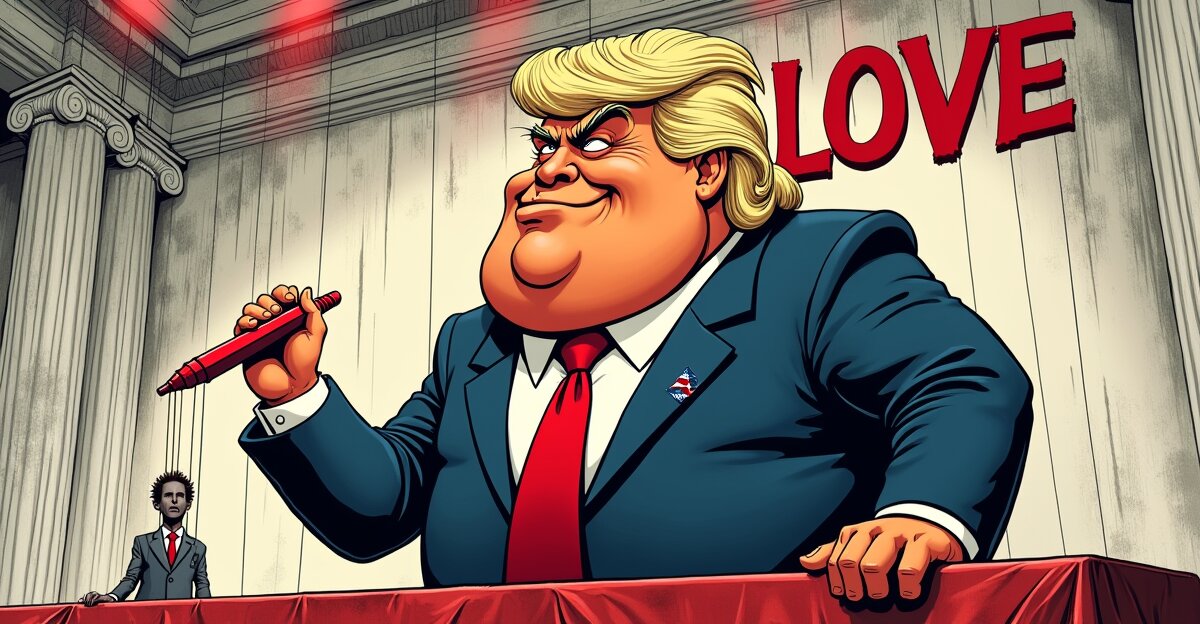
The day after his party was routed in a historic sweep, the president summoned reporters to a construction site and spent twenty minutes describing the staircase.
"If I Were on the Ballot I Would Have Won."
— President Donald Trump, at the White House ballroom construction site, the day after the 2026 midterms
The verdict came Tuesday night, and it was not subtle. Democrats took the Senate, gaining at least seven seats, a margin that political historian Allan Lichtman notes was exceeded only by the wave election of 1994. They took the House as well, the first time in twenty years both chambers have changed hands, with defeats in some of the deepest Republican strongholds in the country, including Texas and South Carolina. In Texas, former solicitor general Ken Paxton lost the Senate race and Governor Greg Abbott lost his own. The New York Times put it this way: the party was "still picking through the wreckage of a political earthquake."
The White House response was a photograph.
As the dust settled, the official White House account posted a picture of a stern-faced Donald Trump standing behind his Oval Office desk, captioned in the style of a public service announcement: "PSA: TRUMP IS STILL YOUR PRESIDENT." Reuters described a White House that "struck a defiant public tone." A president whose party had just lost the Senate for the next six years addressed the electorate with a PSA.
Then he signed a steel beam.
On Wednesday, Trump began the day with a schedule of private meetings only. Then he decided, at the last minute, to invite the press to the construction site where the East Wing had been demolished to make room for a new ballroom, to watch the final steel beam hoisted into place on the roof. The beam was topped with a small evergreen tree, symbolizing growth and luck. He signed it with a marker: "Love!" followed by his name in supersize letters.
Then he talked, for nearly twenty minutes, into a microphone that sent loud feedback echoing around the cavernous space, about minute building details. "This has been a structure the likes of which has never been seen anywhere," he said. The ballroom, he explained, would be the "safest place in Washington," stretching five stories underground and featuring a vein of marble that "people have been after for 50 years." He paused to explain why the kitchen was going subterranean: "We have large staircases coming from the kitchen. If I put the kitchen on top, you would lose three walls, because a kitchen takes about 30% of the space."
He did not mention that his party had just lost control of Congress. He did not mention the cost of living, or the federal corruption that the AP voter poll says helped drive voters to the Democrats. About two-thirds of voters told the poll that Trump does not have the right priorities, and the overwhelming majority of them backed Democratic House candidates. The Associated Press, which was there, described "the kind of detached behavior that voters around the country said was a key reason they opted to punish his party." Later, he flew to Florida to give a speech on the space program.
Translation: the voters said the problem was him. He agreed. So he signed the beam.
Presidents have a ritual for the day after a midterm rout, and it is roughly two words long. George W. Bush, after his Republicans lost both chambers in 2006, called it "a thumping." Barack Obama, after his Democrats lost the House in 2010, called it "a shellacking." Bill Clinton, after the 1994 swamping, was reduced to arguing plaintively that "the Constitution gives me relevance."
Trump has offered, so far, no expression of humility. "In the days since his defeat, he has sounded like a man in denial," wrote Peter Baker, the New York Times columnist who has covered five presidents through their midterm defeats. "Unlike other presidents who suffered midterm defeats, Mr. Trump has largely not acknowledged the setback." He seems, Baker added, "flat these days, maybe a little dazed."
The buck-passing, to be fair, began before Election Day. In August, Trump told Punchbowl News that voters were angry at Republicans "but they're not angry at me." When Paxton lost, he posted that it "will be because of WEAK and INEFFECTIVE Political Hacks like John Cornyn and Karl Rove," despite having endorsed Paxton over Cornyn himself. When Abbott lost, he wrote that the governor "wouldn't have lost" had he "not become a RINO in the last six months of his Political Life." The pattern is old. After the 2018 House losses, he announced that defeated Utah representative Mia Love "gave me no love, but then she lost. Too bad."
In other words, the party he built as a franchise has a president who cannot take the fall, because the fall belongs, by his account, to the franchisees.
The pretending, too, was not improvised.
An AP analysis of the 39 speeches and rallies Trump staged between September 1 and Election Day found that he used phrasing suggesting he was on the ballot in 30 of them, at least forty instances of asking voters to engage in the bit of make-believe. When the results landed, he told Fox News that he "doesn't like to consider it a defeat for me. I wasn't on the ballot." The rallies had enthusiastic crowds, he said, but "we weren't able to transfer love to the candidates."
The first senior Republican to say out loud what everyone had voted for was his own vice president. JD Vance, in a long post, pinned the loss on the Iran war that Trump launched: "If you'd like to argue it was worth it, that losing the Senate for the next six years was worth it, then do so. But everyone knows why we lost. And any honest conversation about where we go from here must start there."
And the fixations? Back in the summer, the New York Times' Maggie Haberman told Axios that roughly 70 percent of the president's bandwidth went to construction projects and statuary. The election did not change the bandwidth. It merely gave the construction a bigger stage.
What a president without a party still has is more than you might think, at least for now.
He can keep issuing the executive orders that carried this presidency: tariffs, the military operations in Venezuela and Iran, unilateral cuts to congressionally approved spending. And if the new Democratic Congress tries to stop any of it, the Constitution hands him a veto that only a larger majority than the one the Democrats now hold could override. Asked on Wednesday about the Democrats, he answered: "I'll get along probably with the Democrats, unless they want to be destructive. But I have the power of the veto."
But the clock is ticking, and the history is not kind. Lichtman offered two analogies for the 2026 rout: 1994, and 1894, when Grover Cleveland's Democrats suffered a loss that "presaged what was a long-term Republican sweep of American politics," with only one Democrat, Woodrow Wilson, back in the White House between Cleveland and Franklin Roosevelt. The roles, Lichtman noted, are now reversed. "The rout in 2026, of course, was to a significant extent based upon the sour economy, but there was more involved here," he wrote. "The unpopular war was a factor unto itself, independent of its effect on the economy."
The old playbook says a president who loses big fires the architect of the war. After the 2006 thumping, George W. Bush fired Donald Rumsfeld. According to the BBC, Trump is asking close advisers whether he should replace Defense Secretary Pete Hegseth, one of that war's architects. He denied it. In this administration, the scapegoat is always in pre-production.
The beam is up. The evergreen sits on top, the marker is dry, and the word "Love!" will hang in supersize letters over the highest room in the West Wing for a hundred years. The ballroom will be the safest place in Washington, five stories down, with the marble vein people chased for fifty years. It is a monument to denial, engineered: a structure built to look permanent, in the shadow of a White House that has just been told it is not.
The question was never whether the verdict was fair. The question is what happens to a president who has already decided not to read it.
Comments (0)
No comments yet. Be the first to speak up.
Join the Riot
Login with Google to leave a comment.
Login to Comment