
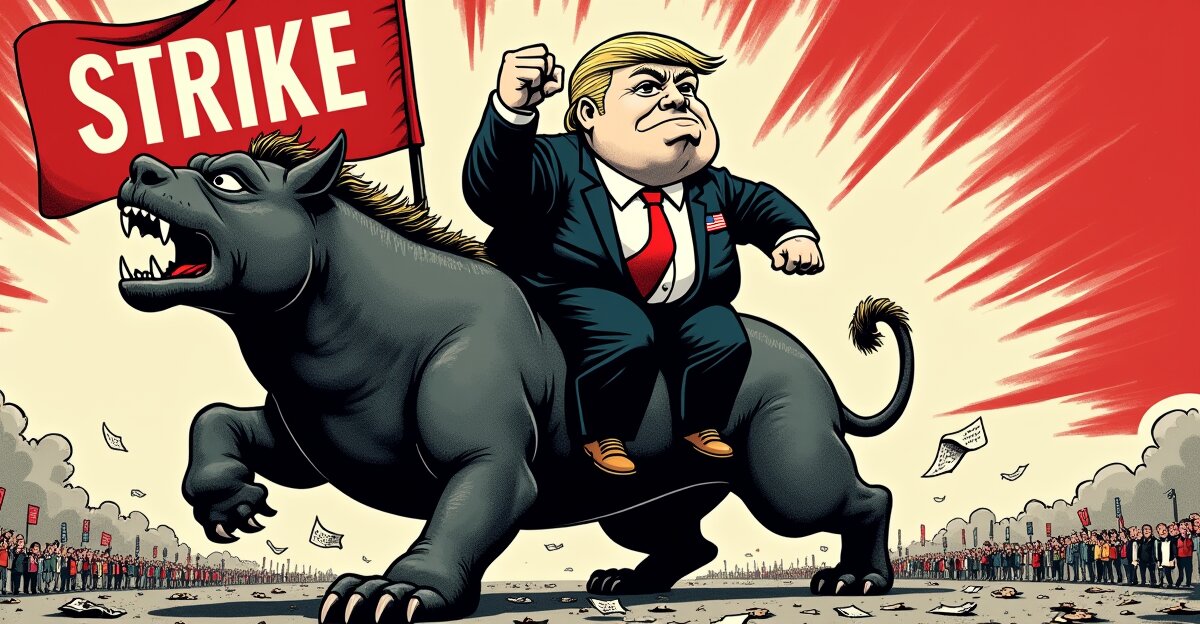
He swore he would not bomb Iran before the midterms. On the last night before the vote, he did.
"I'm not looking to, you know, kill lots of people, but if we have to, we'll have to."
— President Donald Trump, election day, 2026, on the war he had pledged to pause
On October 8, the president of the United States posted a promise to the country. "We will not be attacking Iran at any time prior to the midterm elections to be held in the United States on November 3rd," he wrote on Truth Social, and, in the same breath, assured the public that Washington and Tehran were engaged in "productive discussions."
The pledge landed in the eighth month of a war that had already choked the Strait of Hormuz, the world's most important oil corridor, into a shootout. Attacks on commercial shipping in the strait and nearby waters hit a record high in October, with more than two dozen incidents on record. And the war was the least popular thing in America. A Pew Research Center survey found 65 percent of Americans disapproved of how Trump was handling military action against Iran, against 33 percent who approved. Other tracking put disapproval near 71 percent, with roughly seven in ten voters saying the war was not worth fighting.
By the time the polls opened Tuesday, the war was not an issue in the midterms. It was the midterms.
When your administration's most unpopular policy is also its most important one, the election stops being a test of the policy and becomes a test of the president's nerve.
On the night before that test, the United States bombed Iran.
Iranian state media reported five explosions in rapid succession on Qeshm Island, the island at the mouth of the strait where the war's logistics live or die. Some residents said they saw two aircraft in the night sky. The Wall Street Journal was first to report the strikes, and it carried a detail that mattered more than the bombs: the administration had been "purposefully" keeping its recent campaign of smaller strikes quiet, "so as not to signal any intention of resuming major combat operations."
Quiet. That was the point. A strike on the last night of a campaign is not an accident of timing. It is the timing.
A U.S. official characterized the attack as a "defensive measure," after Iran's Revolutionary Guard fired a surface-to-air missile at a U.S. jet fighter, which "fired back in self-defense." The week had not started any differently. On October 30, an attack in the Persian Gulf killed a ship's captain. On October 31, a drone strike set a fishing boat ablaze off Qeshm's southern coast. Four fishermen were wounded. One brother, his knee broken, could only watch from the burning deck as his family struggled in the water. Two men clung to wreckage for hours.
Iran's deputy foreign minister, Kazem Gharibabadi, said Tuesday that "Iran is prepared for any scenario," and that the country "retains its right to legitimate self-defense until the military aggression has been brought to a complete and permanent end."
On election morning, the president confirmed the strikes. On Fox & Friends, he called them a "minor attack" and told the viewers what they had hit. "They built an anti-aircraft facility," he said. "As soon as it was completed, we hit it last night very nicely."
Asked what he planned to do after the midterms, he offered the sentence that will define the rest of this war: "I'm not looking to, you know, kill lots of people, but if we have to, we'll have to."
That is the entire theory of the pledge, in one breath. The October 8 promise was never a constraint. It was a campaign ad, and like all campaign ads, it carried an expiration date: 11:59 p.m., November 3.
The ad did not work. Democrats took the House in what commentators called the biggest congressional rout in three decades, a landslide that was, by every read, a referendum on the war. The president immediately blamed the Iran war for the loss. Vice President JD Vance was blunter. "The reason we lost is the war. The president himself said so last night," Vance said Thursday. New York City Mayor Zohran Mamdani, the night's progressive poster child, compressed the whole matter into one line: "This is a war they started."
Translation: the bombs did not buy a mandate. They bought a defeat.
Since Tuesday, the administration has done what it does best: oscillated between total war and imminent peace.
On Thursday, Trump said the United States may have to "destroy" the rest of Iran, adding that the country will "know soon enough" if he acts. The day before, unnamed Pentagon officials and military commanders told The New York Times that thousands of U.S. air and naval forces, on more than a dozen ships and at bases across the Middle East and the United States, are poised to resume major combat operations against Iran on his order.
On Friday, two more missile strikes hit the Suza area of Qeshm. Iranian state broadcaster IRIB reported that the country's air defenses intercepted and destroyed a U.S. MQ-9 Reaper drone over the island. Central Command, which runs the operation, called the situation "relatively calm."
The president called the Friday strikes what he calls everything: minor. "We do minor strikes," he told reporters in West Palm Beach. "They built a little bit of an anti-aircraft device, and we knocked it out in about 15 minutes, maybe five."
Also Friday, Central Command posted on X that the United States is "offering a reward of up to $20 million and possible relocation for information about Iran's nuclear program, including its facilities, equipment, and associated personnel, such as those in the scientific community." A bounty, in other words, on the scientists who keep a war from becoming a nuclear one.
Senator Chris Murphy, a Democrat who received a classified briefing before the election, said the administration is weighing an "insane" plan to resume major attacks once the votes were counted, and that it "will lead to devastating escalation and the likely destruction of our commitment to the rule of law." Over the weekend before the midterms, Tucker Carlson claimed the administration was "within days of launching a nuclear strike on Iran." The National Iranian American Council called the mere possibility "an unconscionable horror."
Minor strikes, major escalation. In this administration's arithmetic, an adjective stops meaning anything once the noun gets big enough.
In the meantime, the mediators are working. Qatar, the war's principal broker, said Saturday that reports the negotiations had failed were "false claims" that "serve only those seeking to prolong the war and destabilise the region." The Qatari prime minister, speaking at Oxford on Friday, said his country has been "working with colleagues in the US administration who have very genuine intentions to find a way to contain the situation and de-escalate it," and that "thanks also to some wise voices in Tehran, we have prevented that from getting out of control."
Jamal Abdi, president of the National Iranian American Council, said the election-eve strikes killed the only real hope of the past eight months. "After eight months of an illegal war, there was finally some hope that a diplomatic agreement might be within reach," he said. "But these deeply alarming revelations suggest we may be heading in precisely the opposite direction. Every day that Congress fails to intervene is another day this administration is allowed to wage an unauthorized war, conceal its military operations, and gamble with millions of lives. Americans must raise their voices and demand that their representatives act now. There is still a chance to prevent another catastrophe, but that window may be closing."
The pledge was never meant to be kept. It was meant to be believed for 26 days, long enough to fill out a ballot. That is the lesson of the last night before the vote: when the polls close, the only thing left to constrain this administration is the next strike. And the next strike is already in the air.
Comments (0)
No comments yet. Be the first to speak up.
Join the Riot
Login with Google to leave a comment.
Login to Comment