
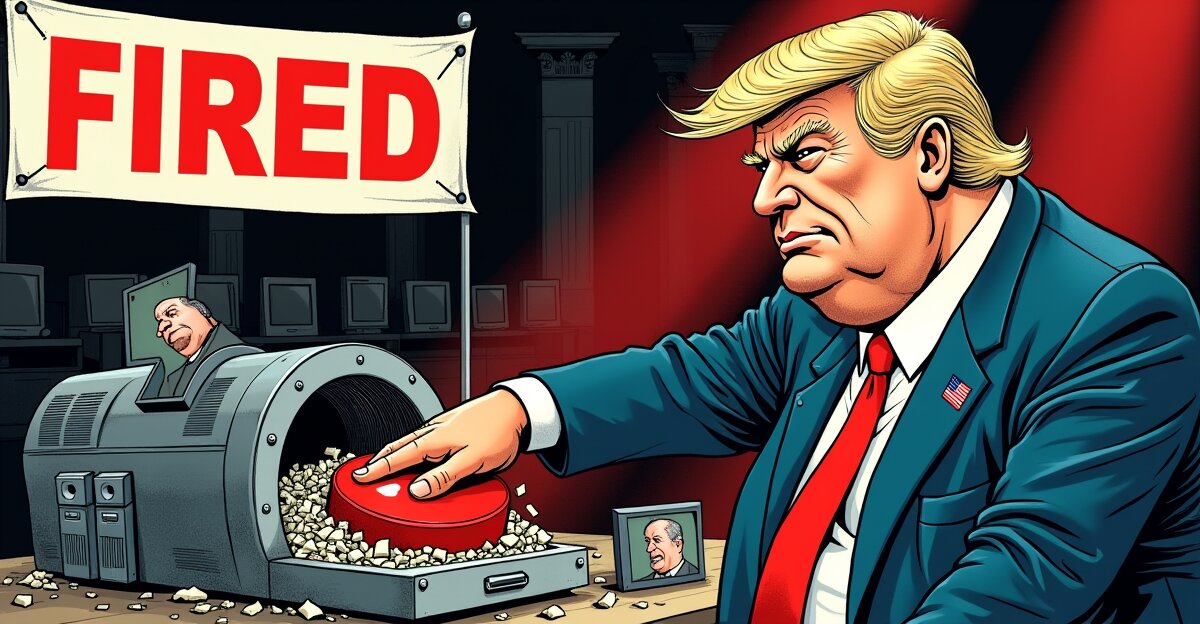
The federal government spent a week on fire, and the White House's answer was to fire the one person whose job was to put it out.
"I didn't think he was good enough."
— President Donald Trump, explaining the firing of National Cyber Director Sean Cairncross, November 20, 2026
Friday was the fifth day of a week in which America's digital plumbing gave way one component at a time. A Microsoft bug that had been sitting in the code for months knocked Outlook and much of Microsoft 365 down across the corporate world. The Federal Aviation Administration issued a rare nationwide ground stop, halting departures across all 22 regional control centers after a flood of data overwhelmed older air traffic systems. Chase's banking services went down on Monday. By Tuesday, NSANet, the National Security Agency's classified internal communications network, had gone dark long enough for the agency to declare a code yellow at its Fort Meade headquarters and tell non-emergency staff not to arrive before noon.
The agency's explanation was a "temporary degradation during routine maintenance," with "mission-critical capabilities remain fully operational" doing a lot of quiet work in that sentence. The Wall Street Journal reported the outage stemmed from a software update. The New York Times reported the network had been unstable for weeks and was a running source of frustration among staff.
The administration's official posture: no evidence of a cyberattack. Transportation Secretary Sean Duffy suggested the ground stop traced to contractor error or a faulty router, and the FAA paused new router installations while it investigated. Homeland Security Secretary Markwayne Mullin told reporters authorities had "not seen any footprints." From Manila, the president called the constant outages inevitable. "Things like that happen," he said, adding that the situation was "very much under control."
Translation: the government's entire nervous system is spasming, and the official explanation is that things like that happen.
The man who was supposed to be in charge had been there for fifteen months. Sean Cairncross has served as national cyber director since August 2025, at the head of the office that coordinates cybersecurity policy and strategy across the federal government. His résumé, as reported, reads like a study in lateral fits: chief operating officer of the Republican National Committee in 2016, a senior adviser to the White House chief of staff during Trump's first term, deputy chief operating officer of the RNC again in 2024. He had no prior cybersecurity career when the Senate confirmed him.
He was also, per NBC News, the administration's public face on artificial intelligence policy, directly involved in deliberations that included Commerce Secretary Howard Lutnick's summer order for Anthropic to take down its two most powerful AI systems over national security concerns. Even before the outages, the doubts were on the record. In May, Politico reported that officials within the administration were worried Cairncross was not equipped to lead the White House's AI efforts. Then the lights started going out, one by one, in the systems his office was supposed to keep standing.
On Thursday the White House confirmed he was leaving. On Friday, asked why, the president supplied the whole autopsy: "because I didn't think he was good enough."
Not good enough to be there when the building caught fire.
The firing did not make the week better; the week kept going. The same day CNN reported that apparent hackers had accessed NCIC, the National Crime Information Center database through which law enforcement agencies nationwide share warrant and background check data, the second major breach of a federal law enforcement system in under three months, after a ransomware group broke into a Bureau of Alcohol, Tobacco, Firearms and Explosives system in August. Hours later, NBC News reported, citing two former USDA officials, that hackers had breached the Department of Agriculture's farmer payment system, forcing the agency to take its loan and payment applications offline.
You can blame a resignation. You can't blame a breach.
That is the arithmetic the White House was forced to do this weekend. A wave of outages gets waved away as glitches. A week later, the wave turns out to have been partly real, and the person who was hired to stand in front of the wave has just been pushed into it.
The replacement tells you what the administration thinks the problem is. Kirsten A. Davies, the Pentagon's chief information officer, will serve as acting national cyber director. The position requires Senate confirmation, but the applause started before any votes were cast. Secretary of State Marco Rubio, who also serves as national security adviser, congratulated her on X. Defense Secretary Pete Hegseth called her "a dedicated patriot and professional" and said he was confident she would advance "President Trump's America First agenda across the cybersecurity landscape."
Davies framed the job herself in the language of a commander: "Our nation stands in the crossroad of analog, digital, and quantum technologies," she wrote on X late Thursday. "Our opportunity is to dominate the cyber landscape for generations to come …but only if we modernize and drive resilience into the foundations our great nation runs on."
The administration's answer to civilian infrastructure rot is a military IT chief who, until last week, was managing the Pentagon's own share of the same fire. The new cyber doctrine fits in five words: more patriot, less patch.
The other thread running through the week is the one nobody at the podium wants to pull: artificial intelligence. Some officials and analysts have suggested AI systems may have played a role in the cascade, and The New Republic attributed the failures in part to code updates rushed through hastily to close the vulnerabilities the AI era has been opening faster than anyone can patch them. The GAO warned this week that hackers had remotely manipulated refrigeration systems at hundreds of European supermarkets. On November 12, the FBI itself warned the public about FaceStealer, a North Korean social engineering operation the Justice Department said was tied to roughly $400 million in stolen cryptocurrency. The threat environment is not a hypothetical. The government is just losing the thread.
House Democratic leader Hakeem Jeffries asked the administration to send officials to Capitol Hill to brief lawmakers, saying the public deserves more transparency. Mike Wiacek, a former Department of Defense analyst, put the skeptics' case in one line: "Without data, I can't say for certain whether this is or isn't a cyber-attack," he said, "but four major outages in under a week (Outlook, the FAA, the banks and now the NSA) look suspicious."
There is a version of this story in which the outages were an attack, and a version in which they were fumbles, and the administration has not given anyone enough to tell them apart. What the record does show is a set of systems that were unstable for weeks, a response built on press conferences about footprints, and a president who, watching the servers go down, decided the right fix was a personnel fix.
The question is not whether this week's failures were hacks or bugs. The question is who the White House fires when the next outage hits: the hacker, or the man holding the bucket.
Comments (0)
No comments yet. Be the first to speak up.
Join the Riot
Login with Google to leave a comment.
Login to Comment