
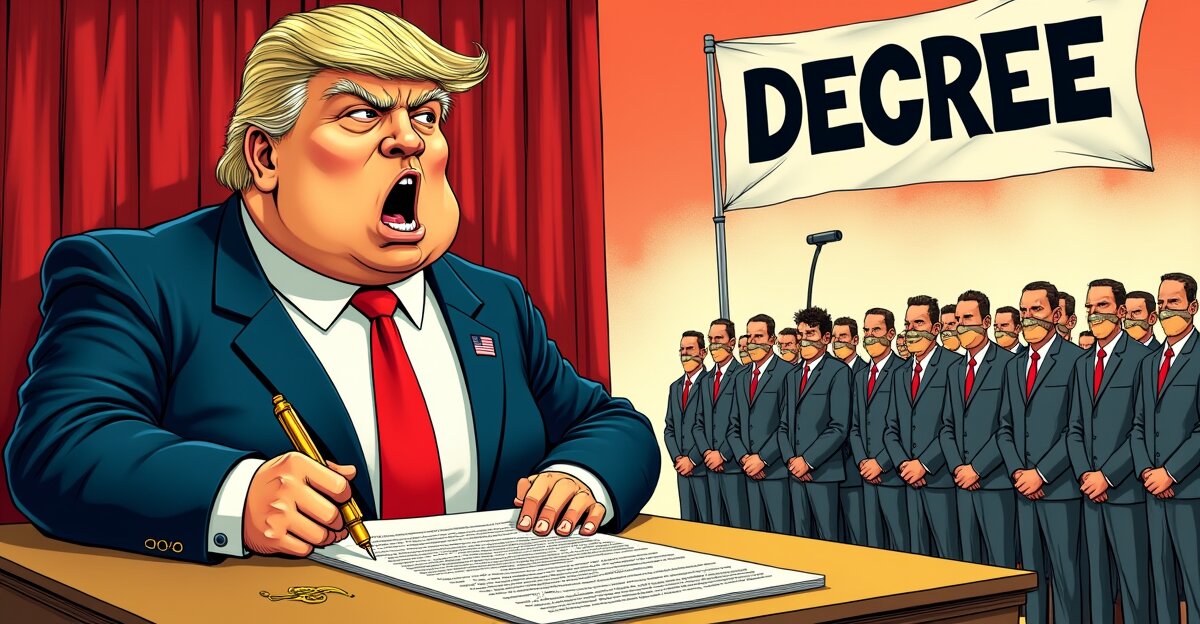
He knows the new Congress is coming for the money, so he has ordered every company that touches it to go quiet.
"We will confront White House corruption and lawlessness with the full powers of Congress, the 'predominant' branch of government (Madison), the representatives of the people. Preserve all your records, Mr. President."
— Rep. Jamie Raskin (D-Md.), who led the 2021 impeachment effort, after Trump signed the order
The order is called "Protecting the Executive's Privileges and Enhancing Efficiencies in Federal Contracting." The title alone is a confession: it spends more syllables on justification than the first draft spends on substance.
Late Friday, President Donald Trump signed an executive order directing federal contractors and subcontractors to notify the White House about any information requests they receive from Congress and to withhold anything the administration deems privileged. The companies must coordinate "appropriate responses" with the White House and the relevant agencies. The order applies to all contractors and subcontractors, a universe of tens of thousands of businesses running the machinery of the American state, from defense primes to the small firms staffed into ICE field offices.
The penalty for noncompliance is spelled out. The White House warns that contracts could be terminated, cancelled, suspended, or that the companies could be debarred from future federal work. In other words, a private company that answers a congressional subpoena truthfully now faces the loss of its livelihood.
Translation: every firm billing the federal government now has a second employer, and the two of them increasingly disagree about who gets the truth.
The timing is the point. Democrats won a "blue tsunami" in the November midterms and take over both chambers of Congress in January, and their stated first order of business is an investigative blitz. "Voters gave congressional Democrats a sweeping mandate to root out corruption and ensure that the government is accountable to the people," Rep. Robert Garcia (D-Calif.), who is expected to lead the House Oversight Committee, wrote in document preservation letters he sent this week to a dozen current and former Trump administration officials.
The White House saw the letters and reacted early. This week, White House Counsel Will Scharf ordered federal agencies to get approval from his office and the Office of Legislative Affairs before any employee agrees to appear before Congress. In a letter to Garcia, Scharf suggested that some of the incoming Democrats' investigations could amount to "blatant criminality." The new executive order simply extends that logic to the private sector: if your company holds a federal contract, your silence is now a condition of your employment.
Garcia called the order part of the administration's "blatant attack on Congress' constitutional right to conduct oversight." Then, in a phrase that has the ring of a countdown: "We're just getting started."
Why contractors, and why now? Because of where the money has gone.
Democrats have vowed to make federal contracts, particularly Pentagon contracts, a major target of the 120th Congress, and for a reason that is not hard to state. Companies affiliated with the president's two eldest sons have scored key federal contracts during his second term, particularly at the Department of Defense. A Reuters investigation found that the Trump family generated at least $2.3 billion from four crypto ventures, with little-to-no downside risk while investors took the other side of the trade. In his first year back, the Trumps pocketed at least $2.2 billion, more than half of it from that family cryptocurrency operation.
Lisa Gilbert, co-president of Public Citizen, laid it out bluntly. "Throughout the Trump administration we've seen widespread abuse of the contracting process, with lucrative contracts doled out to political allies, inexperienced startups, and flatly unqualified bidders, for everything from major ICE operations to Trump's vanity projects," she said. "No-bid and emergency awards have become the norm, circumventing rules designed to prevent corrupt contracting."
The reach of the expected probes goes beyond the family. Rep. Jim Himes (D-Conn.), the top Democrat on the House Intelligence Committee, sent a letter Friday to Elon Musk about SpaceX's role in the Starshield service disruptions in Ukraine last month. "Contracts with Musk are a national security risk and should be treated as such," wrote Jonathan Cohn, political director of Progressive Mass.
The irony is not subtle. Steve Bannon and Peter Navarro, both advisers in Trump's first term, went to jail for refusing to cooperate with congressional investigations. The president who benefited from their silence is now ordering the entire federal contracting universe to have it.
Here is the legal knot at the center of the order, and it is a knot that cuts against the administration.
Congressional subpoenas are enforceable by contempt proceedings under 2 U.S.C. 192, which carries fines and prison time. The statute of limitations on those charges is five years, which stretches well past Trump's departure from office in January 2029. A president can refuse to prosecute. The next one can decide otherwise.
Crowell & Moring, a major government contracts law firm, told its clients that the order "has little precedent in the government contracting field and will force contractors to grapple with how the EO is to be understood in light of existing laws mandating cooperation with Congress." Reuters noted the restrictions "could face legal challenges, particularly if contractors are told to withhold information sought through congressional subpoenas," because executive privilege allows the president to protect certain confidential communications, but courts have repeatedly intervened in disputes over Congress's authority to obtain information.
The order is also not self-executing. It assigns OMB the task of issuing implementation guidance, with no deadline, no notice procedure, and no response clock. For the moment, it is mostly a threat dressed as a rule, and the threat is the operative part.
Executive privilege was designed to keep the president's deliberations confidential. It was never designed to keep a company's invoices confidential.
The White House fact sheet frames the order as "protecting executive privileges from congressional overreach," arguing that "certain congressional leaders have threatened to intrude on these executive prerogatives by seeking confidential executive branch information from executive agencies and harassing private companies that contract with the federal government."
It is worth pausing on that word, harassing. According to this document, a legislator asking a contractor for records that the taxpayer paid for is not oversight. It is harassment. The word choice tells you who the actual threat is in the White House's account of the story, and it is not Big Brother. It is a congressman with a subpoena.
Raskin, the Judiciary Committee's likely next chair, called the order "totally unprecedented and blatantly unlawful," and offered the one sentence in the whole controversy that states the underlying principle: public contractors have "a duty and a right to speak truthfully when Congress calls."
Gilbert put the spin and the substance in the same breath. The order, "dressed up in fancy talk about executive privilege and enhancing efficiencies, is nothing but a naked ploy to try and protect the perpetrators of this corruption. It will not succeed. Sunlight is coming and corrupt administration insiders and contractors, both, will have to face the American people."
There is a final detail in the order that says everything, and it is a detail that requires no analysis to appreciate. It is a threat aimed at private companies that the government can enforce only because those companies want the government's money. That is the entire architecture of the lever: not law, not privilege, not national security, but the federal check.
The new Congress convenes in January with a subpoena power it has already started using, preservation letters already in mail, and a five-year clock that outlasts the man who tried to pause it. Trump has not made his contractors loyal. He has made them afraid, and fear is the one thing that depreciates faster than a subpoena is served.
The question was never whether the order could survive a court challenge. The question is why the White House needed to build a wall between Congress and the contractors before the Congress had even taken the oath.
Comments (0)
No comments yet. Be the first to speak up.
Join the Riot
Login with Google to leave a comment.
Login to Comment