
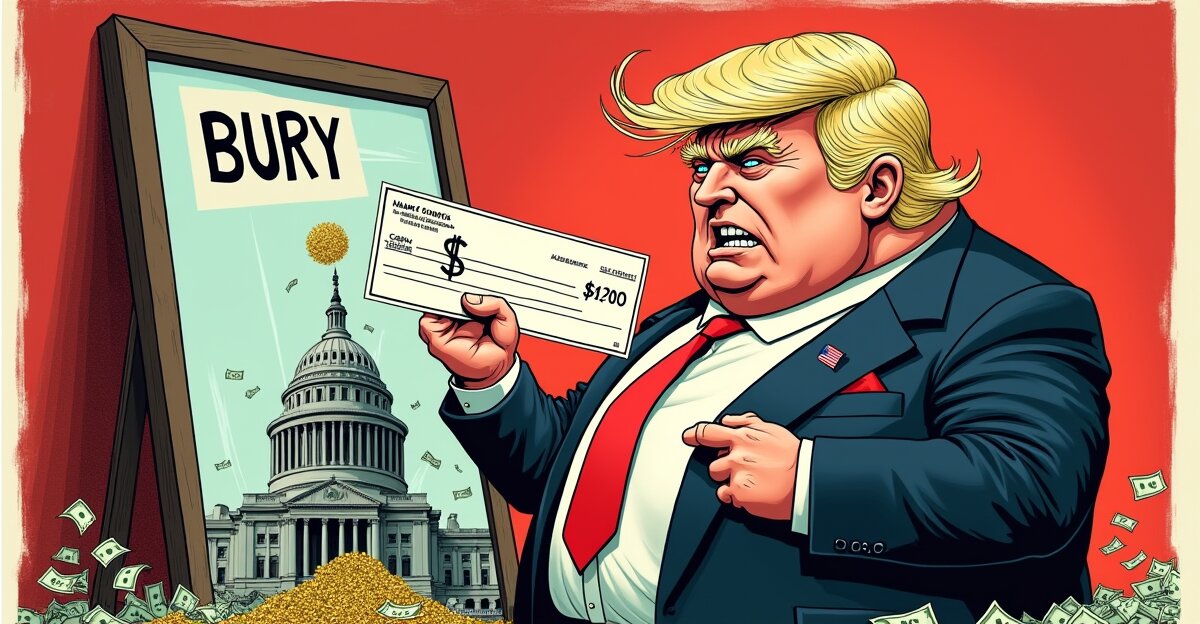
On the morning of the midterm elections, the president announced the end of America's free money to Israel, just as his own government was moving to bury that money inside the Pentagon, where no public can see it.
"Why should we suffer the slings from lunatics like El-Sayed when they don't need it? It's a bad talking point."
— President Donald Trump, on Fox and Friends, November 3, 2026
On the single most important morning for his party in four years, Donald Trump did what he does best. He redefined the news. In a phone interview with Fox News while Americans were driving to the polls, the president claimed that the United States will stop providing roughly $4 billion a year in aid to Israel starting next year. He said Prime Minister Benjamin Netanyahu had pitched the idea "a couple of years" ago. He said Israel doesn't need the money. And he said, almost as an afterthought, that the real problem is Abdul El-Sayed, the Democrat in the Michigan Senate race, who keeps bringing it up.
"It gets cut off at the end of the year. Because they don't need it. I asked them, they don't need it," Trump told the network. He did not explain why an announcement this consequential landed on Election Day, the morning his party is expected to lose its grip on Congress. He did not need to. The timing was the point. Israeli officials had not confirmed the announcement, and the White House had not provided any details. A "deal months ago" apparently produced one sentence on a Fox News phone call.
Start with the boring part: what the $4 billion actually is. It is the annual slice of a ten-year memorandum of understanding that Barack Obama signed in 2016, delivering roughly $38 billion in military and economic aid from 2019 to 2028. The current agreement was already scheduled to expire in 2028, so even on Trump's own timeline, the "cut" would arrive barely a year ahead of schedule.
Josh Paul spent more than eleven years as the director of congressional and public affairs at the State Department bureau that oversees arms transfers to foreign nations. He resigned in 2023 over U.S. military assistance to Israel, which says something about the kind of career this issue ends. Asked about the announcement, his response was essentially one sentence: "It's not plausible there will be a total cut-off starting January 1." The money, he noted, is baked into existing and pending legislation. His guess: Trump was speaking off the cuff about the next ten-year MOU, "in a way that is at best inaccurate or imprecise."
Translation: the money was already on a clock. Trump simply grabbed the microphone on the morning it mattered most.
Here is what the announcement did not touch. The pending National Defense Authorization Act, the roughly $1.15 trillion Pentagon budget, contains a provision that would embed Israeli technology inside American defense programs and the supply chain. Backers call the new relationship "Special Relationship 2.0": less aid, more partnership, a full combination of the two militaries and defense industries, with military and intelligence information handled inside classified Department of Defense operations.
The mechanics are worth sitting with. Annelle Sheline served as a foreign affairs officer in the State Department's Bureau of Democracy, Human Rights, and Labor. Under the old arrangement, money to Israel flows through State security assistance, which carries the Leahy Laws, transparency requirements, and an annual vote in Congress. The NDAA would move that funding into Pentagon procurement, which carries none of those things. "Insulated from public opinion and away from public visibility, U.S. funding to Israel is likely to grow exponentially," Sheline said.
The Institute for Middle East Understanding's Policy Project put it more bluntly: the move "would result in Americans funding Israeli weapons makers in record amounts." In July, a House committee blocked an effort to strip the integration measure out of the Pentagon bill, meaning pro-Israel lawmakers held the votes to keep the door open before the president announced the door was closing.
The aid cut is not a cut. It is a paperwork transfer, from an agency that must show its work to an agency that does not.
Meanwhile, the underlying bill kept running. In the first two years of Israel's war in Gaza, the United States provided a record $21.7 billion in military aid, according to Brown University's Costs of War project, a figure its researchers call highly conservative. The IMEU Policy Project counts more than $20 billion in weapons giveaways since Trump took office, and the war it says was launched at Israel's request has already cost every American household more than $2,000, the equivalent of $262 billion. More is queued up. A taxpayer-funded package of $3 billion in 2,000-pound bombs is still pending, and Trump was careful to note that Israel can still "buy whatever they want" in American weapons.
The war the funding feeds has killed nearly 75,000 people in Gaza and wounded nearly 176,000 more, according to the Palestinian Ministry of Health. A recent United Nations report found that Israeli forces "continue to commit genocidal acts with the genocidal intent to destroy, in whole or in part, the Palestinians in Gaza." The announcement did not mention Gaza. It didn't need to. The announcement was the point.
So why now? The numbers are no longer on Trump's side, and he knows it. A Fox News poll from August 2026 found that 55 percent of Michigan voters, the state that will decide the Senate race, oppose continued military aid to Israel. That includes 70 percent of Democrats, 66 percent of Independents, and 35 percent of Republicans. An October poll by the IMEU Policy Project and YouGov found majorities in six key swing states, Georgia, Iowa, Maine, North Carolina, Ohio, and Texas, supporting a halt on bomb transfers. Gallup data shows sympathy for Israel has fallen from roughly half of Americans to 36 percent, while sympathy for Palestinians has climbed to 41. Among Democrats, support for Israel has collapsed from more than 50 percent in 2001 to about 17 percent this year.
In the race that set the timing, El-Sayed has made the aid a central issue. The president's answer was not to defend the spending. It was to declare it a bad talking point and promise to take it away. "The left uses the $4 billion payment, that everybody knows about, it's no secret, as a signal of unfairness, and we can't allow that to happen," he said.
Translation: when a foreign policy becomes an electoral liability, the fix is not to end it. The fix is to move the bill out of sight.
There is one final layer, the kind of detail that makes the story worse instead of better. In the same interview, Trump floated the idea that if Americans ever got tired of him, he would "move to Israel and become prime minister." The timing was awkward for reasons he may not have calculated. Netanyahu has been fighting for his political life after an inconclusive election in Israel last week. Meanwhile, Jared Kushner, the administration's key negotiator on Gaza, owns a private equity firm that is the largest shareholder in a Tel Aviv company investing heavily in Israeli arms makers, according to reporting this fall. The president says he is cutting off the money. His people are taking equity in the recipient.
When a president announces that America is ending its payments for Israel's bombs, the first question should be what actually changes. The aid does not end. It moves. It moves from a State Department process with an annual vote and a body of case law into a Pentagon procurement process with neither. It moves from a line item critics can quote on television to a classified partnership that its backers are already calling a "special relationship." The number on the check goes down. The checks go underground.
The question was never whether America would stop paying. The question is who gets to see the receipt.
Comments (0)
No comments yet. Be the first to speak up.
Join the Riot
Login with Google to leave a comment.
Login to Comment