
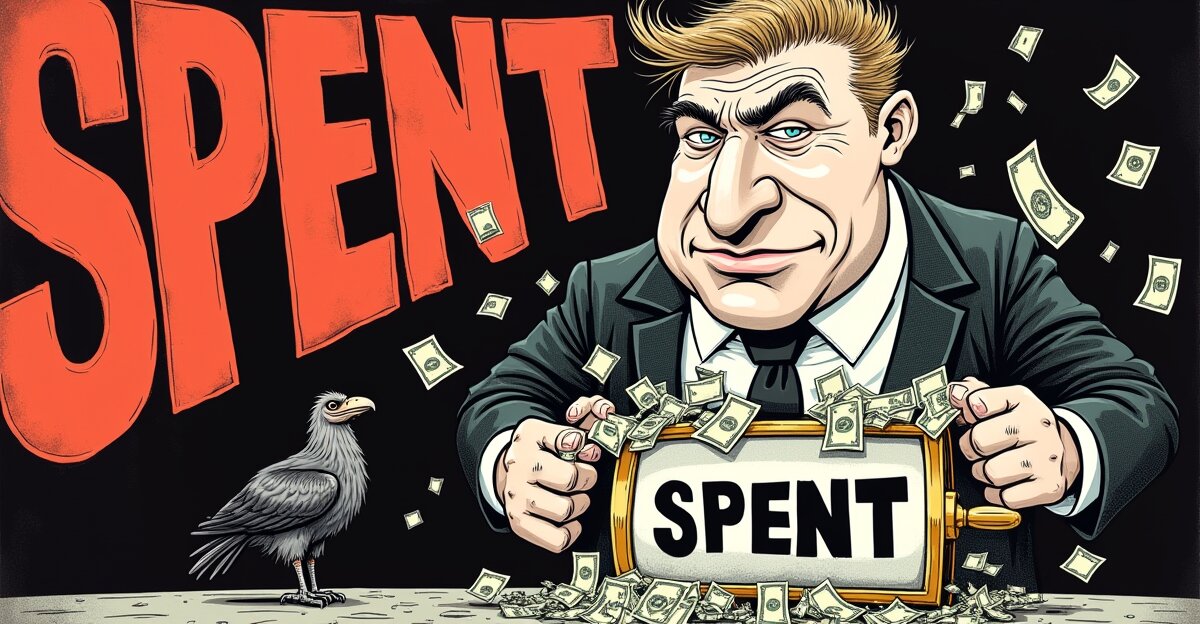
He spent $445 million trying to buy the midterm elections, and the only thing he bought was a congressional subpoena.
"Paxton is funded by one dude. Elon Musk wants our land. He wants our water. He wants our tax dollars. He wants his very own personal United States senator."
— James Talarico, at his final rally in Austin, Texas
The world's first trillionaire went to war with the 2026 midterm elections, and he lost so badly the receipt is now public record. By Election Day, Elon Musk had poured at least $445 million into Republican causes, according to The Associated Press. The Guardian counted $446 million. Forbes Middle East said $458 million. Nobody is disputing the order of magnitude: it is the most a non-candidate has ever spent on a single American election, and roughly what a person on a $100,000 salary would save over 4,400 years, down to the last penny.
The money did not arrive politely. The Brennan Center for Justice counted 40 mega-donors putting up $2.5 billion in the 2026 cycle, the vast majority for Republican candidates, but Musk outgave the entire cryptocurrency industry by more than two to one, all by himself. He set aside more than $100 million for a get-out-the-vote ground operation, funneled millions through the Senate Leadership Fund into statehouses that needed saving, and warned his opponents, in his own words and on his own platform, that he was preparing to go to war with anyone who threatened to investigate his business practices or his time running the Department of Government Efficiency.
A trillion is a big number, but so, it turns out, is an exit poll.
The centerpiece of the operation was Texas, Musk's adopted home, where he has based himself, several of his companies, and an appetite for land, water, and tax breaks. He put at least $158 million behind Ken Paxton's bid to leap from impeached state attorney general to United States senator, with more than $200 million going to Texas-related efforts overall, according to Politico. The channel was the Senate Leadership Fund, and the effect was to flood the state's vast media market with one message: James Talarico, the Democratic challenger, is a transgender-rights extremist.
It was Gilded Age theater, as Truthout put it: a non-candidate oligarch, in broad daylight, trying to buy himself a senator. Talarico and gubernatorial candidate Gina Hinojosa ran the other side of the ledger. Hinojosa told a crowd in Austin that Musk had collected a $1.7 billion property tax break in Texas, property taxes "that the rest of us have to pay full price on." The AP's own voter poll of more than 5,000 Texans found slightly more than half of voters holding an unfavorable view of Musk, in a state whose median household income is $85,000. The pitch was simple: no billionaire has ever spent this much to buy your state's loyalty, and the price includes your land, your water, and your tax dollars.
Translation: the most expensive Senate candidate in American history lost, and the invoice is public record.
The results read like a box score for a heist gone wrong. Talarico won the Texas Senate seat, the first Democratic statewide victory in the state in more than 30 years. Hinojosa unseated incumbent Greg Abbott in the governor's race, where Musk had also injected at least $5 million. Democrats took the Texas state House. In Ohio, Vivek Ramaswamy lost the governor's race. In New Hampshire, John Sununu lost the seat the party had flagged as a possible pickup. In New York's 17th congressional district, the money could not save Mike Lawler. Truthout's tally concluded that more than 98 percent of Musk's dollars produced zero political gain.
On election night, Musk joked on X, the platform he owns: "Guess my election-interfering space lasers didn't work this time." He followed it up, hours later, with "Data centers in space looking pretty appealing right now." In the wake of the loss, he deleted dozens of election-day posts that had urged Americans to vote Republican. The silence after the deletions said more than the tweets did.
The billionaire tried to outspend the electorate and learned that a vote, unlike a market, cannot be cornered.
The markets voted too. On Wednesday, Tesla's market cap shed roughly $40 billion and SpaceX's shed about the same, and Forbes tallied a $45 billion hole in Musk's net worth in a single day. "Worries that he may face congressional investigations contributed to the early plunge for his benchmark firms," said Joe Mazzola, a strategist at Charles Schwab, which is about as close to a postmortem as a Wall Street professional gets. And the investigations are real, not hypothetical. Democrats in Congress were, per the AP, already queuing for their shot at Musk, with subpoenas and hearings in the queue. Virginia Democrat James Walkinshaw wrote that Musk "waved a chain saw on stage and laughed while he fired public servants and gutted the services Americans rely on," and that he "must answer for it under oath."
The Texas ledger will add up too. In August alone, Musk's companies collected a $30 million state grant for a semiconductor plant projected to create 3,000 jobs, one of several cash infusions his businesses have drawn from state programs. With a Democratic governor and a Democratic House in Austin, every one of those deals is now reviewable.
History has a folder for this, and it is not empty. Michael Bloomberg put more than $1 billion into a presidential campaign in 2020 that went nowhere. Tom Steyer spent upwards of $200 million on a futile run for California governor. Musk's Texas bet was the first time a non-candidate donor has ever committed this much to a single marquee race, and the first time the receipt has come due in public. The difference this cycle is that the electorate learned the trick. The Democrats did not try to outspend him. They made his spending the issue, and in a moment defined by rage at economic elites, the brand became the liability.
The incoming Texas Democrats are already naming the bill. Gene Wu, who will lead the newly empowered state Democratic caucus, promised that "this era of open corruption is going to come to an end." Representative Greg Casar put the national version in a single line: voters rejected Republicans in part because they were "bought and paid for by AI billionaires," and Democrats "must hold them accountable instead of cashing their checks." Even Chip Roy, the outgoing Texas congressman on the losing side, conceded that at some point "you're reaching the upper bound of the benefit of any of these dollars."
Musk had warned he would go to war if he lost. He did not have to: the war came to him. It arrived as subpoenas from a Democratic Congress, a Democratic governor and a hostile state ledger in Austin, and a public reckoning over the $1.7 billion in tax breaks that made the whole operation possible. The $445 million was supposed to buy a senator. It bought a subpoena, a hostile statehouse, and a lesson in the one asset that does not trade: the electorate. Texans can't be bought. They just needed a trillionaire to find out the hard way.
Comments (0)
No comments yet. Be the first to speak up.
Join the Riot
Login with Google to leave a comment.
Login to Comment