
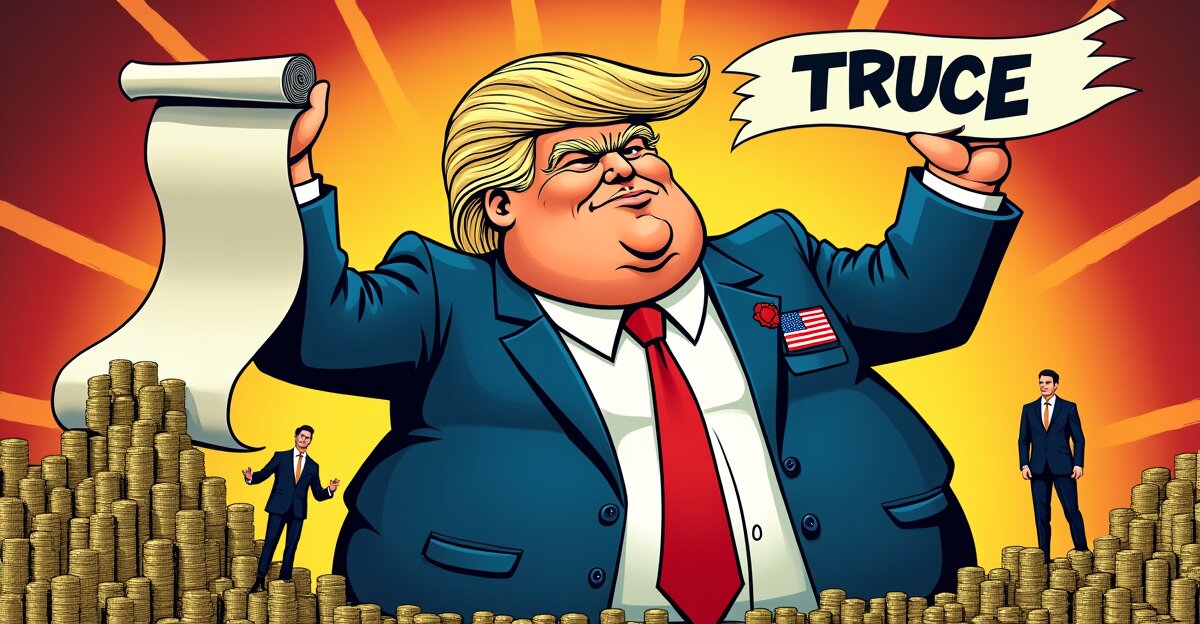
The three largest nuclear powers just declared peace. The first item on the agenda was telling the world's war crimes court to mind its own business.
"They agreed that the International Criminal Court and other similar institutions must not abuse their jurisdiction."
— The US-China-Russia "Peace Declaration," signed in Shenzhen, November 19, 2026
Ninety minutes on Thursday, the leaders of the three largest nuclear arsenals on earth sat in one room in southern China and, by their own account, "are really making history." The trilateral in Shenzhen, on the sidelines of the APEC gathering, was the first of its kind: Trump, Xi, and Putin, together, with cameras rolling. The Kremlin's nuclear briefcase showed up in the photos. Russian papers called it a diplomatic victory. European leaders, analysts noted, huddled nervously in Berlin at a Coalition of the Willing meeting, watching three men who looked set to redraw the map of what counts as the international order. Comparisons to Yalta started before the meeting even ended.
What they produced was a "peace declaration." It pledged that "nuclear war cannot be won and must never be fought." It committed the three to reforming the United Nations, to dialogue on reducing nuclear risks, and to steadying energy flows after the American war on Iran closed the Strait of Hormuz in February, the waterway that once carried a fifth of the world's oil.
For most of its length, it read like a photo op. Then it said the one sentence it had actually been assembled to say.
The declaration "agreed that the International Criminal Court and other similar institutions must not abuse their jurisdiction." It stressed state consent and "respect for the immunity of officials." In the language of international law, that is a description of a shield.
The shield is for one man above all. In March 2023, the ICC issued an arrest warrant for Vladimir Putin, accusing him of the war crime of unlawfully deporting Ukrainian children from occupied territory to Russia. That warrant is why Putin has skipped recent G20 summits: the European members of the grouping made clear they do not want to share a room with him, and his presence in a state party risks triggering an arrest obligation.
Translation: the three governments most exposed to that court just told the court, jointly, to look the other way.
Trump was not subtle about the subtext. In his opening remarks he called the ICC "out of control." Then, in a move that made the declaration's immunity language read less like rhetoric and more like policy, he invited Putin to the G20 summit the United States is hosting in Miami next month. The U.S. is not a member of the court. It has no obligation to arrest him.
The Shenzhen clause is the diplomatic tip of a much longer, uglier campaign. The United States has been at war with the court since 2020, when the first Trump administration sanctioned the prosecutor and judges who opened an investigation into alleged American war crimes in Afghanistan. The Biden administration lifted them. The second Trump administration brought them back, and then escalated.
In February 2025, Washington sanctioned the court's chief prosecutor, his two deputies, and six judges, nearly all of them because they had investigated the conduct of U.S. personnel or had voted for the ICC's arrest warrants for Israeli Prime Minister Benjamin Netanyahu and former Defense Minister Yoav Gallant over the "war crime of starvation" in Gaza.
In October, the administration went after the court itself. Hours after former ICC judge Navanethem "Navi" Pillay, a South African jurist, won the 2026 Nobel Peace Prize, the Treasury imposed sanctions on the entire institution: no dollar-denominated transactions, frozen U.S. assets, and a ban on using the American banking system. In the administration's own framing, the court is a "rogue" body that must be "dismantled." The ICC called the move "an assault on the rule of law."
Trump's response to the Nobel, from a man who has campaigned for the prize for years, was to dismiss Pillay as "a liberal person who works at the United Nations, who nobody has ever heard of."
The economic aim is not symbolic. The court's staff and operations run on international financial rails, and those rails are paved with dollars. France's Axa terminated its life and health insurance contracts with the ICC in October, reportedly citing the American campaign. European institutions, some of them well outside American jurisdiction, are preemptively cutting ties before Washington comes knocking. The point is not to close the courtroom. It is to stop the payments.
The legal architecture of the threat has been in place for twenty-four years. The 2002 Hague Invasion Act, signed by George W. Bush and still on the books, authorizes the president to use military force to free any American, or ally, held by the ICC. Last Friday, Secretary of State Marco Rubio updated the doctrine at a National Lawyers Convention keynote with a quote from the Roman general Pompey: "Stop quoting laws to men with swords."
The reversal deserves a moment. Rubio spent fourteen years in the U.S. Senate co-sponsoring a resolution urging other nations to support the ICC's investigation of Russian war crimes in Ukraine. The same man now tells a room of lawyers that "the fundamental purpose of the law, American law and international law alike, is to weaken the United States."
While the declaration was being signed, the war it does not name kept going. On Tuesday, a Ukrainian missile and drone attack destroyed the central road section of the Crimean bridge. On Thursday, Putin promised a "far more painful" retaliation. Kyiv was hit by Russian drones during the same hour as his post-summit press conference.
The war is in its fifth year. The "peace declaration" does not mention Kyiv once. A Kremlin spokesman said Ukraine was not even the "central topic" of the trilateral. What the declaration does mention, pointedly, is a courtroom, and the message is that the courtroom has overstepped. The two wars the three powers are actively fighting, Ukraine and Iran, get one line of energy talk between them. The institution built to prosecute the men who started wars gets a joint rebuke.
This is the part that should worry even people who hold no particular love for The Hague. The postwar order was built on a simple, unglamorous idea: that the men who order the killing can be tried, and that the power which drafted the rules will answer to them. The United States was the chief prosecutor at Nuremberg and Tokyo. American judges wrote the charges. "Never again" was a product of American hegemony, and the institution meant to enforce it was built under American leadership.
Now the three largest nuclear powers on earth have issued a joint statement telling the world that courts must not exceed their jurisdiction, that officials are immune, and that consent is the only jurisdiction that counts. It is a peace declaration signed by the men in the dock, on behalf of the men in the dock.
The three powers have made their peace. The only institution not invited to that peace was the one whose job is to prosecute them. That is not a detail in the "peace declaration." It is the entire point of it.
Comments (0)
No comments yet. Be the first to speak up.
Join the Riot
Login with Google to leave a comment.
Login to Comment