
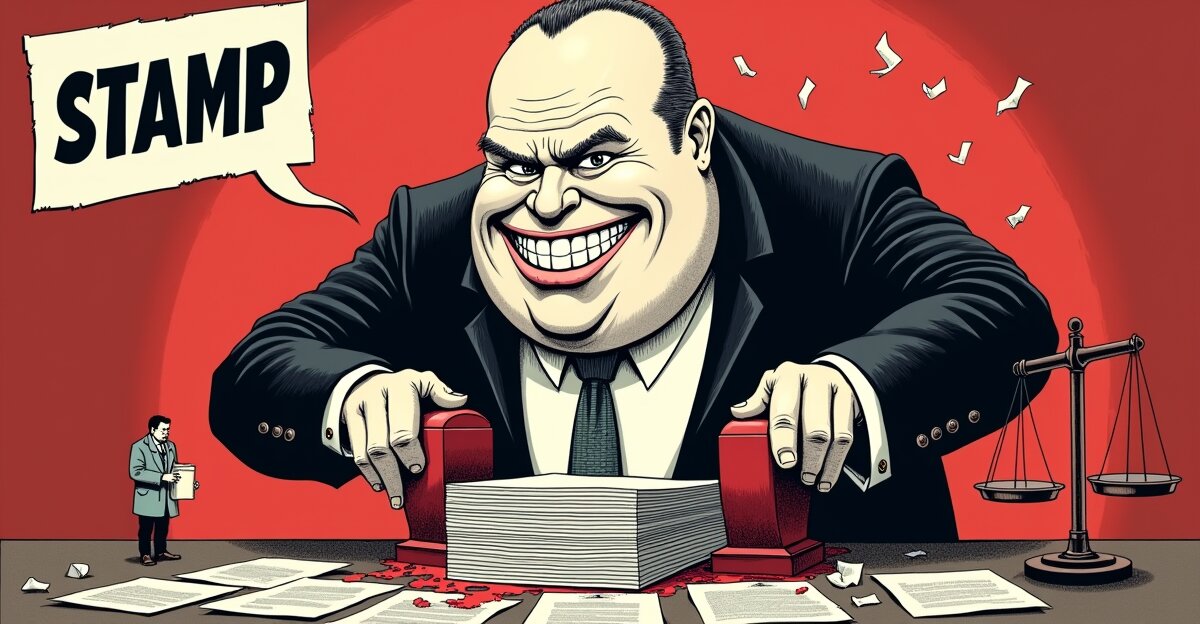
The architect of the most aggressive paperwork crackdown in a generation just became the paperwork problem.
"Miller's own filings don't add up, and the White House signed off on them anyway."
— Zach Everson, Public Citizen Research Director
The man who has spent the last year defining what a paperwork error looks like in America now has paperwork of his own that does not add up.
Over the past seven weeks, the Justice Department has charged dozens of immigrants, nearly all of them green-card holders, with making false statements on voter-registration forms or citizenship applications. On Oct. 12, federal agents searched the Washington home of a sitting member of Congress, Rep. Ilhan Omar, as part of an investigation that, according to the Wall Street Journal, involves whether her age was misstated on immigration paperwork 26 years ago. The administration's pitch is simple, and it has been repeated until it became an ideology: the document is the case. Get the paper wrong, and the consequences follow.
No one has repeated that pitch louder than Stephen Miller. In 2023, the man who now serves as White House deputy chief of staff and homeland security adviser wrote that the Trump-era "denaturalization project," a program that can strip Americans of citizenship over misstatements on their immigration paperwork, would be "turbocharged" in 2025. In March, Vice President JD Vance said publicly that he and Miller had discussed how to "go after" Omar, claiming without evidence that she committed immigration fraud. Miller is not a bystander in this paperwork era. He is its chief architect.
So when Public Citizen published its forensic report this week, comparing the official's own financial disclosures against the certificates of divestiture issued to his family by the Office of Government Ethics, the group was not reaching for metaphor. The report, titled "Rules for Thee: Stephen Miller's Paperwork Problem," found that in at least 10 of the 27 stock sales listed on Miller's Aug. 29, 2025, transaction report, "the reported proceeds are too low to match the shares listed on the certificates of divestiture at any price those stocks traded on Aug. 14, the day of the sales."
Translation: the government certified that Miller's family sold a specific number of shares on a specific day, and on the very form where he was required to report what they brought in, he reported less than those shares could have brought in at any price they actually traded for that day.
The largest gap is the most suggestive. MP Materials, the rare-earth mining company the Pentagon made its largest shareholder five weeks before the sale, through a "transformational public-private partnership." Miller's family was certified to sell 3,000 shares. At the day's lowest price, they were worth at least $223,050. Miller reported the sale in the $50,000-to-$100,000 range.
Even at the day's lowest price, the sale was worth more than twice the top of the range Miller reported.
The report does not stop at one line item. The shares certified for sale from the three children's custodial accounts were worth roughly $443,000 to $507,000 per child on the day of the sales, about $1.4 million in all. By the end of 2025, according to Miller's annual report, each account held just $1,000 to $15,000 in cash, plus, in one account, Spotify shares it already owned. The report does not explain where the rest of the money went.
His wife's IRA tells the same story. In March 2025, Katie Miller's IRA held shares of Arm Holdings, Spotify, Alphabet, Viking Therapeutics, MP Materials, Apple and Amazon. On the year-end report, the IRA holds just Spotify shares and cash. Miller's only transaction report for the year lists no sales of Alphabet, Viking Therapeutics or Apple at all. The holdings did not move. They simply stopped being reported.
The White House response arrived the way White House responses always arrive: a statement of principle with no engagement with the facts. Spokeswoman Lauren Bis said, "The White House regularly works with appointees to provide ethics guidance and help ensure compliance with applicable federal ethics laws and regulations. Stephen Miller complies with all ethics requirements." She did not address a single specific discrepancy. Nor did anyone mention that White House Deputy Counsel Scott Gast certified Miller's 2025 annual report on Sept. 3, 2026, with the inconsistencies sitting in plain sight across his earlier filings.
Certification is the point of the system. An ethics official signs the document, and the document is presumed to have been checked. In Miller's case, the signature appears to have preceded the arithmetic.
And the stakes are not hypothetical, because the statute at issue is the same statute this administration is now loading against immigrants. Under the Ethics in Government Act, knowingly and willfully falsifying a financial disclosure carries a civil penalty of up to $75,540. Under the federal false-statements statute, it is a crime, punishable by up to five years in prison.
That last number is the one that stings: five years is also the ceiling facing many of the immigrants charged in recent weeks over misstatements on voter-registration and citizenship forms.
Nobody is asking for federal agents to search Miller's home. Public Citizen's demand is narrower, and in a functioning system it should be enough: have OGE review the filings, require an explanation, and confirm the holdings are dutifully reported. Whether the gaps are sloppiness, bureaucratic error or something else is a question the White House has declined to answer. But the pattern is not a question. For seven weeks, this administration has treated a one-time error on a green-card holder's form as a federal charge, and the age on a 26-year-old immigration document as grounds to search a sitting member of Congress.
By the administration's own logic, a certified sale reported at barely half its minimum value, a family fortune of roughly $1.4 million that evaporates from the ledger, and a certified signature on top of all of it should be worth at least a corrected filing.
The paperwork era began with a promise of equal standards. Miller's own file shows what the standard actually is.
Comments (0)
No comments yet. Be the first to speak up.
Join the Riot
Login with Google to leave a comment.
Login to Comment