
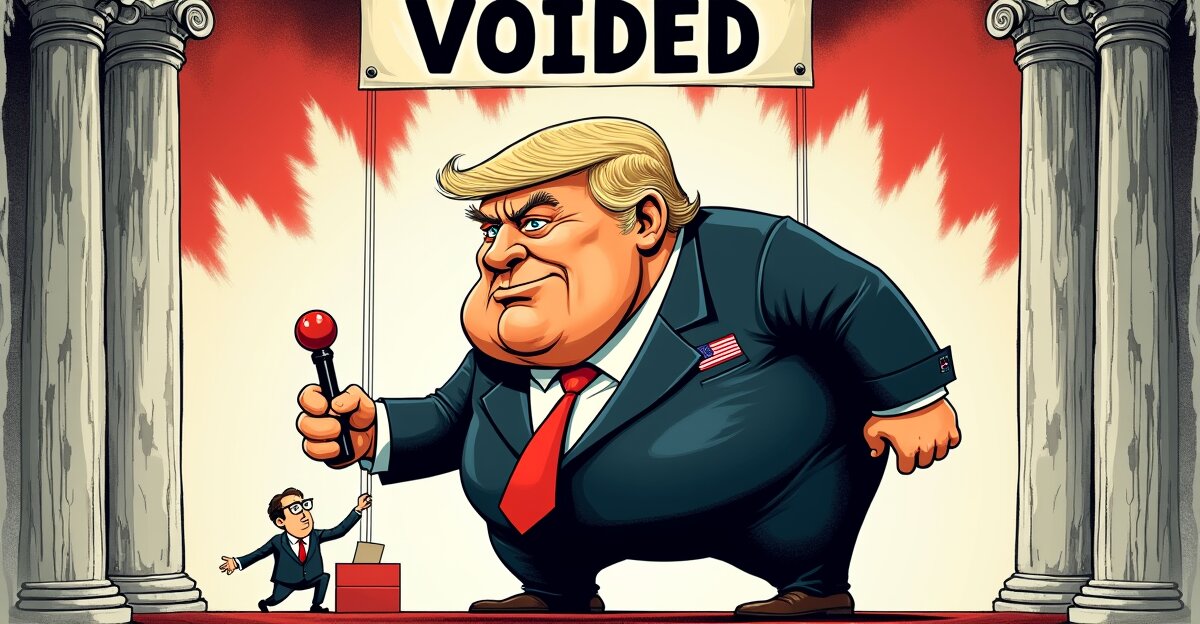
The Justice Department sued the State of Alaska to stop it from counting its own votes on the eve of the election, a legal trap built to spring only if the president's candidate lost.
"I don't even have my glasses on. It's pretty clear. It's in black and white."
— An Alaska voter, on which of the two Dan Sullivans on the ballot is the incumbent senator
On Sunday, two days before Alaskans head to the polls, a federal judge in Anchorage threw out what may be the strangest election lawsuit in modern American history. The Justice Department had sued the State of Alaska, asking a court to block the state from certifying the results of its U.S. Senate race. With one condition. The suit, filed in federal court on October 22 while early voting was already underway, asked the court to freeze the election "if . . . Senator Sullivan does not win the election," and only if reallocating every vote cast for the second Sullivan to the incumbent would change the result. Then it asked for an investigation into whether voters had confused the two candidates who share his name.
Judge Sharon Gleason, a U.S. District Judge appointed by Barack Obama, dismissed the case in full. The government, she wrote, had offered "no workable plan" for what it wanted to do, and what it wanted to do was impossible anyway.
"Simply, the Court cannot grant the United States the relief it seeks."
Translation: a lawsuit that only activates if the president's party loses is not a legal theory. It is an outcome with footnotes.
The ostensible problem is a name. Alaska's November 3 ballot lists four candidates for U.S. Senate: incumbent Dan S. Sullivan, a Republican seeking a third term; former Rep. Mary Peltola, the Democrat; Gerald Heikes, a second Republican; and Daniel J. Sullivan Jr., a retired schoolteacher with no party affiliation. The ballot clearly marks the senator as "Republican" and "Incumbent." The retired teacher has neither label.
CNN asked Alaskan voters about the confusion the federal government had been warning about. "Not a bit," one answered. "You've got Daniel J. Sullivan Jr., and then you have Sullivan Dan, who's a registered Republican and incumbent. And I don't even have my glasses on. It's pretty clear. It's in black and white."
The entire federal emergency rested on the theory that a state of a little over 700,000 people could not read its own ballot.
The dispute itself is not new. It has been running since June, and the Republican side has already lost it twice in state court. On June 10, the Alaska Republican Party filed a complaint asking that Sullivan Jr. be removed from the ballot as a bad-faith effort to confuse voters. Five days later, the director of the Alaska Division of Elections removed him. He sued. In June, the Alaska Supreme Court ruled that under state law he had to be on the ballot. He ran in the August open primary, finished fourth with roughly 2.5 percent of the vote, and earned a place on the ranked-choice ballot.
Then, last week, The New York Times reported that Peltola's campaign and the Democratic Senatorial Campaign Committee had recruited Sullivan Jr. as a spoiler. Peltola has denied any involvement. "I am not interested in tricking voters," she said. Sullivan Jr., who says he never communicated with her campaign about entering the race, has not answered recent requests for comment. The Times report remains unproven, and it is the subject of an investigation.
What the report did trigger was a cascade. On Thursday, the Justice Department expanded a criminal probe into Sullivan Jr.'s candidacy and issued grand jury subpoenas to Democratic officials. On October 30, the U.S. Attorney for Alaska announced at a press conference in Anchorage that the probe was "ongoing." The state's Republican governor, Mike Dunleavy, ordered his own investigation and suggested the state might withhold certification. "If we find out there's wrongdoing, and if that means the certification then is stopped or changed, then that's what happens," Dunleavy said. And the president posted on Truth Social: "Mary Peltola should suffer the Legal and Political consequences for what she has done, A FRAUD ON THE AMERICAN PEOPLE, and Dan Sullivan should be allowed to run without either Mary Peltola or FAKE Dan Sullivan on the Ballot."
The state's own courts had already decided this question twice, against the Republican Party. The federal government's innovation was to ask a different court to decide it a third time.
The legal theory was on no ground. The DOJ's complaint cited the National Voter Registration Act. The NVRA is a law about voter registration, how states keep their rolls current. It says nothing about ballot access, candidate placement, or the certification of election results. It is the legal equivalent of suing a highway patrol over the taste of a restaurant because the patrol's charter mentions public safety.
State attorneys called the filing "meritless." The ACLU, which intervened on behalf of Alaska voters, the League of Women Voters of Alaska, and Common Cause, pointed out that the NVRA "sets requirements only for voter registration practices."
Gleason's ruling went beyond procedure. The relief the DOJ sought, she wrote, was "infeasible" given the volume of votes already cast. More fundamentally, it would have violated the right to a secret ballot.
"The absence of any explanation from the United States as to how its requested relief could redress its alleged injury while simultaneously maintaining the secrecy of the ballot is telling," she wrote. "If this Court were to order that certain ballots will be segregated and subject to a future and as yet unspecified investigation by law enforcement, it would likely result in voter 'confusion and consequent incentive to remain away from the polls.' Such late-breaking changes to the election rules are strongly disfavored."
She also invoked the Purcell principle, the doctrine that federal courts should not change election rules on the eve of an election, and the Constitution itself, which leaves the conduct of elections to the states.
The DOJ plans to appeal. A spokesperson, Kiersten Pels, told NPR that "Alaskan voters deserve a fair election, not to be misled in an attempt to rig outcomes." The department's Rapid Response account on X insisted the case was "dismissed on procedural grounds" while maintaining that Daniel J. Sullivan "entered the race as a frivolous candidate to confuse voters," a man the department referred to by the nickname Decoy Dan.
The incumbent had his own position. On Sunday, Dan S. Sullivan told CNN that he would accept the election results, win or lose, while also noting that he was "sure I'm going to lose a lot of votes to that trickery."
"Accept the results, win or lose," said the senator who had spent the previous week presiding over a federal lawsuit designed to make losing a legally unresolved event.
The history is worth a moment, because the decoy-candidate complaint has a partisan pedigree. Republicans and their allies have a long record of fielding their own spoiler candidates to split opponents' votes. The state told Gleason that Alaska had already taken "significant steps" to help voters tell the two Sullivans apart, and that a confused voter could simply ask for help at the polls or read the candidate statements in the official state election booklet.
What is not in dispute is this: whatever is true about the recruitment of a man with the incumbent's name, the federal remedy the Justice Department sought was to freeze the entire election. Not to remove a candidate. Not to clarify a ballot. To hold a state's count in escrow until an unspecified future investigation decided whether the result was acceptable.
And the count had already started. More than 86,700 Alaskans had cast early ballots before the judge ruled.
The race is a swing seat that could determine control of the Senate, and that is the whole point. The lawsuit was never about the ballot. It was about the outcome. A filing that does nothing if the incumbent wins and voids the election if he loses is not an enforcement action. It is a wager, placed by the United States against a state it expects to lose.
The judge saw through it. The ballot itself did not need seeing through. Two names, one marked Republican and incumbent, one marked with nothing at all, and, in the words of the man asked about the confusion, clear in black and white, glasses optional.
The question was never whether Alaskans could tell the two Sullivans apart. The question is what a Justice Department does when its first instinct is to reach for the counting machine before the boxes are even open.
Comments (0)
No comments yet. Be the first to speak up.
Join the Riot
Login with Google to leave a comment.
Login to Comment