
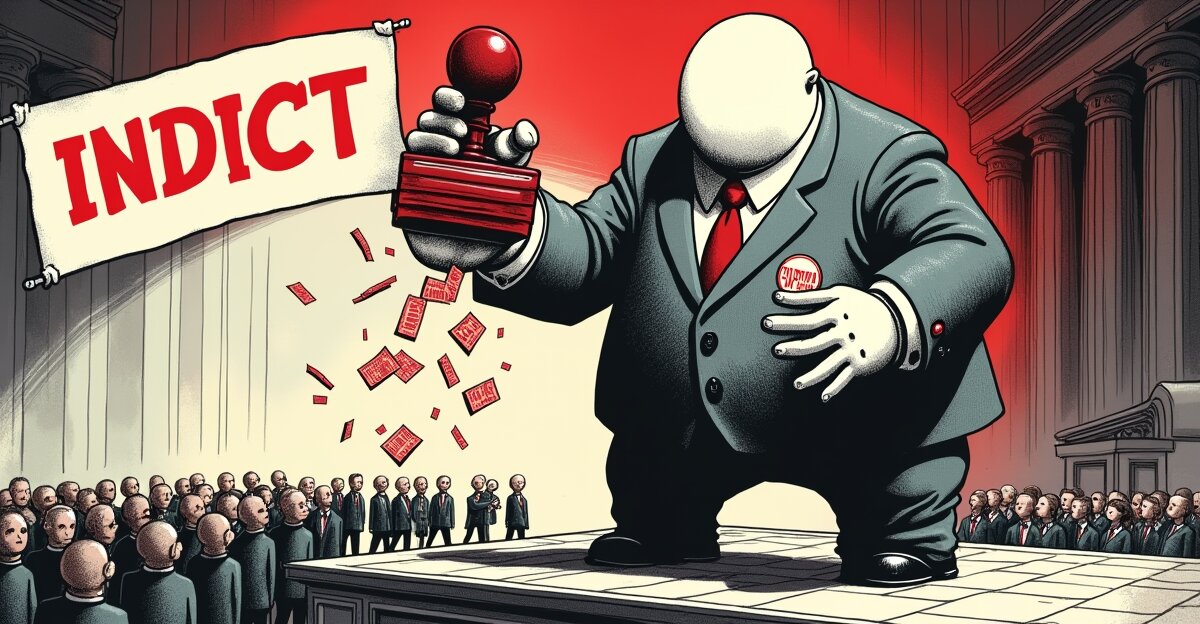
Twelve students are in federal court over some spray paint, and to finish the job, the government subpoenaed a union of 1.7 million members.
"I think that this is a strategy that the federal government is using in order to try to actually receive the information that they are trying to get by usurping us as a local union and going instead to AFT national."
— Hiab Teshome, president of the Graduate Employees' Organization
In August 2026, no headlines ran. There was no press conference, no photo op, no post on the president's social media app. At its Washington headquarters, the American Federation of Teachers received a federal grand jury subpoena. Inside were demands for complete membership rolls, staff personnel records, payroll records on officers, reimbursement policies, audit reports, and every transcribed minute of membership and executive board meetings for the University of Michigan local, going back to January 2023, a year before the protests this case is about began.
The AFT has more than 1.7 million members across more than 3,000 local chapters, making it one of the largest and most consequential labor organizations in the country. The federal government did not subpoena the local union caught up in the case, the Graduate Employees' Organization, Local 3550, which was served first, on August 11. It subpoenaed the parent, the giant, the institution that could not be ignored. Because what the government wanted was not one union's paperwork. It wanted the map.
The subpoena is tied to a federal investigation into pro-Palestine protests at the University of Michigan, now known as the "Michigan 12." The protests began in 2024, when students occupied campus to pressure the university to divest its holdings tied to Israel, and continued through 2025 and 2026 in rallies and paint and police. The government's theory of the case, as laid out in its filings, is that the students ran a sustained pressure campaign involving vandalism and threats. The original eight were indicted for conspiracy to transmit threats in interstate and foreign commerce and for conspiracy to intimidate a witness.
Then, on October 29, the FBI raided the home of a Detroit public school teacher on his way home from teaching, agents with rifles pointed at the windows, refusing for an hour to show a warrant. The next day the government unsealed a superseding indictment adding four recent University of Michigan graduates, and the Michigan 8 became the Michigan 12. All twelve now face sentences ranging from five years to several decades for conduct the government's own press release described as a protest campaign.
Here is the detail that should chill anyone who has ever signed a petition: in that press release, U.S. Attorney Jerome F. Gorgon Jr. claimed the defendants aimed "to terrorize our Jewish community" and compared them to Hitler and to the biblical Pharaoh. None of the twelve has been charged with terrorism, with a hate crime, or even with a direct count of vandalism.
The government's theory of the case is a protest. The charge is a conspiracy.
The timing of the union subpoenas is the detail that makes the whole thing read as what it is. The AFT subpoena, like GEO's, was signed the same day that politically motivated embezzlement charges against Teshome, the graduate union's president, were thrown out. Local prosecutors and the university police had charged her with felony embezzlement, alleging that while she sat on the bargaining team in the middle of contract negotiations, she misused union funds to buy laptops for a campus club. The university's student government found her cleared of wrongdoing. A judge dismissed the charges. And that same day, the union says, the federal government signed its demand for the union's records.
GEO's attorneys moved to quash the subpoena immediately. AFT's national office told the government it will not respond until GEO's motion is adjudicated, and has not publicly acknowledged the subpoena at all. The Department of Justice declined to comment. The Intercept, which obtained the documents, calls the move a dramatic escalation in Trump's war on the left.
The feds did not subpoena the students. They subpoenaed the organization that can defend them.
This is not a one-off legal maneuver. It is a pattern with a signature. Xavier de Janon, executive director of the National Lawyers Guild, put the history plainly: "Historically, federal grand jury subpoenas have been used against social movements and political dissent to gather information, to isolate individuals, and of course to try and prosecute people. What is different in politicized cases is the extent of people and places that get subpoenaed." The Michigan 12 case is a member of a family: the Minnesota 15, anti-ICE organizers charged with conspiracy, and NPSM-7, the presidential directive Teshome described as an attempt to criminalize leftist political organizations and which has already been pointed at labor organizers. The Intercept reports the administration has spent two years painting left-of-center protest, nonprofit work, and labor organizing as a "nefarious far-left conspiracy," and the Tahrir coalition, the student collective at the center of the Michigan case, is referenced repeatedly in the federal filings.
The unions know this family. In a statement, GEO compared the subpoenas to "coordinated attacks against unions and attempts to paint them as conspiratorial networks, as in the Minnesota 15 case." A subpoena to a person can be weathered. A person can go quiet. A subpoena to a union's rolls, payroll, and minutes is a different order of threat, because those documents are the operating system of the organization, and handing them to a grand jury is not cooperation. It is dismemberment.
And the timing lands in a week that should have settled the question of what this government thinks it can get away with. On November 3, American workers voted in the biggest blue wave in fifty years, and Democrats took both chambers of Congress. A 600,000-member machinists union wrote to the Senate demanding new leadership. One of the Michigan 12 had reportedly worked on the campaign of Abdul El-Sayed, who won the open Michigan Senate seat this month, and his campaign distanced itself from her after the June FBI raid. The administration's answer to its worst election result, in the state where its own case sits, is more subpoenas.
That is the logic of a government that cannot accept a loss: the people voted, so count the votes, then subpoena the organizations that did the voting.
So let's be precise about what is happening. In August, a grand jury demanded the membership records of the country's largest teachers union in a case whose underlying conduct, in the government's own filings, is a protest campaign. The union has refused to answer. The government's position, as best it can be read from the filings, is that the 1.7 million names on that roster are not a membership. They are a suspect list, waiting to be checked.
The question is not whether the government can subpoena a union. It can, and it did, and the fact that the subpoena went out quietly, with no announcement, is itself the statement. The question is what the administration thinks it will find in the rolls. It will find teachers and graduate students and contract clerks. It will find the people who showed up in 2024 and 2026 and stayed. Twelve of them are already in federal court over some spray paint. The rest, the government apparently believes, are the crime scene.
Comments (0)
No comments yet. Be the first to speak up.
Join the Riot
Login with Google to leave a comment.
Login to Comment