
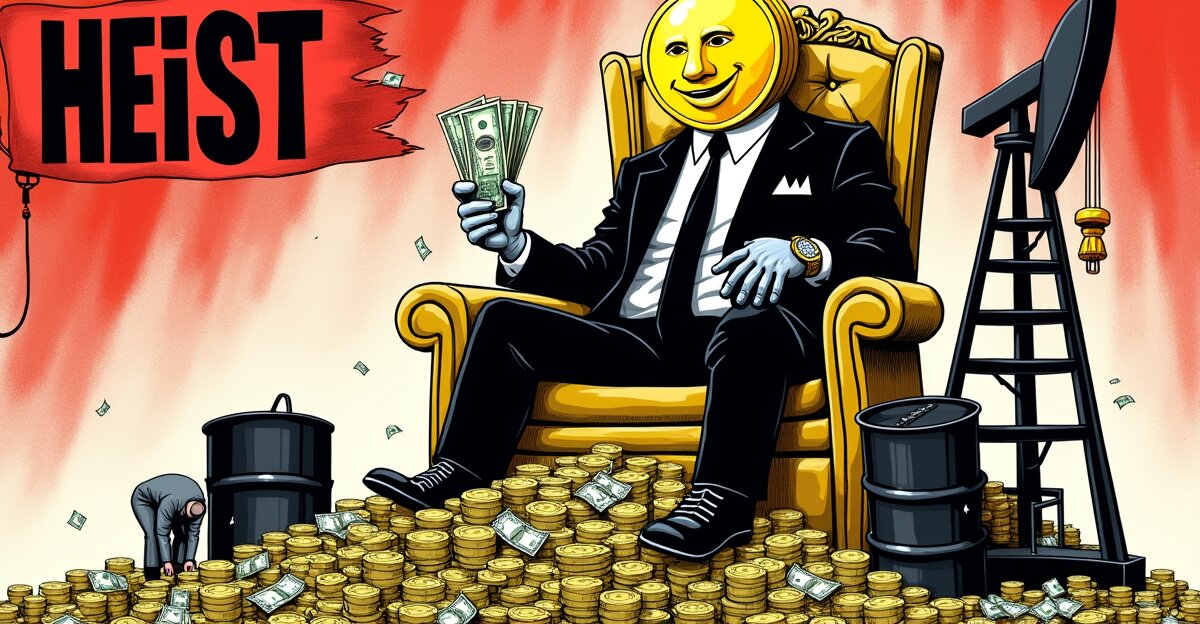
Buried in the fine print of trade deals nobody reads, the world's oil companies found a clause that lets them sue governments for protecting the climate, and they have now claimed $443.8 billion for it.
"ISDS payouts are the same as the owners of enslaved people being compensated for their grotesque harms following abolition in the early 19th century."
— Nick Dearden, director of Global Justice Now
This week, as world leaders gather in Antalya, Türkiye, for COP31, the United Nations climate summit, a quieter and far more profitable negotiation is underway in arbitration rooms around the globe. The world's fossil fuel companies have been using a provision hidden in international trade agreements to sue governments over the laws they pass, and they have now claimed at least $443.8 billion for the privilege.
The numbers come from an analysis of UN Conference on Trade and Development data released Thursday by the British campaign group Global Justice Now and the German research organization PowerShift, ahead of an official side event at the summit. Based on 987 publicly disclosed cases, corporate investors have demanded a total of $1.177 trillion through 2025, a sum that is $321 billion, or 37.5 percent, higher than the total they were demanding at the end of 2023.
The provision is called Investor-State Dispute Settlement, or ISDS. It is one of those phrases that sounds like a tax form and works like a hostage negotiation. It lets a company drag a foreign government into a private arbitration over a law that the government's own legislature passed, on the theory that the law damaged the company's investment or its profits. The law was democratic. The panel deciding whether to pay for it was not elected.
The scale is the part that should alarm anyone. The $443.8 billion demanded by fossil fuel investors alone is, the campaigners say, equivalent to the estimated minimum amount of economic loss that developing countries will face from climate change in 2030. Last year, the total amount actually awarded to corporate investors in these cases reached $123 billion, and fossil fuel investors received "the lion's share of $85.9 billion, representing almost 70% of all payouts." That $123 billion, the groups note, equals the entire bilateral development aid that rich OECD countries gave in 2025.
Translation: last year's payouts from these secret tribunals matched everything the developed world spent on bilateral development aid, and the industry that caused the crisis collected seventy percent of it.
This week the heist moved from spreadsheet to docket. ExxonMobil launched a legal challenge to the European Union's Net Zero Industry Act, the law that requires the company to pay for carbon storage. The company's objection, in a statement, is that the law would saddle Exxon with "unrealistic timelines." Last month, Exxon reported adjusted earnings of $17.5 billion for the third quarter. It is doing fine, in other words, by the disease it now calls unrealistic to cure.
The template is not new. Last year, a UK-based mining company and its Singapore-based majority shareholder sued the British government for £300 million ($398 million) after officials blocked a "unviable" coal mine planned for Cumbria. Niall Toru, a senior lawyer at Friends of the Earth, called the challenge "a last, desperate attempt by investors to make some money out of a project which belonged in the last century."
Dearden, who has spent his career tracking the payouts, made the comparison that stuck. ISDS compensation, he said, is the same as compensating slave owners for the harms they caused after slavery was abolished. "We know fossil fuel corporations are making a fortune out of global crises, hitting ordinary people hard," he said. "It's obscene that the very corporations which have created the climate crisis are demanding eye-watering payouts when governments take much needed climate action."
The pattern is consistent: a regulation arrives, the lawsuit follows, and the money flows to the side that broke the thing.
Why fossil fuels? Because the clock is running. In 2025, nearly half of all new ISDS cases were fossil fuel-related claims, according to the analysis, which was also done with the European Trade Justice Coalition. Amounts demanded in fossil fuel cases rose by $80 billion, or 22 percent, compared with 2023. As more governments write laws that keep carbon in the ground, the industry is quietly building its case that it should be paid for the privilege of surviving.
The clause works because it is hidden. Coverage of COP31 describes ISDS mechanisms as buried in the text of treaties, and the 987 cases in the UN dataset are only the ones that have been made public. Fabian Flues, investment policy lead at PowerShift, says the industry is "weaponizing" ISDS to siphon "money from public budgets that are already stretched."
ISDS was sold to the world as protection against exotic abuses: a government seizing a factory, a state grabbing assets. What it has become is an insurance policy on the carbon in the ground, with the premium paid by the countries that can least afford it.
Three thousand miles from the climate summit, the United States Senate voted 73-25 on Monday to advance a bill called the Bipartisan American Affordability and Jobs Act. The name is fiction. The bill, backed by the Trump White House and the American Petroleum Institute, would exempt pipeline expansions and other energy projects from review under the National Environmental Policy Act, weaken the Clean Water Act, and make it harder for opponents of a project to challenge it in court.
Twenty-two Democrats voted for it, including Chuck Schumer, Sheldon Whitehouse, Martin Heinrich, Chris Blumenthal, Kirsten Gillibrand, Amy Klobuchar, and Raphael Warnock, days after voters delivered the biggest blue wave in 50 years. Senator Jeff Merkley, one of the 25 who voted no, said the bill "accelerates the extraction and burning of fossil fuels," restricts states' ability to raise clean water concerns about gas pipelines, and "eliminates tools that states and localities use to fight the development of new data centers and detention centers." On Monday, Trump said he would not approve the construction of any wind turbines. The affordability bill, in other words, is not about the price of energy. It is about who gets to decide.
The sharpest optics belonged to Whitehouse, a lead sponsor of the bill who is also attending COP31. Collin Rees, the US campaign manager for Oil Change International, called the pairing a "smokescreen for the Big Tech, Big Oil, and industry-funded front groups who have spent millions of dollars lobbying for the bill," and noted that at best the legislation leaves US emissions over 2.1 billion tons short in 2040 of even a modest climate goal. In January, the industry's executives sat in the White House East Room with Trump, who is personally invested in the industry and has boasted that "we're making a freaking fortune."
The heist abroad and the giveaway at home are the same move in two time zones: sue the rules first, then vote the rules away.
There is an exit ramp, and the campaigners at COP31 are asking delegations to take it. The goal is a coordinated phase-out of ISDS from trade agreements. On Monday, Global Justice Now and the Netherlands-based group Both ENDS are holding an official side event in Antalya featuring Ralph Regenvanu, the climate minister of Vanuatu, representatives from communities at the center of ISDS disputes, and a senior government official from Australia, which announced a policy in 2022 of excluding ISDS mechanisms from future trade deals. South Africa and Indonesia have also taken significant steps to free themselves from the mechanism, Flues says.
The UN's own chief has set the tone. Addressing COP31, António Guterres said: "Fossil fuels must go the way of the dinosaurs, but that won't happen on its own. The dinosaurs did not have a lobby, but fossil fuels do."
Flues put the demand in one sentence: "Governments need to stop this heist and cancel the international agreements that enable fossil fuel investors to sue over climate policies."
The people who negotiated these trade deals knew what they were signing. The clause was not an accident; it was the point. A way for the companies to keep an option on the carbon in the ground, with the cost assigned to whichever country dared to act.
The heist was never really about any single lawsuit. It is about a principle that is now written into international law: that a government, elected to protect its people, has contracted to be sued for doing so. The dinosaurs, Guterres observed, did not have a lobby. Fossil fuels did, and they spent it. The question is no longer whether the fine print can be enforced. It is whether the governments that signed it are still in the business of protecting anyone at all.
Comments (0)
No comments yet. Be the first to speak up.
Join the Riot
Login with Google to leave a comment.
Login to Comment