
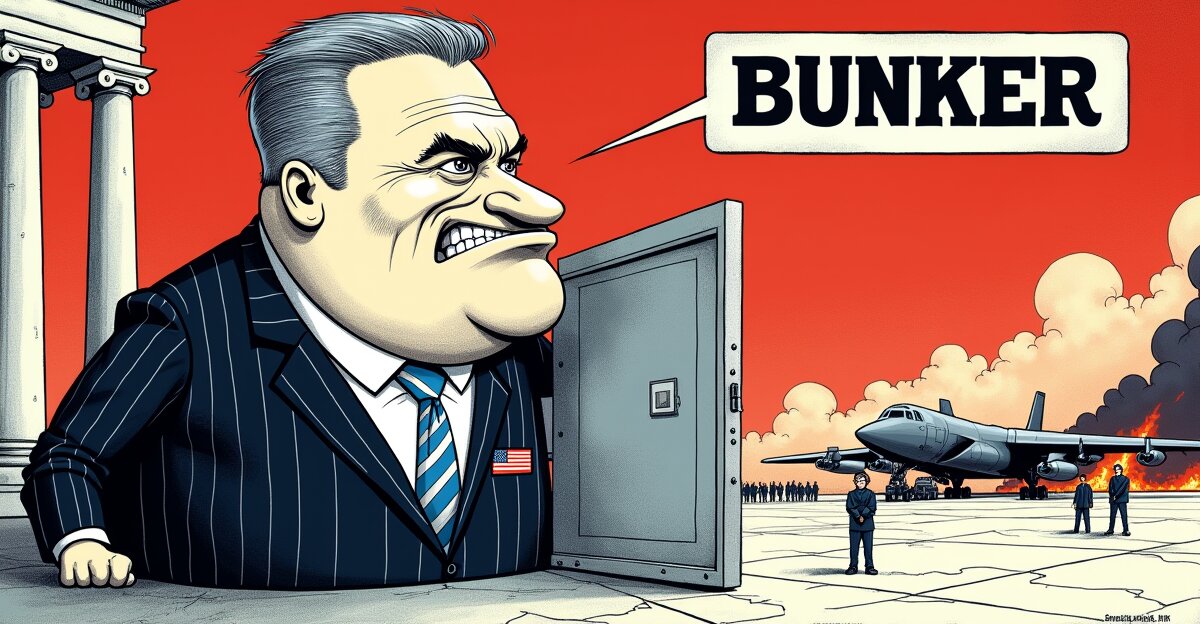
For eighty years, an American military base was a promise: power that could not be touched. Now the Pentagon is quietly asking how to make its buildings disappear.
"Every major military installation in America is going to generate its own power. Independent of the civilian grid. If an adversary takes down the grid by cyberattack, by sabotage, by any means, our bases stay lit. Our aircraft keep flying. Our command centers never go dark."
— Pete Hegseth, Secretary of War, announcing the FORTRESS America initiative
The most powerful military in the history of the world has a problem, and the problem is not a country. It is a drone that costs less than a car payment.
The era of the invincible base ended on February 28, 2026. Iranian missiles and drones destroyed Navy facilities in Manama, Bahrain, the region's most critical logistics hub. The Combined Air Operations Center at Al Udeid Air Base in Qatar, one of the pillars of American power projection for three decades, was severely damaged and rendered inoperable. Both bases were hit again later, and satellite imagery from July showed a hole punched through a warehouse roof at the U.S. Navy's 5th Fleet headquarters. A Pentagon inspector general report from September put it in writing: Iranian strikes "damaged and destroyed hundreds of buildings and structures at U.S. bases" in Kuwait, Bahrain, Qatar, the UAE, Saudi Arabia, Iraq, Oman, and Jordan. Eight countries. One line item in a classified briefing that the Pentagon will not put in a public document.
One of the government officials who spoke to The Intercept this week called the destruction a "seismic shift." Another offered a summary that should hang in every war college lecture hall in America: "Now all the world knows what the SecDef should have."
The fear inside the Pentagon is no longer theoretical, and not just about Iran. On Friday, the Trump administration leaked a highly classified intelligence memo to Fox News and Axios. The October 23 memo claimed Iran had "substantially increased" its efforts to target U.S. diplomats and officials in the Middle East and beyond, and that "the lethal plotting efforts by the Iranians against U.S. citizens have reached advanced stages." The same day, the State Department ordered further staff reductions at diplomatic posts in Jordan, Lebanon, Qatar, Saudi Arabia, and the UAE.
Translation: the most powerful military on earth is currently drafting memos about how to stop being hit, and its own officials admit the leaks look like a case being built to justify renewing a war that has already failed.
The threat picture does not end at the Strait of Hormuz. In August, Russian drones struck an air freighter carrying military assistance to Ukraine at Leipzig/Halle Airport in Germany, the opening move of what one official described as a months-long campaign of sabotage and cyberattacks against NATO that "didn't show any signs of stopping." It stopped abruptly in September. Not because of any defensive breakthrough, but because President Trump announced the United States would buy Russian diesel to push fuel prices down before the midterms and asked Ukraine to stop hitting Russian refineries. "That's what Putin always does," the official said. "He keeps testing us, pushing us, to see how far he can go."
So what is the plan? Last week, buried in a special notice from the office of Dale R. Marks, the assistant secretary of war for energy, installations, and environment, the Pentagon began shopping for a "base of the future." The document's goal, in the words the military uses about itself, is to "move past traditional 'pour-concrete-and-hope' hardening."
The shopping list reads like a fantasy novel. Advanced construction methods using metamaterials designed to survive air attack. Energy-dissipating composites. Self-healing materials. "Novel concrete formulations." Decoy structures to draw fire. Facilities camouflaged into the terrain, with their thermal and electromagnetic signatures masked. And then, because hiding above ground clearly stopped being enough, the Pentagon is interested in "high-speed tunneling," the rapid creation of protected caverns, and "shock-isolated underground structural designs." The Vietnamese did this in the 1960s with tunnels. The Pentagon is researching it with grant money.
The base that can be hit is the base that exists. The new doctrine, if you want it in one line: make the base invisible, or dig it out of sight, or pretend it is not there at all.
The anxiety is no longer confined to overseas outposts. A January inspector general report found that the Pentagon's counter-drone task force required "immediate attention," that its own "documents contradict one another," and that key facilities conducting critical missions had not even been designated for protection. In March, small drones flew over Barksdale Air Force Base in Louisiana, the home of Global Strike Command, the organization that oversees America's intercontinental ballistic missiles. The same IG report tallied ten U.S. installations where drone incursions had already occurred.
Closer to the action, intelligence revealed a plot to launch small drones from just beyond the fenceline of RAF Fairford in England, at B-1 supersonic bombers sitting in the open on the tarmac, a tactic apparently copied from Ukraine's own Operation Spider's Web. The bombers were flown home in such a hurry that aerial refueling tankers were still being deployed to support their panicked flights. U.S. officials referenced additional threats against bases in Europe, including Ramstein Air Base in Germany.
Hegseth, who spent one "unhinged" address to the troops last year attacking the press and calling parts of the military "beardos" and "wimps," at least admitted the problem in passing. The Pentagon, he said, was now "hardening every installation on American soil" against "sabotage and drones." That is a first. The installations were supposed to be the part of the country that never needed hardening.
How much has the losing of this argument cost? One U.S. official told The Intercept that repairing and rebuilding the destroyed Middle East outposts could run "upwards of $50 million," with the "real cost" possibly "far higher." The Pentagon refuses to release the figure. It has shared the number only in classified briefings. Democratic Sens. Elizabeth Warren, Richard Blumenthal, Mazie Hirono, Tammy Duckworth, and Gary Peters wrote to Adm. Brad Cooper, the commander of U.S. Central Command, with what should be the easiest request in the history of war: "The American people deserve to know the full cost of the Trump administration's unauthorized war against Iran." CENTCOM did not answer.
Hegseth's answer to the whole dilemma is FORTRESS America, which he brands a "national insurance policy for the American homeland." Under the plan, every major military installation generates its own power, independent of the civilian grid. The military stockpiles "long overdue strategic reserves deep enough to fight through disruption. Think munitions. Fuel. Medicine. Blood." If the world's supply lines break, Hegseth says, "America keeps fighting anyway."
A former Pentagon analyst had a more precise reading. "It sounds as if he is saying to people 'fuck off and you're on your own,'" the analyst said. The bases keep the lights on. The grid, the hospitals, the grocery stores, that is everyone else's problem. In a country where the military's mission is supposed to be national survival, this is the quietest and most honest confession yet: the survival plan has a membership fee, and only the warrior elite gets the keycard.
Iran knows the scoreboard. Mahdi Mohammadi, a senior adviser to the country's lead nuclear negotiator, posted on X that the "second generation of surprises will be on their way, at the time and place of our choosing, in the manner we have devised." It is the message of a side that lost the air war and found out it won something more valuable: the right to decide where America can keep its jets.
For eighty years, the base was the promise. Concrete and steel planted on foreign soil said that this power could not be touched, that the distance between Washington and the battlefield was a one-way street. That promise is gone, and everyone from Bahrain to Barksdale now knows it. The drones are cheap. The bombers are not. The question is no longer whether America's bases can be hit. The question is who gets to stay inside when the lights come on.
Comments (0)
No comments yet. Be the first to speak up.
Join the Riot
Login with Google to leave a comment.
Login to Comment