
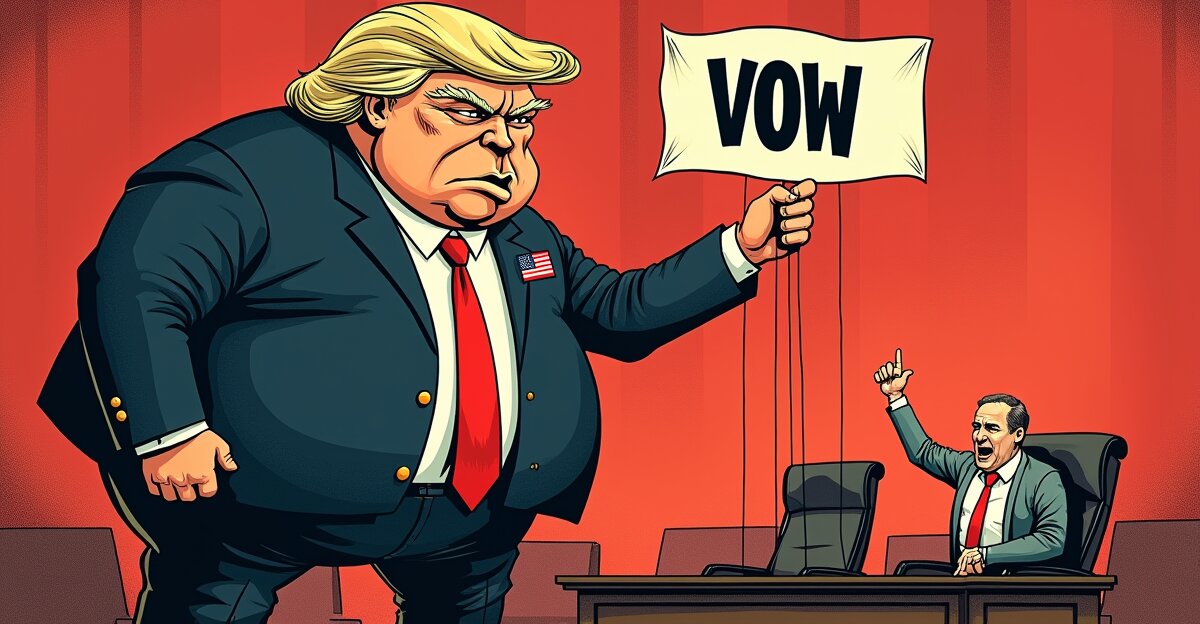
The worst Republican midterm result in three decades produced no apology, no reckoning, no single sentence of self-doubt, just a sixty-second oath of devotion delivered on a private club stage in Palm Beach.
"If it wasn't for President Trump the United States of America would not exist right now. This man saved America."
— Stephen Miller, first public remarks as White House chief of staff, Mar-a-Lago, Nov. 6
Three days after the midterms, President Donald Trump did what presidents do when the country says no. He swapped the person responsible. On Friday, he announced that Stephen Miller, 41, his deputy chief of staff and the architect of the administration's hardline immigration agenda, would replace Susie Wiles as chief of staff on Monday, November 9. The AP described the choice well: a loyal, combative bulldog installed as the president's closest adviser just as he braces for a new Democratic Congress. The same Congress that just told the president, in the only language his office has ever respected, that the answer to his policies is no.
When asked why, Trump offered the line that may define the second half of his presidency: "Not because of the election. It's just time. The election wasn't my election. I wasn't on the ballot."
Translation: forty million people voted on a ticket his party carried. He has formally announced that he wasn't on it.
The woman out the door was everything the new man is not. Wiles, 69, the daughter of the late broadcaster Pat Summerall, was the first woman to hold the post and the longest-serving of the four chiefs of staff Trump cycled through in his first term. She ran DeSantis's 2018 campaign, then Trump's best-run campaign in 2024, by the president's own telling. In March she went public with a breast cancer diagnosis; in September she declared herself cancer-free. She was the most disciplined person the White House had, the woman who brought order to a president's chaos. She had planned to stay through the end of the year.
She gave Trump her resignation Thursday night. One source told the AP about the private conversation; three sources told CBS it was tied to the midterms. Last month, asked whether Wiles could be replaced, Trump said there was "zero chance" and that "Susie is here and she's gonna be here for a long time." Five weeks later: "Sometimes in life, you have to make moves." She will continue working for his political organization. Trump praised her as having done a "very good job, great job." By his own telling, it is both a tribute and a boot.
There is a reason the timing is not a coincidence. Hours before the announcement, Calley Means, a Robert F. Kennedy Jr. ally who resigned from the administration last month, told Joe Rogan that Wiles had run a corrupt operation inside the White House. He called her "the most powerful chief of staff in modern American history" with a "stranglehold on any policy decision" that pointed one direction: toward the money. "Susie said to me many times: 'We need money for the midterms, Calley. We need money for the midterms.'" He alleged that companies which hired Wiles's daughter as a lobbyist received "high priority" treatment, that her team pushed fruit-flavored e-cigarettes as tobacco companies donated at least $20 million to the GOP, and that it caved to the kratom industry on what critics call gas station heroin. "You pay Susie's daughter," Means said, "and it was openly discussed when they had a client." The White House did not directly address any of it.
In December, Wiles told Vanity Fair that Trump has "an alcoholic's personality," that Attorney General Pam Bondi had "whiffed" on the Epstein files, and that JD Vance has been "a conspiracy theorist for about a decade." Trump and his aides rushed to her defense. She was out the door four months later, five days after her party lost the election.
The man through the door has a longer fuse and a simpler theology. Miller joined Trump as a speechwriter on a long-shot 2016 campaign and has been inside the circle ever since. He drafted the executive orders that built the first term's immigration wall: zero-tolerance family separations, the travel bans, third-country deportations, up to 300 arrests a day. In this past campaign he spent weeks calling Democrats "extremists, freaks and America-hating lunatics" and promoting unfounded theories of election fraud in California and Alaska.
The AP's midterm voter poll found about six in ten voters said the administration's immigration enforcement had gone too far. That is not a criticism aimed at a party. It is a scorecard aimed at Miller's America, and the president has just put the man who drew it in charge of the West Wing. The AP's read is blunt: a Miller who has "built a deep and sophisticated understanding of a president's executive power" portends "a potential burst of executive actions in the final two years."
A loyalty test is not a management plan, but it may be all there is.
The first act was performed Friday night at CPAC's Circle Retreat and Gala at Mar-a-Lago, caught on a bystander's phone by Overton Institute co-founder Joey Mannarino. Trump called Miller "a very hot commodity" and handed him the microphone.
Miller opened with the golden escalator, the 2015 ascension, framed as personal salvation: "It was the privilege of a lifetime to join President Trump all the way back in 2015." Then the claim that will be quoted for decades, because it is the truest sentence ever delivered in that building: "This man saved America. He saved our military from collapse. He saved our economy from destruction. He saved our border from annihilation." He said Trump "took a bullet for us" and "faced down life in prison for us," and that he "saved the Republican Party from the ash heap of history," despite Tuesday's voters having done the exact opposite.
The close was the point of the exercise: "It is the honor of my life to be President Trump's chief of staff, and I swear to you, and I pledge to you, Mr. President, my absolute loyalty, my unwavering commitment, and my total devotion to your success and the success of this country." On X that day, Miller called the president "the most transformative political leader in American History" and set the mission: "Fight with all of our soul to support our President."
The incoming opposition has already written the opening statement. Incoming House leader Hakeem Jeffries called Miller "a dangerous xenophobe and reckless extremist who has American blood on his hands" and said "his presence in government should be eradicated like a malignant tumour." Rep. Robert Garcia, who will chair House Oversight, was more surgical: "Just days after the American people rejected his corrupt and lawless presidency, Donald Trump is doubling down. Stephen Miller is the architect of the unconstitutional ICE raids that have terrorized our communities and kidnapped and killed American citizens and immigrant families." His advice, in four words: "Stephen Miller should lawyer up."
White House communications director Steven Cheung's response was the oath in miniature: "There is no bigger advocate for the Trump agenda than Stephen." The Democrats, to their credit, do not think the question is whether Miller advocated. It is what he will be asked to testify about, and under what oath.
The exodus was not limited to the woman in the Oval Office. The same Thursday, three senior Justice Department officials walked: Harmeet Dhillon, who ran the civil rights division, John Eisenberg, the national security division chief, and Jason Reding Quiñones, the Florida U.S. attorney at the center of the drive to use federal prosecutors against perceived political foes. In an interview released the same afternoon, Trump told 60 Minutes' Ross Douthat: "I love my Cabinet. I think they're good. I'll be doing maybe a few changes. I don't want to mention who."
The president who fired his chief of staff is openly threatening to fire the rest, with an explanation no other person in the country would survive. The ballot is the only line between a president and his choices, and he has drawn a new one: the ballot reaches his party, but not him.
The voters spoke on Tuesday. The White House answered on Friday with an oath. That is the entire second act in one exchange: the country asks a question, and the answer is a pledge of loyalty to the man who, by his own chief's account, saved it. Wiles is out because in December she called the president what she thought he was, on the record. Miller is in because he has now said what he thinks the country is: a thing that owes its existence to the president, under oath. The election wasn't on the ballot. Only the loyalty was. And in that West Wing, loyalty has always been the only qualification that matters.
Comments (0)
No comments yet. Be the first to speak up.
Join the Riot
Login with Google to leave a comment.
Login to Comment